

Bitcoin price prediction: BTC holds $92,443 as dollar collapse and labor weakness signal macro fragility

Bitcoin is trading around $92,443, up 2.5% in the past day, with a market capitalization of $1.85 trillion and a 24-hour trading volume of $46.98 billion. The price has moved between $89,425 and $93,467, reflecting recovery after an ugly intraday slide below $90,000 as investors weigh dollar collapse to 8-week lows against accelerating labor market deterioration and persistent institutional skepticism.
Highlights
- The dollar index falls to 98.35, marking an 8-week low as jobless claims hit their highest in over 2 months.
- Treasury yields decline to 4.13% despite upgraded growth forecasts revealing market confusion.
- $440 million in crypto liquidations within hours of the Fed decision demonstrates fragile positioning.
Bitcoin is attempting to stabilize near $92,443 as post-Fed positioning reveals increasing macro fragility across multiple indicators. The dollar index fell to 98.35 on December 12, marking an 8-week low, as softer employment data reinforced expectations for 2 Fed rate cuts in 2026 after initial jobless claims rose more than expected, hitting a high in more than 2 months. Treasury yields eased to 4.13% despite the Fed projecting stronger growth at 2.3% next year, revealing trader disbelief in official guidance.
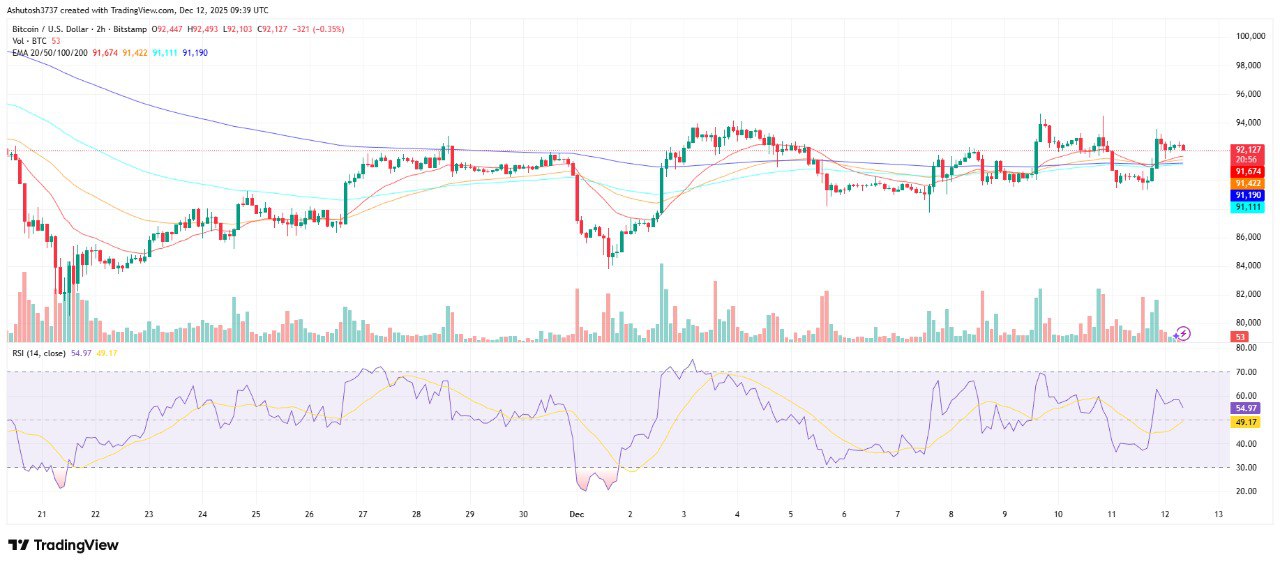
Bitcoin price dynamics (Source: TradingView)
Bitcoin consolidates as dollar weakness meets labor market fragility
The dollar collapse accelerated to 8-week lows as post-Fed dovish repricing gained momentum. The DXY exchange rate fell to 98.35 on December 12, marking an 8-week low, as softer employment data reinforced expectations for 2 Fed rate cuts in 2026. Initial jobless claims rose more than expected in the week of December 6, hitting the highest in more than 2 months. The dollar index dropped 0.78% over the past month and 8.06% over the last 12 months, with traders now pricing in 2 additional rate cuts in 2026 despite the Fed's dot plot pointing to just 1 more 0.25% reduction next year.
White House spokeswoman Leavitt said that U.S. President Trump wants to see more interest rate cuts, reinforcing market expectations that policy pressure will force the Fed toward additional easing beyond current projections. For Bitcoin, this persistent dollar weakness below 98.50 provides mechanical tailwinds through currency rebalancing flows. However, the fact that the dollar is collapsing despite the Fed's hawkish dot plot reveals a fundamental breakdown in market confidence where traders no longer believe official projections.
Treasury yields declined modestly as markets digested the Fed's mixed message on future policy trajectory. The yield on the U.S. 10-year Treasury note eased to 4.13% on December 11, marking a 0.03% point decrease from the previous session after the Federal Reserve delivered the expected 0.25% rate cut. A subtle change in the Fed's statement referencing the extent and timing of additional adjustments suggests officials are likely to pause further cuts in January as they await more data to assess the economic outlook. Policymakers now expect the economy to expand 2.3% next year, up from 1.8% in September, while 2027 growth is projected at 2%, slightly above the previous 1.9% forecast.
Bitcoin recovered above $92,000 but faced persistent whale distribution despite improving institutional adoption narratives. Bitcoin is trading around $92,000 to $92,800 on December 11 after an ugly intraday slide below $90,000 left BTC down roughly 27% from its early October all-time high near $126,000. About $440 million in crypto positions were liquidated within hours of the Fed decision, with the majority in long futures positions, according to derivatives data, demonstrating how fragile leveraged positioning remains despite institutional adoption progress. Standard Chartered cut its year-end 2025 Bitcoin target from $200,000 down to $100,000, arguing that corporate treasury accumulation has largely run its course, though the bank still projects Bitcoin could reach around $500,000 by 2030.
Global labor market deterioration accelerated as multiple data points confirmed synchronized weakening. Initial jobless claims rose to the highest in more than 2 months during the week of December 6, reinforcing concerns about labor market fragility that the Fed highlighted in its policy statement. UBS Asset Management noted that the main economic risk still relates to the labor market, as softness could accelerate into something worse, leading them to hedge risk asset exposures with an increase in duration. JP Morgan sees a 35% probability of a U.S. and global recession in 2026, driven by weak business sentiment and an ongoing slowdown in the labor market.
Analysts highlight macro fragility and institutional skepticism
Anton Kharitonov notes that the dollar collapsing to 8-week lows below 98.50 should theoretically support crypto, but the breakdown reflects institutional disbelief in Fed credibility rather than pure easing dynamics.
Viktoras Karapetyants explains that Treasury yields declining to 4.13% despite upgraded growth forecasts reveal market confusion where traders ignore fundamentals and focus only on dovish Fed rhetoric.
Jainam Mehta adds that Bitcoin's recovery above $92,000 looks constructive superficially, but the $440 million in liquidations and Standard Chartered halving its 2025 target demonstrate fragile positioning.
Technical view shows neutral momentum with a consolidation pattern
Bitcoin is trading near $92,443, with the 20-EMA at $91,813 sitting below the current price as immediate support and the 50-EMA at $91,531 acting as a lower cushion. The 100-EMA at $91,357 and 200-EMA at $91,063 provide deeper support zones, confirming the broader structure remains intact. The RSI at 59 reflects neutral momentum following recent volatility. A clean break above $93,500 would open room for continuation toward higher resistance zones, while a decline below $91,000 could trigger a short-term pullback toward the $89,500 area.
Background and previous analysis
In earlier analysis, Bitcoin's movements were shaped by FOMC positioning and favorable macro conditions meeting weak institutional conviction. The last 24 hours delivered a cautiously bearish macro setup as multiple crosscurrents suggest increasing fragility. The dollar collapsing to 8-week lows should support crypto but reflects confusion. Treasury yields declining despite upgraded growth reveals market disbelief. Bitcoin's recovery above $92,000 looks constructive, but $440 million in liquidations demonstrates fragility. Labor market deterioration creates the most significant risk where additional Fed cuts might arrive alongside recessionary conditions.











-
 Afghanistan
-
 Albania
-
 Algeria
-
 Angola
-
 Argentina
-
 Armenia
-
 Australia
-
 Austria
-
 Azerbaijan
-
 Bahamas
-
 Bahrain
-
 Bangladesh
-
 Belarus
-
 Belgium
-
 Bolivia
-
 Botswana
-
 Brazil
-
 Brunei
-
 Bulgaria
-
 Cambodia
-
 Cameroon
-
 Canada
-
 Chile
Chile
-
 China
China
-
 Colombia
-
 Congo
Congo
-
 Costa Rica
-
 Cote d'Ivoire
-
 Croatia
-
 Cuba
Cuba
-
 Cyprus
-
 Czechia
-
 DR Congo
-
 Denmark
-
 Dominican Republic
-
 Ecuador
-
 Egypt
Egypt
-
 El Salvador
-
 Estonia
-
 Eswatini
-
 Ethiopia
-
 Finland
-
 France
-
 Georgia
-
 Germany
-
 Ghana
Ghana
-
 Greece
-
 Haiti
Haiti
-
 Hong Kong
-
 Hungary
-
 India
India
-
 Indonesia
-
 Iran, Islamic republic
-
 Iraq
Iraq
-
 Ireland
-
 Israel
-
 Italy
Italy
-
 Jamaica
-
 Japan
Japan
-
 Jordan
-
 Kazakhstan
-
 Kenya
Kenya
-
 Korea
Korea
-
 Kuwait
-
 Kyrgyzstan
-
 Laos
Laos
-
 Latvia
-
 Lebanon
-
 Lesotho
-
 Libya
Libya
-
 Lithuania
-
 Luxembourg
-
 Madagascar
-
 Malaysia
-
 Malta
Malta
-
 Mauritius
-
 Mexico
-
 Moldova
-
 Mongolia
-
 Montenegro
-
 Morocco
-
 Mozambique
-
 Myanmar
-
 Namibia
-
 Nepal
Nepal
-
 Netherlands
-
 New Zealand
-
 Nigeria
-
 North Macedonia
-
 Norway
-
 Oman
Oman
-
 Pakistan
-
 Palestine
-
 Panama
-
 Papua New Guinea
-
 Paraguay
-
 Peru
Peru
-
 Philippines
-
 Poland
-
 Portugal
-
 Puerto Rico
-
 Qatar
Qatar
-
 Reunion
-
 Romania
-
 Rwanda
-
 Saudi Arabia
-
 Serbia
-
 Singapore
-
 Slovakia
-
 Slovenia
-
 Somalia
-
 South Africa
-
 Spain
Spain
-
 Sri Lanka
-
 Sweden
-
 Switzerland
-
 Syria
Syria
-
 Taiwan
-
 Tajikistan
-
 Tanzania
-
 Thailand
-
 Trinidad and Tobago
-
 Tunisia
-
 Turkey
-
 UAE
UAE
-
 Uganda
-
 Ukraine
-
 United Kingdom
-
United States
-
 Uruguay
-
 Uzbekistan
-
 Venezuela
-
 Vietnam
-
 Yemen
Yemen
-
 Zambia
-
 Zimbabwe
- Forex
- Crypto












