

Bitcoin price prediction: BTC rotates lower to $90,230 as dollar pressure and yield compression fail to stimulate risk flows

Bitcoin is trading around $90,230, down 2.5% in the past day, with a market capitalization of $1.80 trillion and a 24-hour trading volume of $58.14 billion. The price has moved between $89,623 and $94,177, reflecting weak positioning despite favorable macro conditions as dollar weakness accelerates, Treasury yields decline, and global liquidity hits record levels, but institutional caution persists.
Highlights
- Dollar index tumbles to 98.59, lowest level since October 20, following Fed's 0.25% rate cut.
- Treasury yields fall to 4.12% as markets price 2 additional 2026 cuts despite the Fed dot plot showing 1.
- Global M2 hits record $105-trillion while long-term holders dump 800,000 BTC signaling weak conviction.
Bitcoin is struggling near $90,230 as post-Fed positioning unfolds with mixed signals across asset classes. The dollar index tumbled to 98.6 on December 10, its lowest level since October 20, following the Federal Reserve's anticipated 0.25% rate cut and its projection of 1 additional reduction in 2026. Treasury yields fell to around 4.12% marking a 2nd consecutive session of declines despite the Fed's hawkish tilt on 2026 cuts. Global M2 across major central banks hit a record above $105 trillion in November 2025, signaling a synchronized easing cycle, while the Fed ended quantitative tightening, redirecting $15 to $20 billion per month into short-term Treasuries.
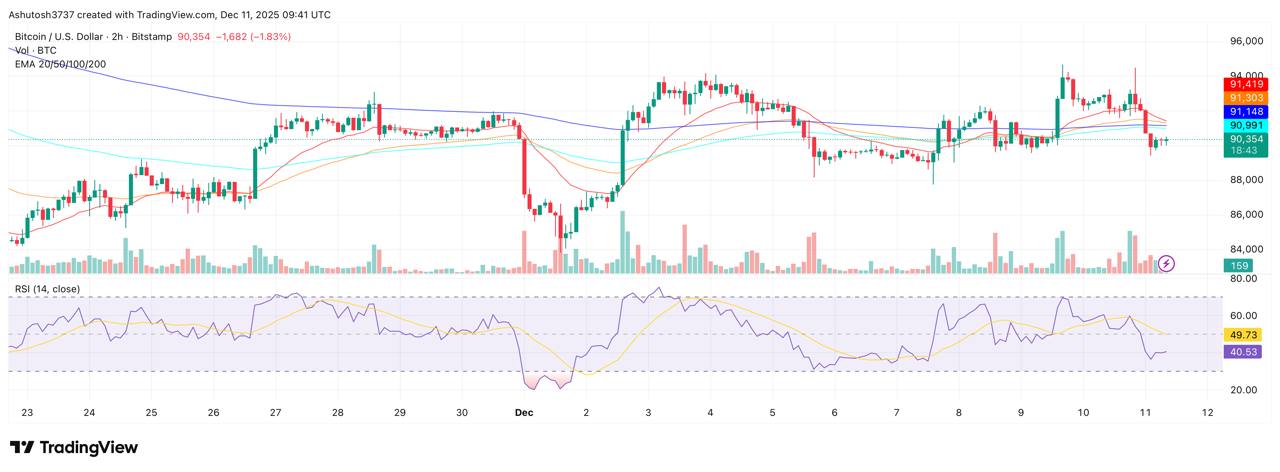
Bitcoin price dynamics (Source: TradingView)
Bitcoin consolidates as favorable macro conditions meet institutional caution
Dollar weakness accelerated to multi-week lows as post-Fed positioning unwound. The DXY exchange rate fell to 98.59 on December 11, down 0.04% from the previous session and extending its monthly weakness with a 0.91% decline over the past month and a 7.82% decline over the last 12 months. Fed Chair Jerome Powell emphasized that the focus is on whether to stop cutting rates, lower them slightly, or reduce them more than a little, with no rate hikes under consideration.For Bitcoin, this persistent dollar weakness provides mechanical tailwinds through currency rebalancing flows and reduced pressure on alternative assets. However, the drivers of dollar decline in this cycle involve confidence erosion in U.S. institutions and fiscal credibility concerns rather than pure monetary accommodation. That creates a more complex dynamic where Bitcoin benefits from nominal dollar weakness while still facing headwinds if the underlying reasons trigger broader risk aversion. The dollar's failure to rally even after the Fed signaled fewer 2026 cuts demonstrates that something fundamental has shifted in currency markets beyond just interest rate differentials.
Treasury yields fell modestly as markets absorbed the Fed's mixed message. The U.S. 10-year Treasury yield fell to around 4.12% on December 11, marking a 2nd consecutive session of declines after the Federal Reserve delivered its 3rd quarter-point rate cut this year in line with expectations. The Fed signaled a less hawkish stance than markets anticipated, with Chair Jerome Powell suggesting a rate hike is off the table, prompting traders to price in 2 additional cuts in 2026 despite the dot plot pointing to just 1 more 0.25% reduction next year.
The central bank said it will begin buying short-dated Treasury bills to support market liquidity from December 12, with the initial round totaling about $40-billion. This bond market reaction creates a paradox where yields are declining despite the Fed's hawkish tilt on 2026 cuts. The fact that traders are pricing in 2 cuts when the dot plot shows 1 reveals deep skepticism about the Fed's ability to hold rates elevated. For Bitcoin, falling yields typically provide support by reducing the opportunity cost of holding non-yielding assets, but the current decline reflects confusion rather than conviction.
Bitcoin held above $92,000 on institutional adoption narratives despite whale distribution signals. Bitcoin surged back over $94,000 in morning U.S. action Tuesday, gaining more than $3,000 in less than 1 hour and up more than 4% over the past 24 hours, with 1 analyst taking note of deeply defensive positioning by traders as possibly setting the stage for the bounce. The Exchange Whale Ratio, which measures how much of total inflows come from the top 10 large wallets, climbed from 0.32 earlier this month to 0.68 on November 27, and even after easing to 0.53, remains in a zone that historically reflects whales preparing to sell, not accumulate.
Standard Chartered's Geoff Kendrick slashed his outlook for the price of Bitcoin on Tuesday, now expecting $150,000 in 2026, down from the earlier $300,000 target and pushing the $500,000 level out to 2030, 2-years later than previously forecast. This price action creates a complex picture where short-term momentum looks constructive, but the underlying distribution dynamics and slashed Wall Street targets suggest fragility rather than conviction.
For Bitcoin to sustain gains above $94,000, either whale selling needs to be exhausted completely or fresh institutional demand needs to emerge that can absorb the ongoing supply.
Analysts highlight macro support meeting weak institutional conviction
Anton Kharitonov notes that the persistent dollar weakness below 99 and Treasury yields declining to 4.12% both provide mechanical support, but institutional caution, reflected in Standard Chartered halving its 2025 target, reveals fragility.Viktoras Karapetyants explains that global liquidity expansion to record $105 trillion with the Fed ending QT creates a theoretically bullish backdrop with a 60 to 90-day lag into late January 2026.
Jainam Mehta adds that long-term holders dumping over 800,000 BTC despite favorable macro conditions reveals fragile conviction, while Bitcoin's tight 40% correlation with equities limits independent upside.
Technical view shows deteriorating momentum with support breaking
Bitcoin is trading near $90,230 with the 20-EMA at $90,160 sitting just below the current price as immediate support and the 50-EMA at $91,336 acting as overhead resistance. The 100-EMA at $91,257 and 200-EMA at $91,000 provide resistance zones that the price must reclaim to stabilize. The RSI at 43 reflects weakening momentum and bearish positioning. A recovery above $92,000 would stabilize the near-term outlook, while a break below $89,500 could trigger a deeper retracement toward the $88,000 zone.Background and previous analysis
In earlier analysis, Bitcoin's movements were shaped by FOMC positioning and technical dynamics. The last 24 hours delivered a cautiously neutral macro setup with crosscurrents pointing in opposite directions. The persistent dollar weakness and declining Treasury yields both provide mechanical support. Global liquidity expansion to record $105-trillion with the Fed ending QT creates a theoretically bullish backdrop that should manifest with a 60 to 90-day lag in late January to early February 2026. However, these positives compete against institutional caution and long-term holders dumping over 800,000 BTC.






-
 Afghanistan
-
 Albania
-
 Algeria
-
 Angola
-
 Argentina
-
 Armenia
-
 Australia
-
 Austria
-
 Azerbaijan
-
 Bahamas
-
 Bahrain
-
 Bangladesh
-
 Belarus
-
 Belgium
-
 Bolivia
-
 Botswana
-
 Brazil
-
 Brunei
-
 Bulgaria
-
 Cambodia
-
 Cameroon
-
 Canada
-
 Chile
Chile
-
 China
China
-
 Colombia
-
 Congo
Congo
-
 Costa Rica
-
 Cote d'Ivoire
-
 Croatia
-
 Cuba
Cuba
-
 Cyprus
-
 Czechia
-
 DR Congo
-
 Denmark
-
 Dominican Republic
-
 Ecuador
-
 Egypt
Egypt
-
 El Salvador
-
 Estonia
-
 Eswatini
-
 Ethiopia
-
 Finland
-
 France
-
 Georgia
-
 Germany
-
 Ghana
Ghana
-
 Greece
-
 Haiti
Haiti
-
 Hong Kong
-
 Hungary
-
 India
India
-
 Indonesia
-
 Iran, Islamic republic
-
 Iraq
Iraq
-
 Ireland
-
 Israel
-
 Italy
Italy
-
 Jamaica
-
 Japan
Japan
-
 Jordan
-
 Kazakhstan
-
 Kenya
Kenya
-
 Korea
Korea
-
 Kuwait
-
 Kyrgyzstan
-
 Laos
Laos
-
 Latvia
-
 Lebanon
-
 Lesotho
-
 Libya
Libya
-
 Lithuania
-
 Luxembourg
-
 Madagascar
-
 Malaysia
-
 Malta
Malta
-
 Mauritius
-
 Mexico
-
 Moldova
-
 Mongolia
-
 Montenegro
-
 Morocco
-
 Mozambique
-
 Myanmar
-
 Namibia
-
 Nepal
Nepal
-
 Netherlands
-
 New Zealand
-
 Nigeria
-
 North Macedonia
-
 Norway
-
 Oman
Oman
-
 Pakistan
-
 Palestine
-
 Panama
-
 Papua New Guinea
-
 Paraguay
-
 Peru
Peru
-
 Philippines
-
 Poland
-
 Portugal
-
 Puerto Rico
-
 Qatar
Qatar
-
 Reunion
-
 Romania
-
 Rwanda
-
 Saudi Arabia
-
 Serbia
-
 Singapore
-
 Slovakia
-
 Slovenia
-
 Somalia
-
 South Africa
-
 Spain
Spain
-
 Sri Lanka
-
 Sweden
-
 Switzerland
-
 Syria
Syria
-
 Taiwan
-
 Tajikistan
-
 Tanzania
-
 Thailand
-
 Trinidad and Tobago
-
 Tunisia
-
 Turkey
-
 UAE
UAE
-
 Uganda
-
 Ukraine
-
 United Kingdom
-
United States
-
 Uruguay
-
 Uzbekistan
-
 Venezuela
-
 Vietnam
-
 Yemen
Yemen
-
 Zambia
-
 Zimbabwe
- Forex
- Crypto












