
Iran-U.S.-Israel conflict — Bitcoin drops 4.24%
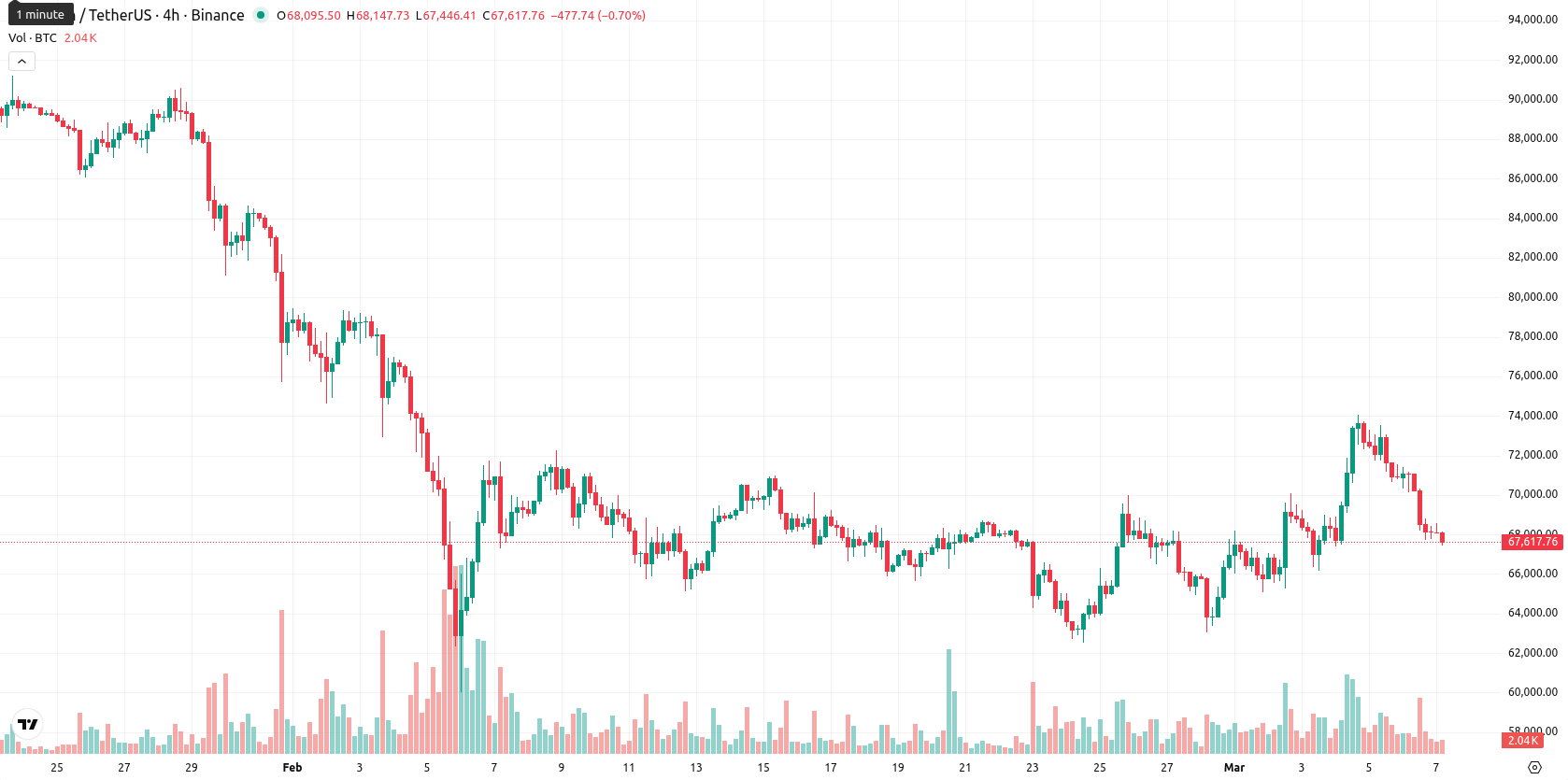
Bitcoin (BTC) is trading at $67,624.35, sitting just below the MA-20 ($67,709.45), and well under both the MA-50 ($75,348.85) and MA-200 ($95,907.44). This configuration suggests short-term pressure from sellers, continued weakness in the medium term, and an absence of long-term support, while the Ichimoku Kijun at $68,280.14 acts as immediate resistance.
 64275.38
66445.93
64275.38
66445.93
Highlights
- Escalating Iran-U.S.-Israel tensions and Strait of Hormuz disruptions have lifted global oil prices, intensifying inflation risks and macro uncertainty for Bitcoin.
- U.S. regulatory scrutiny is rising as authorities investigate crypto's use in sanctions evasion, with pending legislation creating further legal ambiguity for institutional flows.
- Bitcoin trades below key technical support, exhibits strong downside momentum, and is expected to fluctuate between $60,800 and $73,600 with a high probability of further decline.
Geopolitical risks and regulatory crackdowns drive institutional Bitcoin caution
In the first week of March 2026, renewed geopolitical volatility from the Iran-U.S.-Israel conflict and disruptions in the Strait of Hormuz have increased global oil prices, fueling inflationary pressure and deepening macroeconomic uncertainty. These events have intensified scrutiny of Bitcoin as both a speculative asset and a financial tool for sanctioned states like Iran, driving U.S. regulatory attention to crypto mining and transaction flows used to bypass international restrictions. U.S. authorities are actively investigating links between crypto exchanges, illicit capital movement, and terror financing, while institutional Bitcoin flows are exhibiting heightened sensitivity to ETF outflows and shifting Federal Reserve policy on interest rates. Ongoing regulatory uncertainty—highlighted by the pending CLARITY Act and concerns over stricter global compliance—threatens to impact the asset's liquidity, legal clarity, and institutional adoption as external threats escalate. Rising geopolitical tensions, regulatory enforcement, and potential for accelerated sanctions remain the most significant external risks to Bitcoin's accessibility and mainstream financial integration.
Daily bearish momentum intensifies as volatility and selling dominate action
Momentum signals remain bearish on the daily chart, with the MACD and Average Directional Index highlighting sustained downward pressure. The Relative Strength Index backs up this weakness by indicating selling momentum, while the Stochastic RSI is neutral but has oversold readings on several shorter timeframes. The Commodity Channel Index offers a mild buy signal, but the Bull/Bear Power shows overbought conditions earlier, though intraday readings indicate persistent seller dominance. The Awesome Oscillator supports the broader negative trend. Today, Bitcoin opened with a notable gap down from $70,619.99 to $68,114.02, recently falling 4.24% and now resting near the low end of its daily range. Volatility is high, and the tone after the open remains pressured, with momentum and intraday action clearly aligned to the downside.
Sideways trading likely as downside risk remains elevated amid weak momentum
Looking ahead, the next five trading days are likely to see prices fluctuating between $60,800 and $73,600, reflecting both the high intraday volatility and prevailing bearish sentiment. The probability of further decline is very high (more than 80%), while a rebound is much less likely. The baseline scenario calls for a sideways consolidation within this volatility band relative to current levels. A bullish case would require a decisive move above the immediate resistance at $68,280, which could open the way for a test of the upper range near $73,600, while a clear break below $60,800 would confirm a bearish scenario and expose Bitcoin to accelerating downside risk given the weak momentum on both daily and weekly charts.
Last time, analysts noted that retail investors continued accumulating BTC despite profit-taking from larger holders, resulting in persistent selling pressure and elevated market fear indicators. Technical signals suggest BTC is struggling to stabilize above key support, with sentiment driven lower by ETF outflows and ongoing uncertainty around support in the $67,000–$68,000 range.














-
 Afghanistan
-
 Albania
-
 Algeria
-
 Angola
-
 Argentina
-
 Armenia
-
 Australia
-
 Austria
-
 Azerbaijan
-
 Bahamas
-
 Bahrain
-
 Bangladesh
-
 Belarus
-
 Belgium
-
 Bolivia
-
 Botswana
-
 Brazil
-
 Brunei
-
 Bulgaria
-
 Cambodia
-
 Cameroon
-
 Canada
-
 Chile
Chile
-
 China
China
-
 Colombia
-
 Congo
Congo
-
 Costa Rica
-
 Cote d'Ivoire
-
 Croatia
-
 Cuba
Cuba
-
 Cyprus
-
 Czechia
-
 DR Congo
-
 Denmark
-
 Dominican Republic
-
 Ecuador
-
 Egypt
Egypt
-
 El Salvador
-
 Estonia
-
 Eswatini
-
 Ethiopia
-
 Finland
-
 France
-
 Georgia
-
 Germany
-
 Ghana
Ghana
-
 Greece
-
 Haiti
Haiti
-
 Hong Kong
-
 Hungary
-
 India
India
-
 Indonesia
-
 Iran, Islamic republic
-
 Iraq
Iraq
-
 Ireland
-
 Israel
-
 Italy
Italy
-
 Jamaica
-
 Japan
Japan
-
 Jordan
-
 Kazakhstan
-
 Kenya
Kenya
-
 Korea
Korea
-
 Kuwait
-
 Kyrgyzstan
-
 Laos
Laos
-
 Latvia
-
 Lebanon
-
 Lesotho
-
 Libya
Libya
-
 Lithuania
-
 Luxembourg
-
 Madagascar
-
 Malaysia
-
 Malta
Malta
-
 Mauritius
-
 Mexico
-
 Moldova
-
 Mongolia
-
 Montenegro
-
 Morocco
-
 Mozambique
-
 Myanmar
-
 Namibia
-
 Nepal
Nepal
-
 Netherlands
-
 New Zealand
-
 Nigeria
-
 North Macedonia
-
 Norway
-
 Oman
Oman
-
 Pakistan
-
 Palestine
-
 Panama
-
 Papua New Guinea
-
 Paraguay
-
 Peru
Peru
-
 Philippines
-
 Poland
-
 Portugal
-
 Puerto Rico
-
 Qatar
Qatar
-
 Reunion
-
 Romania
-
 Rwanda
-
 Saudi Arabia
-
 Serbia
-
 Singapore
-
 Slovakia
-
 Slovenia
-
 Somalia
-
 South Africa
-
 Spain
Spain
-
 Sri Lanka
-
 Sweden
-
 Switzerland
-
 Syria
Syria
-
 Taiwan
-
 Tajikistan
-
 Tanzania
-
 Thailand
-
 Trinidad and Tobago
-
 Tunisia
-
 Turkey
-
 UAE
UAE
-
 Uganda
-
 Ukraine
-
 United Kingdom
-
United States
-
 Uruguay
-
 Uzbekistan
-
 Venezuela
-
 Vietnam
-
 Yemen
Yemen
-
 Zambia
-
 Zimbabwe
- Forex
- Crypto












