
Middle East conflict escalates — Bitcoin slips below key moving averages

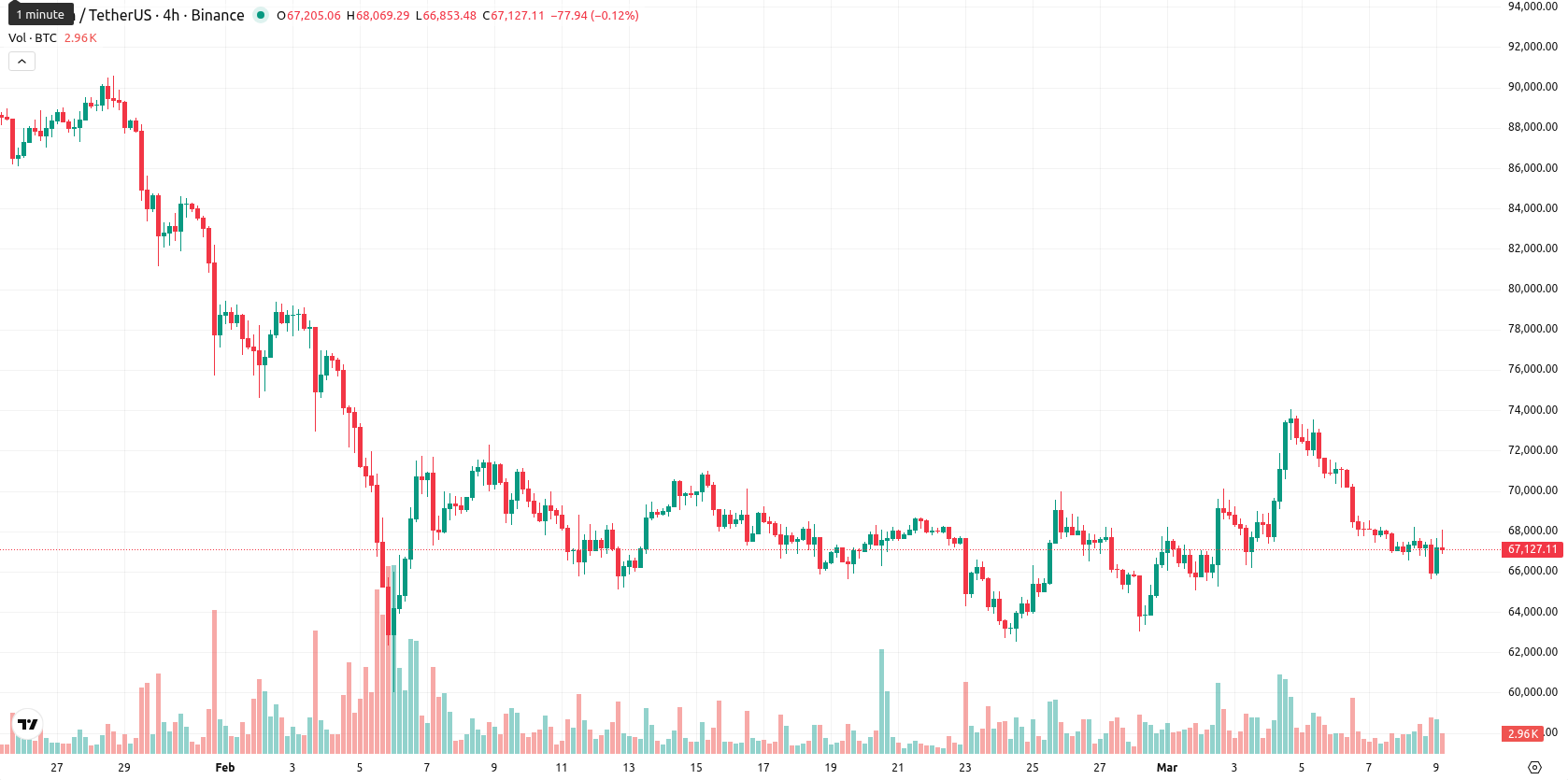
Bitcoin (BTC) is trading at $67,040.25, having slipped 0.48% on the day and remaining below its MA-20 ($67,499.43), MA-50 ($74,205.36), and MA-200 ($95,439.34), which reflects persistent downward pressure across all major timeframes. The Ichimoku Kijun at $68,280.14 marks a technical barrier just above current levels.
 63221.99
65622.83
63221.99
65622.83
Highlights
- Escalating Middle East tensions have disrupted oil transit and spiked energy prices, triggering risk-off sentiment across global assets including Bitcoin.
- Renewed geopolitical instability has heightened market fears of delayed monetary easing and increased regulatory risks for transnational crypto flows.
- Bitcoin faces prevailing downward technical pressure, with current rangebound trade around $66,000–$68,000 and a likely path to the $60,000 support if weakness persists.
Heightened war risk and oil disruptions deepen Bitcoin's macro vulnerability
Earlier this week, escalating conflict between Iran and other states in the Middle East has led to a significant spike in crude oil prices and disruptions at the Strait of Hormuz, a strategic global oil transit corridor. This geopolitical instability has fueled concerns over higher global inflation and triggered a broader retreat across risk assets, including Bitcoin, as investors react to increased macro uncertainty and potential delays in central bank interest-rate cuts. The heightened war risk and energy market disruptions are directly pressuring Bitcoin’s liquidity and risk profile, making it vulnerable to further volatility stemming from external geopolitical escalation. Regulatory exposure remains elevated, as the ongoing global instability increases the likelihood of coordinated state responses or new policy actions impacting transnational crypto flows.
Mixed oscillator signals amid downside momentum and mid-range consolidation
MACD and Average Directional Index both signal persistent negative momentum on the daily timeframe. Relative Strength Index is in bearish territory, while Stochastic RSI and Commodity Channel Index show neutral to mild oversold conditions, creating some divergence among oscillators. Bull/Bear Power suggests buyers retain the upper hand on the daily scale despite the muted move, and the Awesome Oscillator’s buy signal lends mild support to this view. BTC is consolidating mid-range within today’s band of $65,821.97 to $68,069.29, with moderate volatility and some sideways action after early weakness, partially at odds with the negative momentum readings.
Downside favored as low breakout odds shape rangebound outlook
For the coming five sessions, BTC is expected to trade in a typical volatility band between $59,900 and $72,900 centered near the current market level. The probability of a sustained price increase is very low (less than 20%), and the dominant signals favor a further decline. The base scenario suggests rangebound activity near $66,000–$68,000. If buyers overcome resistance at $68,280, testing the $72,900 area is possible, but a breakdown below $65,800 could increase risk toward $60,000, with the path of least resistance still to the downside.
Previously it was reported that Bitcoin’s recent price action has shown a short-term correlation with U.S. tech stocks, largely driven by shared macroeconomic and liquidity factors, though analysts emphasize that only a quarter of Bitcoin’s movement is tied to equities, with the majority influenced by crypto-specific drivers such as network activity and regulatory shifts. The current market trend highlights Bitcoin’s continued independence from traditional safe-haven assets, maintaining its function as a portfolio diversifier despite temporary synchronization with risk-on equity sectors.














-
 Afghanistan
-
 Albania
-
 Algeria
-
 Angola
-
 Argentina
-
 Armenia
-
 Australia
-
 Austria
-
 Azerbaijan
-
 Bahamas
-
 Bahrain
-
 Bangladesh
-
 Belarus
-
 Belgium
-
 Bolivia
-
 Botswana
-
 Brazil
-
 Brunei
-
 Bulgaria
-
 Cambodia
-
 Cameroon
-
 Canada
-
 Chile
Chile
-
 China
China
-
 Colombia
-
 Congo
Congo
-
 Costa Rica
-
 Cote d'Ivoire
-
 Croatia
-
 Cuba
Cuba
-
 Cyprus
-
 Czechia
-
 DR Congo
-
 Denmark
-
 Dominican Republic
-
 Ecuador
-
 Egypt
Egypt
-
 El Salvador
-
 Estonia
-
 Eswatini
-
 Ethiopia
-
 Finland
-
 France
-
 Georgia
-
 Germany
-
 Ghana
Ghana
-
 Greece
-
 Haiti
Haiti
-
 Hong Kong
-
 Hungary
-
 India
India
-
 Indonesia
-
 Iran, Islamic republic
-
 Iraq
Iraq
-
 Ireland
-
 Israel
-
 Italy
Italy
-
 Jamaica
-
 Japan
Japan
-
 Jordan
-
 Kazakhstan
-
 Kenya
Kenya
-
 Korea
Korea
-
 Kuwait
-
 Kyrgyzstan
-
 Laos
Laos
-
 Latvia
-
 Lebanon
-
 Lesotho
-
 Libya
Libya
-
 Lithuania
-
 Luxembourg
-
 Madagascar
-
 Malaysia
-
 Malta
Malta
-
 Mauritius
-
 Mexico
-
 Moldova
-
 Mongolia
-
 Montenegro
-
 Morocco
-
 Mozambique
-
 Myanmar
-
 Namibia
-
 Nepal
Nepal
-
 Netherlands
-
 New Zealand
-
 Nigeria
-
 North Macedonia
-
 Norway
-
 Oman
Oman
-
 Pakistan
-
 Palestine
-
 Panama
-
 Papua New Guinea
-
 Paraguay
-
 Peru
Peru
-
 Philippines
-
 Poland
-
 Portugal
-
 Puerto Rico
-
 Qatar
Qatar
-
 Reunion
-
 Romania
-
 Rwanda
-
 Saudi Arabia
-
 Serbia
-
 Singapore
-
 Slovakia
-
 Slovenia
-
 Somalia
-
 South Africa
-
 Spain
Spain
-
 Sri Lanka
-
 Sweden
-
 Switzerland
-
 Syria
Syria
-
 Taiwan
-
 Tajikistan
-
 Tanzania
-
 Thailand
-
 Trinidad and Tobago
-
 Tunisia
-
 Turkey
-
 UAE
UAE
-
 Uganda
-
 Ukraine
-
 United Kingdom
-
United States
-
 Uruguay
-
 Uzbekistan
-
 Venezuela
-
 Vietnam
-
 Yemen
Yemen
-
 Zambia
-
 Zimbabwe
- Forex
- Crypto











