
Escalating US-Iran conflict — Bitcoin gains 3.87%

Bitcoin (BTC) is trading at $70,010, advancing 3.87% on the day. The asset currently sits above its MA-20 ($67,529.09) but remains below its MA-50 ($73,693.84) and MA-200 ($95,217.32), indicating persistent short-term momentum within a medium- and long-term bearish structure.
 64275.38
66445.93
64275.38
66445.93
Highlights
- Escalating US-Iran conflict has driven oil above $100 and triggered high market volatility, intensifying global stagflation risks.
- Growing macroeconomic uncertainty and stricter US crypto oversight, including anti-money laundering focus, threaten Bitcoin's liquidity and capital flows.
- Bitcoin trades in a volatile $63,500–$75,400 band with short-term buyer strength, but medium-term technical signals remain bearish and favor further consolidation or downside.
Systemic risk rises as geopolitical tensions and U.S. oversight intensify
As of March 10, 2026, escalating military conflict between the United States and Iran has significantly increased geopolitical risk, leading to heightened volatility in global markets and disruption of key oil supply routes, including the threatened closure of the Strait of Hormuz. The resulting surge in oil prices above $100 per barrel has raised stagflation fears, complicating the Federal Reserve's policy decisions and challenging the stability of the U.S. dollar. These geopolitical tensions have increased systemic risk for Bitcoin by amplifying macroeconomic uncertainty and potential capital flight into non-dollar assets; however, ongoing regulatory developments in the U.S.—such as the Treasury's evolving position toward crypto mixers under the GENIUS Act—point to increased oversight and potential tightening of anti-money laundering enforcement, particularly given documented abuse by sanctioned entities like North Korean cyber units. Short-term political and economic shocks, government-imposed capital controls, and further regulatory crackdowns remain principal threats to Bitcoin’s global liquidity and accessibility.
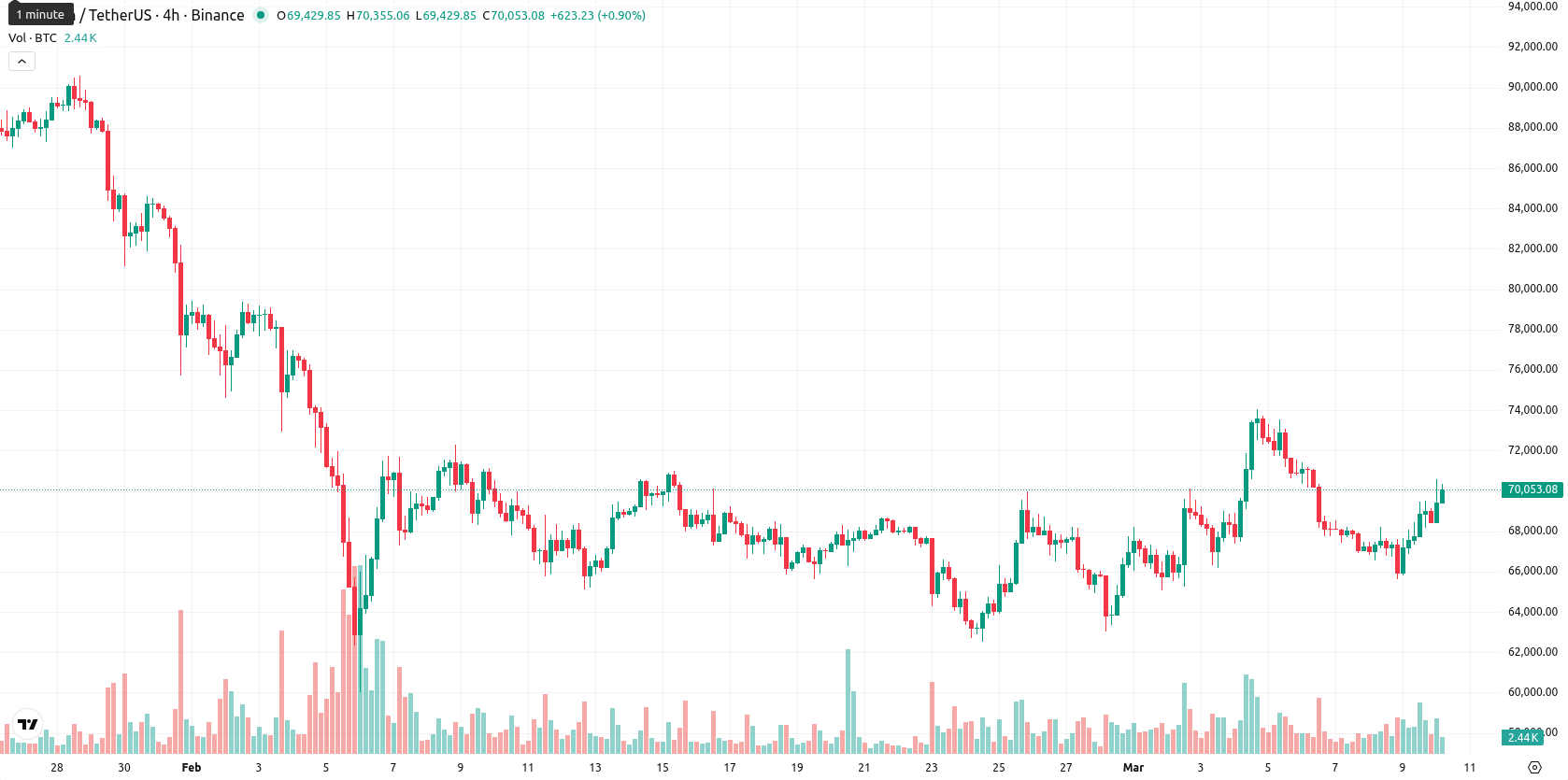
Mixed momentum on technicals as BTC faces resistance at key averages
Technically, BTC holds above its MA-20 but is capped by the MA-50 and MA-200, highlighting short-term strength amid lingering medium- and long-term bearish sentiment. The Ichimoku Kijun on the daily chart stands at $68,280.14, serving as nearest support. Momentum signals are mixed: MACD and ADX on D1 indicate continued bearish pressure, but Stochastic RSI is in buy territory, with the regular RSI displaying slight weakness below neutral and CCI and Awesome Oscillator staying neutral. Bull/Bear Power shows an overbought reading, reflecting dominant buyer activity intraday, though indicator divergence suggests ongoing struggle for direction between bulls and bears.
Near-term consolidation expected as upside breakout odds remain low
For the next five sessions, BTC is expected to trade within a typical volatility band between $63,500 and $75,400. The likelihood of a price increase remains low (below 20%), with further pullbacks more probable. The baseline case anticipates near-term consolidation within this range, while a breakout above $75,400 could trigger accelerated gains. Alternatively, a close below $63,500 would expose renewed downside risk against the backdrop of prevailing medium-term bearish signals.
Previously it was reported that Bitcoin is exhibiting short-term bullish momentum, trading above the MA-20 and Ichimoku Kijun but remaining below both the MA-50 and MA-200, amid strong institutional inflows and declining exchange reserves. However, mixed technical indicators—including bearish MACD/ADX signals against overbought intraday momentum—suggest consolidation is likely, with resistance around $75,000 and support near $62,000, and limited upside expected over the coming week.





Latest Bitcoin News









-
 Afghanistan
-
 Albania
-
 Algeria
-
 Angola
-
 Argentina
-
 Armenia
-
 Australia
-
 Austria
-
 Azerbaijan
-
 Bahamas
-
 Bahrain
-
 Bangladesh
-
 Belarus
-
 Belgium
-
 Bolivia
-
 Botswana
-
 Brazil
-
 Brunei
-
 Bulgaria
-
 Cambodia
-
 Cameroon
-
 Canada
-
 Chile
Chile
-
 China
China
-
 Colombia
-
 Congo
Congo
-
 Costa Rica
-
 Cote d'Ivoire
-
 Croatia
-
 Cuba
Cuba
-
 Cyprus
-
 Czechia
-
 DR Congo
-
 Denmark
-
 Dominican Republic
-
 Ecuador
-
 Egypt
Egypt
-
 El Salvador
-
 Estonia
-
 Eswatini
-
 Ethiopia
-
 Finland
-
 France
-
 Georgia
-
 Germany
-
 Ghana
Ghana
-
 Greece
-
 Haiti
Haiti
-
 Hong Kong
-
 Hungary
-
 India
India
-
 Indonesia
-
 Iran, Islamic republic
-
 Iraq
Iraq
-
 Ireland
-
 Israel
-
 Italy
Italy
-
 Jamaica
-
 Japan
Japan
-
 Jordan
-
 Kazakhstan
-
 Kenya
Kenya
-
 Korea
Korea
-
 Kuwait
-
 Kyrgyzstan
-
 Laos
Laos
-
 Latvia
-
 Lebanon
-
 Lesotho
-
 Libya
Libya
-
 Lithuania
-
 Luxembourg
-
 Madagascar
-
 Malaysia
-
 Malta
Malta
-
 Mauritius
-
 Mexico
-
 Moldova
-
 Mongolia
-
 Montenegro
-
 Morocco
-
 Mozambique
-
 Myanmar
-
 Namibia
-
 Nepal
Nepal
-
 Netherlands
-
 New Zealand
-
 Nigeria
-
 North Macedonia
-
 Norway
-
 Oman
Oman
-
 Pakistan
-
 Palestine
-
 Panama
-
 Papua New Guinea
-
 Paraguay
-
 Peru
Peru
-
 Philippines
-
 Poland
-
 Portugal
-
 Puerto Rico
-
 Qatar
Qatar
-
 Reunion
-
 Romania
-
 Rwanda
-
 Saudi Arabia
-
 Serbia
-
 Singapore
-
 Slovakia
-
 Slovenia
-
 Somalia
-
 South Africa
-
 Spain
Spain
-
 Sri Lanka
-
 Sweden
-
 Switzerland
-
 Syria
Syria
-
 Taiwan
-
 Tajikistan
-
 Tanzania
-
 Thailand
-
 Trinidad and Tobago
-
 Tunisia
-
 Turkey
-
 UAE
UAE
-
 Uganda
-
 Ukraine
-
 United Kingdom
-
United States
-
 Uruguay
-
 Uzbekistan
-
 Venezuela
-
 Vietnam
-
 Yemen
Yemen
-
 Zambia
-
 Zimbabwe
- Forex
- Crypto












