
Steady price for Bitcoin as US and Israeli strikes target Iranian nuclear sites

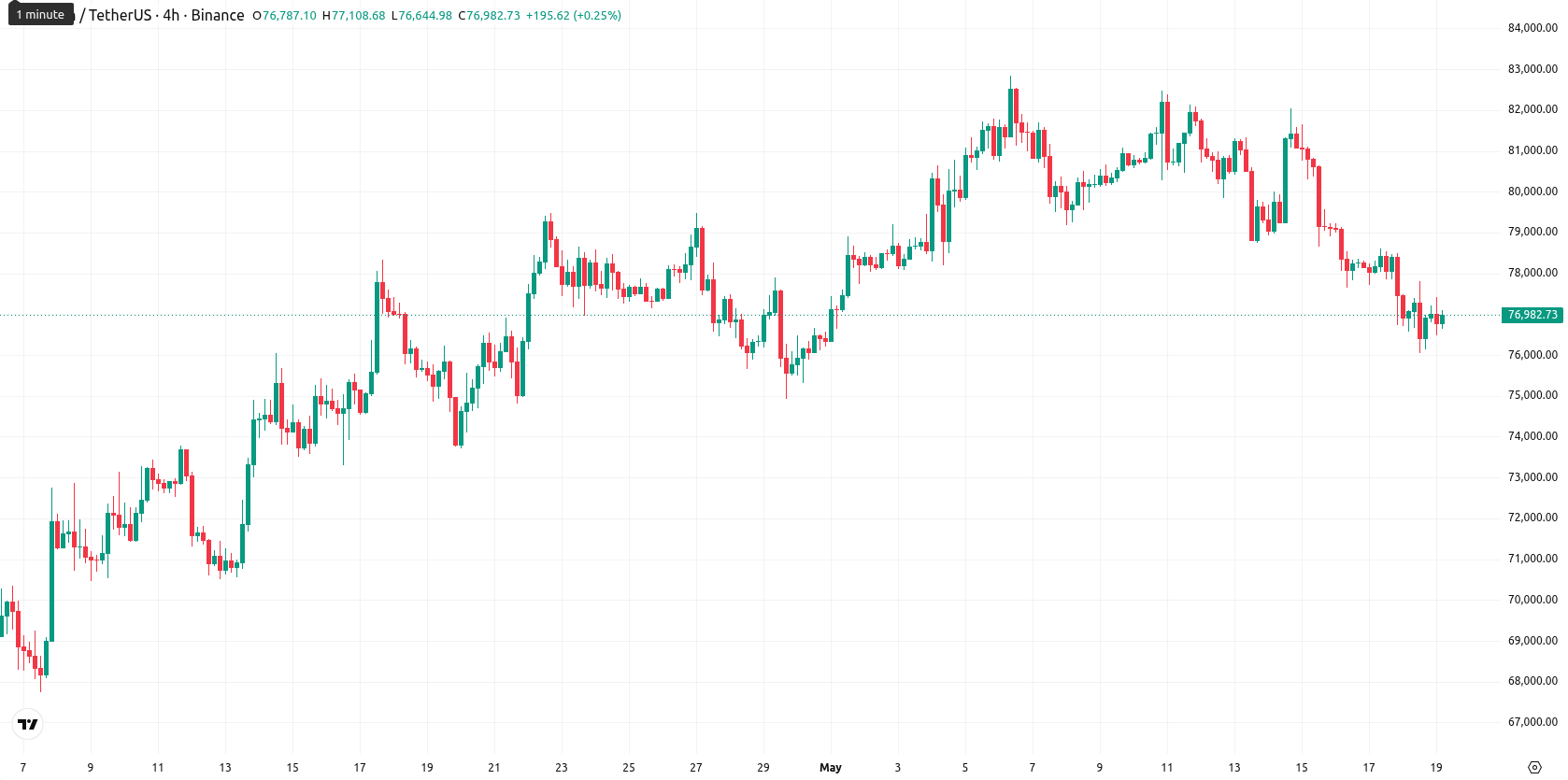
Bitcoin (BTC) is trading at $77,060, up 0.23% for the day. The price sits below its key short-term moving average but remains above certain medium-term levels, reflecting a mixed technical setup.
 64350
64394.44
64350
64394.44
Highlights
- Escalating military conflict between the US, Israel, and Iran triggered a sharp risk-off shift, causing Bitcoin to drop below $77,000 and spurring record $635 million in single-day outflows from US spot Bitcoin ETFs.
- Regulatory uncertainty is intensifying as Iran’s Bitcoin-settled maritime insurance faces OFAC sanctions threats and the US preps a Strategic Bitcoin Reserve amid major crypto legislation in Congress.
- Bitcoin faces bearish technical signals, with short- and long-term selling pressure dominating and a high probability of consolidation between $75,500 and $79,500 in the coming week.
Geopolitical escalation and ETF outflows drive risk-off bitcoin slide
On May 18, 2026, President Donald Trump issued a military threat against Iran, triggering a significant risk-off shock in global markets and causing Bitcoin to fall below $77,000 as investors responded to geopolitical escalation. US and Israeli forces struck Iranian nuclear facilities on Saturday, intensifying Middle East tensions, driving oil prices higher, strengthening the US dollar, and leading to record outflows from US spot Bitcoin ETFs, including a single-day $635 million net withdrawal on May 13. Iran has launched the 'Hormuz Safe' platform, offering Bitcoin-settled maritime insurance for ships passing through the Strait of Hormuz, prompting OFAC to warn on May 1 that paying such tolls exposes participants to US primary and secondary sanctions, with covered shippers and financial intermediaries at risk of being cut off from the American financial system. The US government is also reportedly preparing to announce a Strategic Bitcoin Reserve, emphasizing legal safeguards, interagency cooperation, and the need for statutory codification to prevent asset reversal during regime changes. Regulatory uncertainty remains heightened as key legislation—including the CLARITY Act and the Bitcoin Act—progresses through Congress amid elevated enforcement pressure on both banks and crypto industry stakeholders.
Oversold signals with weak momentum as key averages define range
BTC is currently below the MA-20 at $79,365.21 and well under the MA-200 at $81,463.32, with the MA-50 at $75,644.19 providing nearby support. Immediate resistance is marked by the Ichimoku Kijun at $78,893.76. Momentum indicators give mixed signals: MACD on the daily chart points to continued upward momentum, while RSI remains neutral to mildly bearish and does not indicate any extreme conditions. The ADX signals weak trend strength. Both the Stochastic RSI and Commodity Channel Index are in oversold territory, suggesting the conditions for a potential technical rebound. Bull/Bear Power (BBP) shows strong seller predominance on the daily timeframe, reflecting prevailing intraday bearishness, while the Awesome Oscillator remains neutral.
Bearish momentum caps upside amid volatility and resistance threshold
In the next five trading days, BTC is likely to trade within a typical volatility band between $75,500 and $79,500. Major weekly momentum indicators remain bearish, supporting a higher probability of a decline and limiting prospects for a meaningful rally. A move above $79,500 would be required to shift the outlook toward further gains, while a drop below $75,500 could open the way for additional downside.
Earlier, analysts noted that Bitcoin’s recovery prospects depended on easing selling pressure and stabilizing sentiment after a phase of heightened market stress. The current geopolitical escalation and outsized ETF outflows reinforce these headwinds, making sustained downside risk the dominant scenario unless BTC can decisively reclaim its short-term resistance in the coming sessions.





Latest Bitcoin News










-
 Afghanistan
-
 Albania
-
 Algeria
-
 Angola
-
 Argentina
-
 Armenia
-
 Australia
-
 Austria
-
 Azerbaijan
-
 Bahamas
-
 Bahrain
-
 Bangladesh
-
 Belarus
-
 Belgium
-
 Bolivia
-
 Botswana
-
 Brazil
-
 Brunei
-
 Bulgaria
-
 Cambodia
-
 Cameroon
-
 Canada
-
 Chile
Chile
-
 China
China
-
 Colombia
-
 Congo
Congo
-
 Costa Rica
-
 Cote d'Ivoire
-
 Croatia
-
 Cuba
Cuba
-
 Cyprus
-
 Czechia
-
 DR Congo
-
 Denmark
-
 Dominican Republic
-
 Ecuador
-
 Egypt
Egypt
-
 El Salvador
-
 Estonia
-
 Eswatini
-
 Ethiopia
-
 Finland
-
 France
-
 Georgia
-
 Germany
-
 Ghana
Ghana
-
 Greece
-
 Haiti
Haiti
-
 Hong Kong
-
 Hungary
-
 India
India
-
 Indonesia
-
 Iran, Islamic republic
-
 Iraq
Iraq
-
 Ireland
-
 Israel
-
 Italy
Italy
-
 Jamaica
-
 Japan
Japan
-
 Jordan
-
 Kazakhstan
-
 Kenya
Kenya
-
 Korea
Korea
-
 Kuwait
-
 Kyrgyzstan
-
 Laos
Laos
-
 Latvia
-
 Lebanon
-
 Lesotho
-
 Libya
Libya
-
 Lithuania
-
 Luxembourg
-
 Madagascar
-
 Malaysia
-
 Malta
Malta
-
 Mauritius
-
 Mexico
-
 Moldova
-
 Mongolia
-
 Montenegro
-
 Morocco
-
 Mozambique
-
 Myanmar
-
 Namibia
-
 Nepal
Nepal
-
 Netherlands
-
 New Zealand
-
 Nigeria
-
 North Macedonia
-
 Norway
-
 Oman
Oman
-
 Pakistan
-
 Palestine
-
 Panama
-
 Papua New Guinea
-
 Paraguay
-
 Peru
Peru
-
 Philippines
-
 Poland
-
 Portugal
-
 Puerto Rico
-
 Qatar
Qatar
-
 Reunion
-
 Romania
-
 Rwanda
-
 Saudi Arabia
-
 Serbia
-
 Singapore
-
 Slovakia
-
 Slovenia
-
 Somalia
-
 South Africa
-
 Spain
Spain
-
 Sri Lanka
-
 Sweden
-
 Switzerland
-
 Syria
Syria
-
 Taiwan
-
 Tajikistan
-
 Tanzania
-
 Thailand
-
 Trinidad and Tobago
-
 Tunisia
-
 Turkey
-
 UAE
UAE
-
 Uganda
-
 Ukraine
-
 United Kingdom
-
United States
-
 Uruguay
-
 Uzbekistan
-
 Venezuela
-
 Vietnam
-
 Yemen
Yemen
-
 Zambia
-
 Zimbabwe
- Forex
- Crypto












