
The tweet was deleted by the author.
But we saved everything 🙂.

XRP (XRP) is currently trading at $1.2724, up $0.1367 or 12.04% from yesterday's close of $1.1357. Since today’s open at $1.1855, XRP has risen $0.0869, gaining 7.33% intraday and moving near the top of today’s volatile $1.1752–$1.2927 range. Strong buying pressure has driven prices higher, supported by persistent institutional inflows, positive regulatory developments, and the recent product launch by Ripple, as well as renewed interest from large investors.
 1.2927
1.1878
1.2927
1.1878
$RLUSD is now live on Gate.io, offering new $XRP / $RLUSD spot trading pairs that enhance global capital efficiency and interoperability in digital asset markets. This matters for XRP as it may increase liquidity and usage, strengthening its position within the broader crypto ecosystem. The market’s upbeat response aligns with this development, further supported by continued institutional interest through spot ETFs, significant whale accumulation, and regulatory advances such as the SEC’s approval of a multi-asset crypto ETF including XRP. In addition, Ripple’s expansion into payment services and stablecoin infrastructure underscores positive momentum, while the CLARITY Act’s progress could further increase legal certainty for XRP.
XRP is positioned above the 20-day Moving Average at $1.2095 but remains below the 50-day ($1.3240) and 200-day ($1.5783), suggesting short-term bullishness amid medium- and longer-term resistance. Immediate support is found at the Ichimoku Kijun ($1.2182), while resistance sits near the 50-day MA at $1.3240. Stochastic RSI is in the overbought zone, and daily MACD remains in strong sell despite powerful intraday buying, pointing to divergent signals. The 5-day forecast sees a likely range of $1.1500–$1.3500, with further declines more probable — however, the bullish signal from Ripple’s market integration supports the technical outlook.
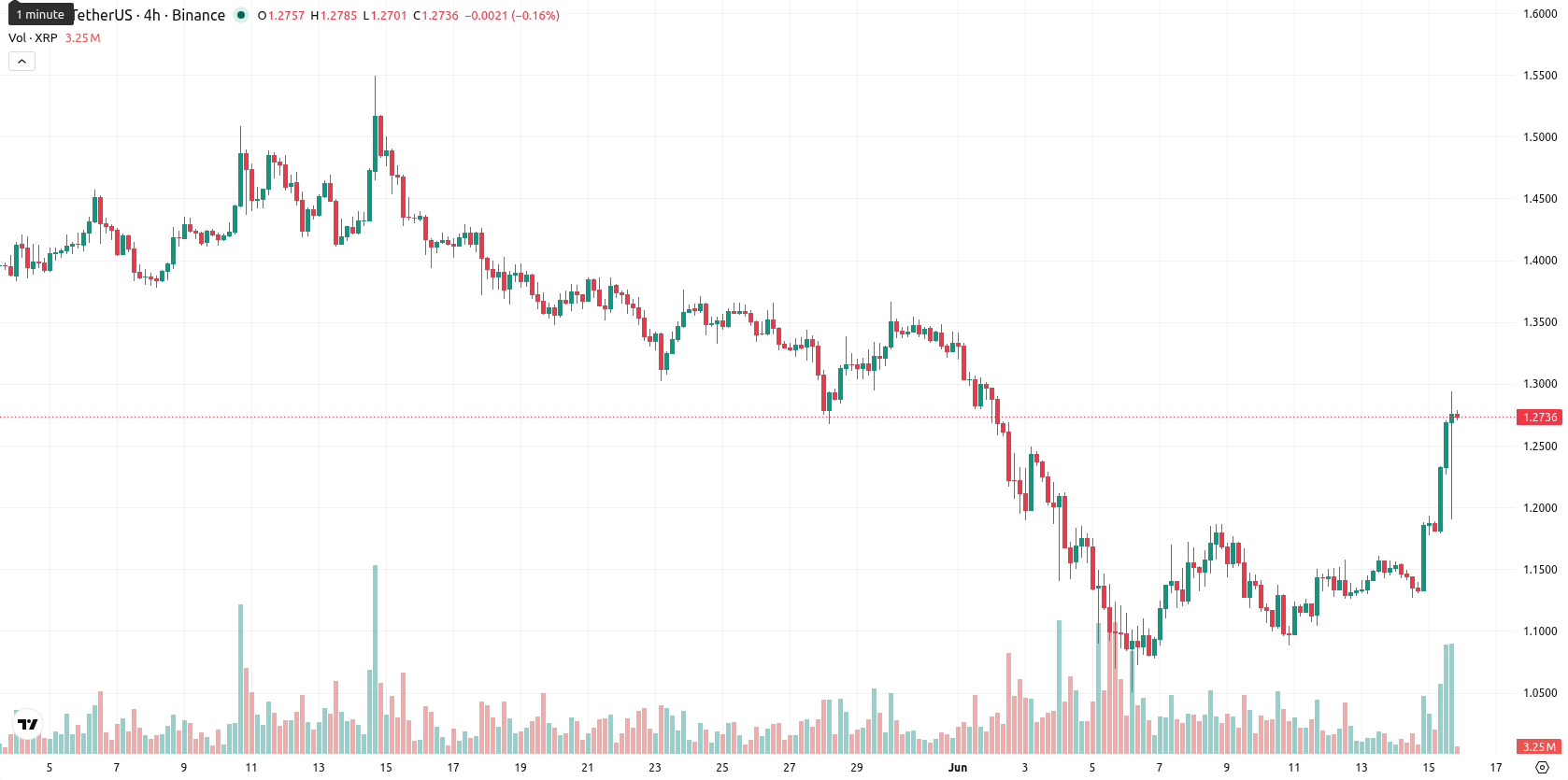
In a recent review, analysts highlighted that XRP was experiencing a short-term positive trend within a broader downtrend, driven by institutional inflows and expanding network utility. The current analysis builds on this perspective, reinforcing the need for traders to monitor for a breakout above key resistance levels as a signal for a more sustained shift in momentum.



 Afghanistan
 Albania
 Algeria
 Angola
 Argentina
 Armenia
 Australia
 Austria
 Azerbaijan
 Bahamas
 Bahrain
 Bangladesh
 Belarus
 Belgium
 Bolivia
 Botswana
 Brazil
 Brunei
 Bulgaria
 Cambodia
 Cameroon
 Canada
 Chile
Chile
 China
China
 Colombia
 Congo
Congo
 Costa Rica
 Cote d'Ivoire
 Croatia
 Cuba
Cuba
 Cyprus
 Czechia
 DR Congo
 Denmark
 Dominican Republic
 Ecuador
 Egypt
Egypt
 El Salvador
 Estonia
 Eswatini
 Ethiopia
 Finland
 France
 Georgia
 Germany
 Ghana
Ghana
 Greece
 Haiti
Haiti
 Hong Kong
 Hungary
 India
India
 Indonesia
 Iran, Islamic republic
 Iraq
Iraq
 Ireland
 Israel
 Italy
Italy
 Jamaica
 Japan
Japan
 Jordan
 Kazakhstan
 Kenya
Kenya
 Korea
Korea
 Kuwait
 Kyrgyzstan
 Laos
Laos
 Latvia
 Lebanon
 Lesotho
 Libya
Libya
 Lithuania
 Luxembourg
 Madagascar
 Malaysia
 Malta
Malta
 Mauritius
 Mexico
 Moldova
 Mongolia
 Montenegro
 Morocco
 Mozambique
 Myanmar
 Namibia
 Nepal
Nepal
 Netherlands
 New Zealand
 Nigeria
 North Macedonia
 Norway
 Oman
Oman
 Pakistan
 Palestine
 Panama
 Papua New Guinea
 Paraguay
 Peru
Peru
 Philippines
 Poland
 Portugal
 Puerto Rico
 Qatar
Qatar
 Reunion
 Romania
 Rwanda
 Saudi Arabia
 Serbia
 Singapore
 Slovakia
 Slovenia
 Somalia
 South Africa
 Spain
Spain
 Sri Lanka
 Sweden
 Switzerland
 Syria
Syria
 Taiwan
 Tajikistan
 Tanzania
 Thailand
 Trinidad and Tobago
 Tunisia
 Turkey
 UAE
UAE
 Uganda
 Ukraine
 United Kingdom
United States
United Kingdom
United States
 Uruguay
 Uzbekistan
 Venezuela
 Vietnam
 Yemen
Yemen
 Zambia
 Zimbabwe