
The tweet was deleted by the author.
But we saved everything 🙂.

Ethereum and Bitcoin, the two largest cryptocurrencies by market capitalization, are experiencing diverging trends amid profit-taking, institutional repositioning, and macroeconomic uncertainty.
Ethereum’s climb toward the $5,000 milestone stalled in late August, peaking at $4,955 before moving into a sideways range. Over the past week, ETH has lost 1.76%, dipping to $4,258 before stabilizing near $4,295. Analysts highlight aggressive futures selling that created a $570 million imbalance in favor of sellers, a pattern that historically coincides with local tops.
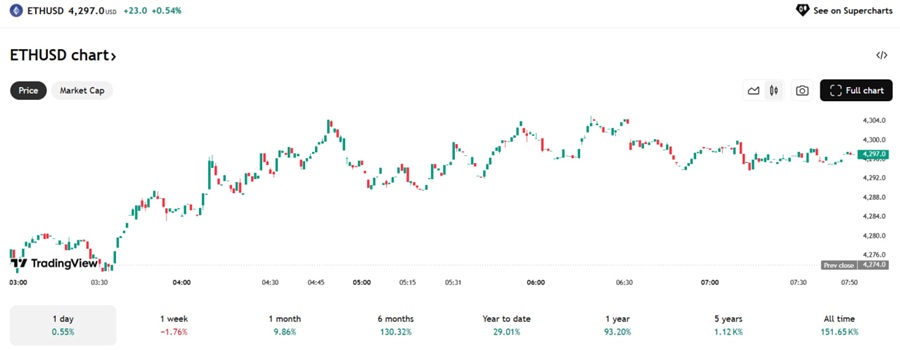
ETH price dynamics. Source: TradingView
Long-term holders (LTHs) have also added pressure by locking in profits. Glassnode’s NUPL metric signals profit saturation levels that often precede corrections, while Coin Days Destroyed has recorded a sharp spike, pointing to heightened selling activity from experienced investors.
Institutional flows amplified the bearish tilt. According to SoSoValue, on Sept. 5 Ethereum ETFs saw $446.71 million in outflows — the second-largest daily redemption on record — led by BlackRock’s ETHA fund. While some analysts attribute this to portfolio rebalancing, the outflows reflect caution following August’s strong rally.
Still, positive signs remain. An ICO-era participant recently staked 150,000 ETH worth $656 million, while firms linked to Alibaba founder Jack Ma have referred to ETH as a “reserve asset.” These moves underscore institutional and long-term confidence despite short-term turbulence.
Bitcoin is consolidating near $110,500 after a corrective phase, finding support at the 100-day moving average. RSI indicators show weak momentum, but declining exchange reserves suggest long-term accumulation. Analysts argue that the supply contraction could trigger a new rally once demand strengthens.
Broader developments complicate the picture. Arkham Intelligence recently uncovered 45,000 dormant BTC tied to the Movie2K case, worth nearly $5 billion. In Germany, debate has reignited over whether such assets should be liquidated or incorporated into sovereign reserves. Meanwhile, Bitcoin mining difficulty has reached a record 134.7 trillion, pressuring smaller miners but strengthening network security.
Gold’s surge above $3,586 has also renewed comparisons with Bitcoin. Critics like Peter Schiff argue BTC cannot be considered a safe-haven asset, while others point to its nearly 1,000% growth over the past five years.
Ethereum faces profit-taking and institutional caution, while Bitcoin stabilizes amid macroeconomic challenges. The crypto market appears set for a consolidation phase, with future direction hinging on new inflows and stronger demand heading into Q4 2025.
Read also: U.S. Senate moves to close loopholes in tokenized equities regulation

 Afghanistan
 Albania
 Algeria
 Angola
 Argentina
 Armenia
 Australia
 Austria
 Azerbaijan
 Bahamas
 Bahrain
 Bangladesh
 Belarus
 Belgium
 Bolivia
 Botswana
 Brazil
 Brunei
 Bulgaria
 Cambodia
 Cameroon
 Canada
 Chile
Chile
 China
China
 Colombia
 Congo
Congo
 Costa Rica
 Cote d'Ivoire
 Croatia
 Cuba
Cuba
 Cyprus
 Czechia
 DR Congo
 Denmark
 Dominican Republic
 Ecuador
 Egypt
Egypt
 El Salvador
 Estonia
 Eswatini
 Ethiopia
 Finland
 France
 Georgia
 Germany
 Ghana
Ghana
 Greece
 Haiti
Haiti
 Hong Kong
 Hungary
 India
India
 Indonesia
 Iran, Islamic republic
 Iraq
Iraq
 Ireland
 Israel
 Italy
Italy
 Jamaica
 Japan
Japan
 Jordan
 Kazakhstan
 Kenya
Kenya
 Korea
Korea
 Kuwait
 Kyrgyzstan
 Laos
Laos
 Latvia
 Lebanon
 Lesotho
 Libya
Libya
 Lithuania
 Luxembourg
 Madagascar
 Malaysia
 Malta
Malta
 Mauritius
 Mexico
 Moldova
 Mongolia
 Montenegro
 Morocco
 Mozambique
 Myanmar
 Namibia
 Nepal
Nepal
 Netherlands
 New Zealand
 Nigeria
 North Macedonia
 Norway
 Oman
Oman
 Pakistan
 Palestine
 Panama
 Papua New Guinea
 Paraguay
 Peru
Peru
 Philippines
 Poland
 Portugal
 Puerto Rico
 Qatar
Qatar
 Reunion
 Romania
 Rwanda
 Saudi Arabia
 Serbia
 Singapore
 Slovakia
 Slovenia
 Somalia
 South Africa
 Spain
Spain
 Sri Lanka
 Sweden
 Switzerland
 Syria
Syria
 Taiwan
 Tajikistan
 Tanzania
 Thailand
 Trinidad and Tobago
 Tunisia
 Turkey
 UAE
UAE
 Uganda
 Ukraine
 United Kingdom
United States
United Kingdom
United States
 Uruguay
 Uzbekistan
 Venezuela
 Vietnam
 Yemen
Yemen
 Zambia
 Zimbabwe