
The tweet was deleted by the author.
But we saved everything 🙂.

The digital asset market is cooling after a hot summer: Bitcoin has fallen below $110,000, and Ethereum is trying to hold around $4,000. The pullback coincides with weaker demand in the United States, outflows from ETFs, and a macroeconomic background in which Federal Reserve officials signal caution regarding rate cuts due to persistent inflation and a strong labor market.
Ahead of the U.S. non-farm payrolls data, positions have become defensive. Opinions in the options departments are divided: some traders sold BTC call options at around $110,000, while others bought put options at around $109,000, and weekend volatility has led to a reduction in positions, which many closed instead of moving to a risk criterion.
According to Farside, Bitcoin ETFs recorded about $900 million in weekly net outflows after a strong previous week. The shift reflects broader macroeconomic uncertainty, but flows are not one-sided: large holders are using weakness for accumulation. The purchase of 584 BTC (~$63.9 million) by one “whale” illustrates the renewed “buy-the-dip” tactic, and the number of entities holding more than 1,000 BTC increased from 1,392 to 1,417 over the week, which indicates that long-term capital still has strategic value.
The market narrative is divided. Seasonal “bulls” note that late-year weakness after a halving has precedents and maintain a constructive view for the fourth quarter in the absence of a decisive breakdown of long-term trends. Meanwhile, derivatives traders remain cautious ahead of key statistics.
A separate focus is the political discussion: proposals to create a national Bitcoin Reserve. Critics warn that such a step could concentrate supply in the hands of the state, create a liquidation risk due to political reshuffles, and even undermine confidence in the U.S. dollar if perceived as a signal of fiat currency fragility, writes Cointelegraph. Germany’s sale of 50,000 BTC in 2024, which is believed to have pressured prices, serves as a warning in favor of government influence on the market.
Ethereum has been declining for the second week in a row, briefly rebounding by about 1%, but still holding near the $4,000 mark. U.S.-registered spot ETH ETFs recorded a record weekly outflow of $800 million, offsetting the strong inflows of early September and emphasizing how quickly institutional sentiment can change. Nevertheless, about $26 billion remains in ETH funds — approximately 5.37% of the total supply, which highlights the asset’s deepening presence in regulated products.
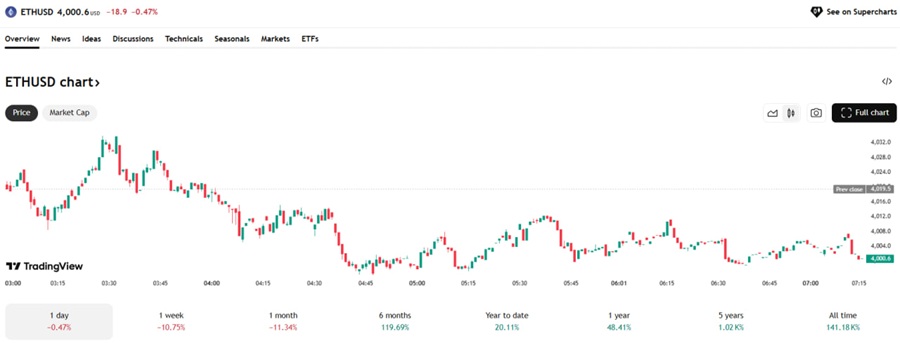
ETH price dynamics. Source: TradingView
On-chain signals are mixed. The rise in the Liveliness metric indicates that long-term holders are distributing assets during the downturn, increasing short-term pressure. At the same time, Ethereum’s exchange supply ratio is close to multi-year lows, indicating a long-term accumulation trend, as less ETH remains on centralized platforms. Large liquidations (~$1.5 billion) this week reinforced this trend, as leveraged long positions were forced out.
Structurally, the ETF portfolio continues to expand. A new wave of amendments to spot Solana S-1 ETFs from major issuers includes staking features — a development that investors see as a potential clarification for staking in spot Ethereum ETFs. Combined with recent innovations in spot XRP and Dogecoin products, new index crypto ETFs, and evolving listing standards, issuers consider October as a possible turning point for the entire crypto ETF complex.
Read also: A Bollywood celebrity couple is embroiled in a $31 million Bitcoin scandal



 Afghanistan
 Albania
 Algeria
 Angola
 Argentina
 Armenia
 Australia
 Austria
 Azerbaijan
 Bahamas
 Bahrain
 Bangladesh
 Belarus
 Belgium
 Bolivia
 Botswana
 Brazil
 Brunei
 Bulgaria
 Cambodia
 Cameroon
 Canada
 Chile
Chile
 China
China
 Colombia
 Congo
Congo
 Costa Rica
 Cote d'Ivoire
 Croatia
 Cuba
Cuba
 Cyprus
 Czechia
 DR Congo
 Denmark
 Dominican Republic
 Ecuador
 Egypt
Egypt
 El Salvador
 Estonia
 Eswatini
 Ethiopia
 Finland
 France
 Georgia
 Germany
 Ghana
Ghana
 Greece
 Haiti
Haiti
 Hong Kong
 Hungary
 India
India
 Indonesia
 Iran, Islamic republic
 Iraq
Iraq
 Ireland
 Israel
 Italy
Italy
 Jamaica
 Japan
Japan
 Jordan
 Kazakhstan
 Kenya
Kenya
 Korea
Korea
 Kuwait
 Kyrgyzstan
 Laos
Laos
 Latvia
 Lebanon
 Lesotho
 Libya
Libya
 Lithuania
 Luxembourg
 Madagascar
 Malaysia
 Malta
Malta
 Mauritius
 Mexico
 Moldova
 Mongolia
 Montenegro
 Morocco
 Mozambique
 Myanmar
 Namibia
 Nepal
Nepal
 Netherlands
 New Zealand
 Nigeria
 North Macedonia
 Norway
 Oman
Oman
 Pakistan
 Palestine
 Panama
 Papua New Guinea
 Paraguay
 Peru
Peru
 Philippines
 Poland
 Portugal
 Puerto Rico
 Qatar
Qatar
 Reunion
 Romania
 Rwanda
 Saudi Arabia
 Serbia
 Singapore
 Slovakia
 Slovenia
 Somalia
 South Africa
 Spain
Spain
 Sri Lanka
 Sweden
 Switzerland
 Syria
Syria
 Taiwan
 Tajikistan
 Tanzania
 Thailand
 Trinidad and Tobago
 Tunisia
 Turkey
 UAE
UAE
 Uganda
 Ukraine
 United Kingdom
United States
United Kingdom
United States
 Uruguay
 Uzbekistan
 Venezuela
 Vietnam
 Yemen
Yemen
 Zambia
 Zimbabwe