

The tweet was deleted by the author.
But we saved everything 🙂.
The potential threat quantum computing poses to Bitcoin has been grabbing a lot of headlines lately, with major investors claiming that this issue is holding back more money from finding its way to the crypto asset.
While so called Q-Day has become a marketing tool used by altcoin promoters to explain why their coin is more secure than Bitcoin, the reality is there is no imminent threat that should cause serious concern. Additionally, Bitcoin developers are already working on the quantum security issue just in case it does become a more practical threat over time.
This FUD around quantum computers also follows a year or so of increased concern over spam and potentially-illegal content finding its way into the Bitcoin blockchain, although the quantum issue seems to be getting most of the attention these days after legal arguments did not stand up to increased scrutiny and the lack of economic support for protocol changes related to spam became more obvious.
So, if the concerns around both spam and quantum computers are overblown, what is the real, most pressing threat to Bitcoin today?
More often than not, the key concern that developers keep bringing up is mining centralization. As former Bitcoin Core contributor Jonas Schnelli recently put it, “If you care about Bitcoin long term, [the number one] priority is mining centralization.”
Despite being on different sides of the recent debates over spam, various Bitcoin Core contributors and Bitcoin Knots maintainer Luke Dashjr have both made it clear that they see mining centralization as a major concern. Many contributors to Bitcoin Core referred to mining centralization concerns as more pressing than spam, and Dashjr has written of mining centralization, “This is not some future risk but a present reality, and it's not sustainable if Bitcoin is to remain a permissionless currency.”
On top of that, while not necessarily related to the issue of mining centralization directly, the pseudonymous Hunter Beast, who is one of the authors behind a Bitcoin Improvement Proposal (BIP) focused on the quantum computing issue, has also indicated he sees poison blocks as a bigger threat to Bitcoin than quantum computing right now.
The reason there is so much concern over the mining centralization issue is bitcoin’s value proposition is directly connected to the level of decentralization found on the network. And one of the key aspects of this decentralization, at least in terms of providing resistance to transaction censorship, is the level of decentralization found in the mining process.
The payment processing aspect of the Bitcoin network starts to look more like a traditional bank once 51% of the network is sufficiently centralized and identifiable, as longtime Bitcoin developer Matt Carollo recently pointed out on X, “[W]ithout some success on mining decentralization efforts over the coming years, I’m really not sure what Bitcoin is for - if three companies, together, control what gets into the chain what’s the point?”
Various attacks are possible when a single entity or a cartel controls at least 51% of the network hashrate. In addition to the potential for double-spending attacks, these miners could effectively implement changes to the network via “forced soft forks” that could be detrimental to the system’s underlying value proposition of permissionless and unregulated financial activity.
The only way for nodes to guard against these changes would be to revolt via a hard fork, but miners attacking the network at all could easily lead to a situation where the Bitcoin experiment has been deemed a failure. However, it should also be noted that an attacking miner would be also harming their own business, which is why the use of government force is also usually included in these hypothetical scenarios involving evil miners.
Specific addresses or types of transactions could be blacklisted via one of these forced forks. And this is not a completely theoretical issue, as Marathon and F2Pool have both blacklisted addresses before, although Marathon quickly reversed this policy following public backlash. Additionally, MIT once conducted controversial research on how miners could be incentivized to censor transactions with no real-world identity tied to them.
In addition to potential censorship issues at the base layer, mining centralization can also negatively impact the security and reliability of various layer-two networks that are intended to enable additional features and help scale the system to magnitudes of more users over time. The most well-known and notorious example of this is in the case of sidechains, as outlined in the innovation’s associated whitepaper.
There are multiple vectors of centralization in Bitcoin mining, including control over the hardware production, the mining pools, and the physical locations of hardware devices.
The most commonly-discussed area of mining centralization comes in the form of the pools, as it’s also the most obvious and transparent. As of this writing, just three mining pools account for more than 50% of the network hashrate, according to Mempool.space. That means the aforementioned attacks could theoretically be conducted if these three pools were to collude. Of course, the owners of the actual hardware pointed at the pools would also have the option to point their hashrate to alternative pools that are acting properly to thwart any attacks.
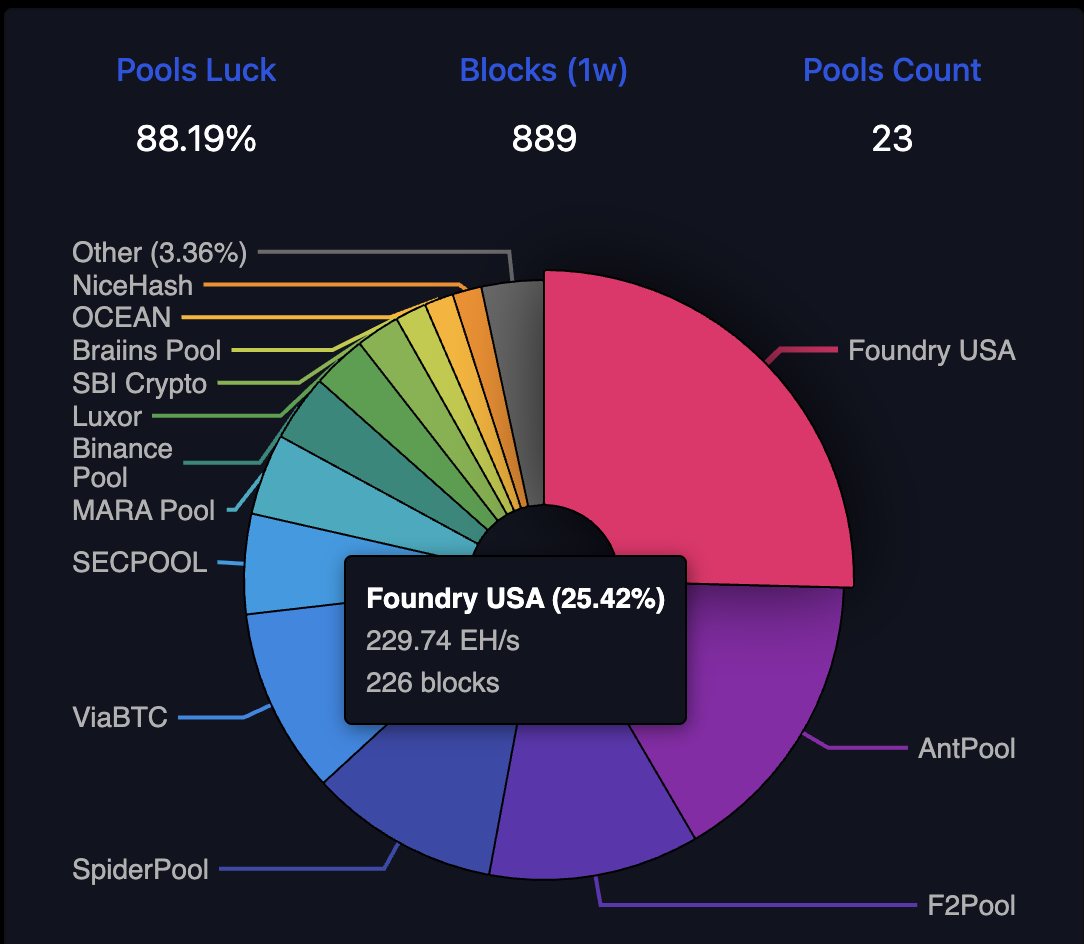
Source: Mempool.space
According to past research from pseudonymous Bitcoin developer B10c, the reality of mining pool centralization is also worse than it appears at first glance because some smaller pools are using the transaction template generated by Antpool rather than creating one of their own.
The additional, underlying centralizing forces of the geographical locations of the actual mining hardware and Bitmain’s 80% share of bitcoin hardware manufacturing are out of the scope of this article, but with all of these aspects of centralization in the bitcoin mining industry, it’s no wonder that it’s something developers continuously point to as a serious issue.
There has been plenty of development on new mining protocols, such as Stratum V2, that would allow miners to continue to pool their hashpower with others while also retaining control over transaction selection, but these enhancements have not yet been widely adopted. That said, things tend to not move in Bitcoin until a crisis occurs, as has been seen with bitcoin exchanges holding off on implementing network upgrades until fees start to rise. So, individual miners may simply not make a change until it is effectively forced upon them.
Enhanced privacy at the base layer can also be helpful in terms of hampering miners’ ability to block specific users or types of transactions, but it doesn’t help for situations where miners simply want to perform a denial-of-service attack on the network.
In terms of the decentralization of mining hardware manufacturing, Block (formerly Square) is now getting involved in the business to provide a U.S.-based alternative, and there is hope that integrating mining equipment into heating systems can help decentralize some of the hashrate in terms of its physical location.
Of course, more issues related to mining centralization, such as the development of MEVil or potential problems related to the declining block subsidy, could eventually pop up over the long term as well, so this is something that needs to be watched closely by any bitcoin holder.

 Afghanistan
 Albania
 Algeria
 Angola
 Argentina
 Armenia
 Australia
 Austria
 Azerbaijan
 Bahamas
 Bahrain
 Bangladesh
 Belarus
 Belgium
 Bolivia
 Botswana
 Brazil
 Brunei
 Bulgaria
 Cambodia
 Cameroon
 Canada
 Chile
Chile
 China
China
 Colombia
 Congo
Congo
 Costa Rica
 Cote d'Ivoire
 Croatia
 Cuba
Cuba
 Cyprus
 Czechia
 DR Congo
 Denmark
 Dominican Republic
 Ecuador
 Egypt
Egypt
 El Salvador
 Estonia
 Eswatini
 Ethiopia
 Finland
 France
 Georgia
 Germany
 Ghana
Ghana
 Greece
 Haiti
Haiti
 Hong Kong
 Hungary
 India
India
 Indonesia
 Iran, Islamic republic
 Iraq
Iraq
 Ireland
 Israel
 Italy
Italy
 Jamaica
 Japan
Japan
 Jordan
 Kazakhstan
 Kenya
Kenya
 Korea
Korea
 Kuwait
 Kyrgyzstan
 Laos
Laos
 Latvia
 Lebanon
 Lesotho
 Libya
Libya
 Lithuania
 Luxembourg
 Madagascar
 Malaysia
 Malta
Malta
 Mauritius
 Mexico
 Moldova
 Mongolia
 Montenegro
 Morocco
 Mozambique
 Myanmar
 Namibia
 Nepal
Nepal
 Netherlands
 New Zealand
 Nigeria
 North Macedonia
 Norway
 Oman
Oman
 Pakistan
 Palestine
 Panama
 Papua New Guinea
 Paraguay
 Peru
Peru
 Philippines
 Poland
 Portugal
 Puerto Rico
 Qatar
Qatar
 Reunion
 Romania
 Rwanda
 Saudi Arabia
 Serbia
 Singapore
 Slovakia
 Slovenia
 Somalia
 South Africa
 Spain
Spain
 Sri Lanka
 Sweden
 Switzerland
 Syria
Syria
 Taiwan
 Tajikistan
 Tanzania
 Thailand
 Trinidad and Tobago
 Tunisia
 Turkey
 UAE
UAE
 Uganda
 Ukraine
 United Kingdom
United States
United Kingdom
United States
 Uruguay
 Uzbekistan
 Venezuela
 Vietnam
 Yemen
Yemen
 Zambia
 Zimbabwe