
WTI crude oil steadies near $58 as Venezuela and Russia risks lift prices

WTI crude oil is consolidating near $57.9 per barrel on Tuesday after extending its rebound for a fourth consecutive session, but the broader technical picture continues to reflect a market struggling to break free from a corrective trend. Prices have stabilized in the short term, helped by renewed geopolitical risk, yet higher-timeframe signals suggest the advance remains a recovery move within a larger downtrend rather than the start of a new bullish phase.
Highlights
- WTI crude is consolidating near $57.9 after a four-session rebound, but remains below key long-term resistance.
- Geopolitical risks tied to Venezuela and Russia are supporting prices, yet surplus fears cap upside.
- The $59–$60 zone remains the key hurdle for any meaningful trend shift in crude oil.
The rebound follows weeks of persistent weakness that dragged crude toward multi-month lows, forcing traders to reassess downside risk as supply headlines returned to the forefront. While the recent bounce has eased immediate selling pressure, conviction remains limited as oil trades below levels that would signal a structural shift in sentiment.
Technical resistance keeps the broader trend under pressure
On the daily chart, WTI continues to trade below all major EMAs, with the 20, 50, 100, and 200-day EMAs bearishly stacked and sloping lower. This configuration has consistently capped rallies since late summer, and the current recovery is again encountering that same dynamic resistance. Buyers have defended the mid-$56 to $57 area successfully, but repeated failures to reclaim the $59–$60 zone on a closing basis leave the broader bias tilted toward consolidation or renewed weakness.
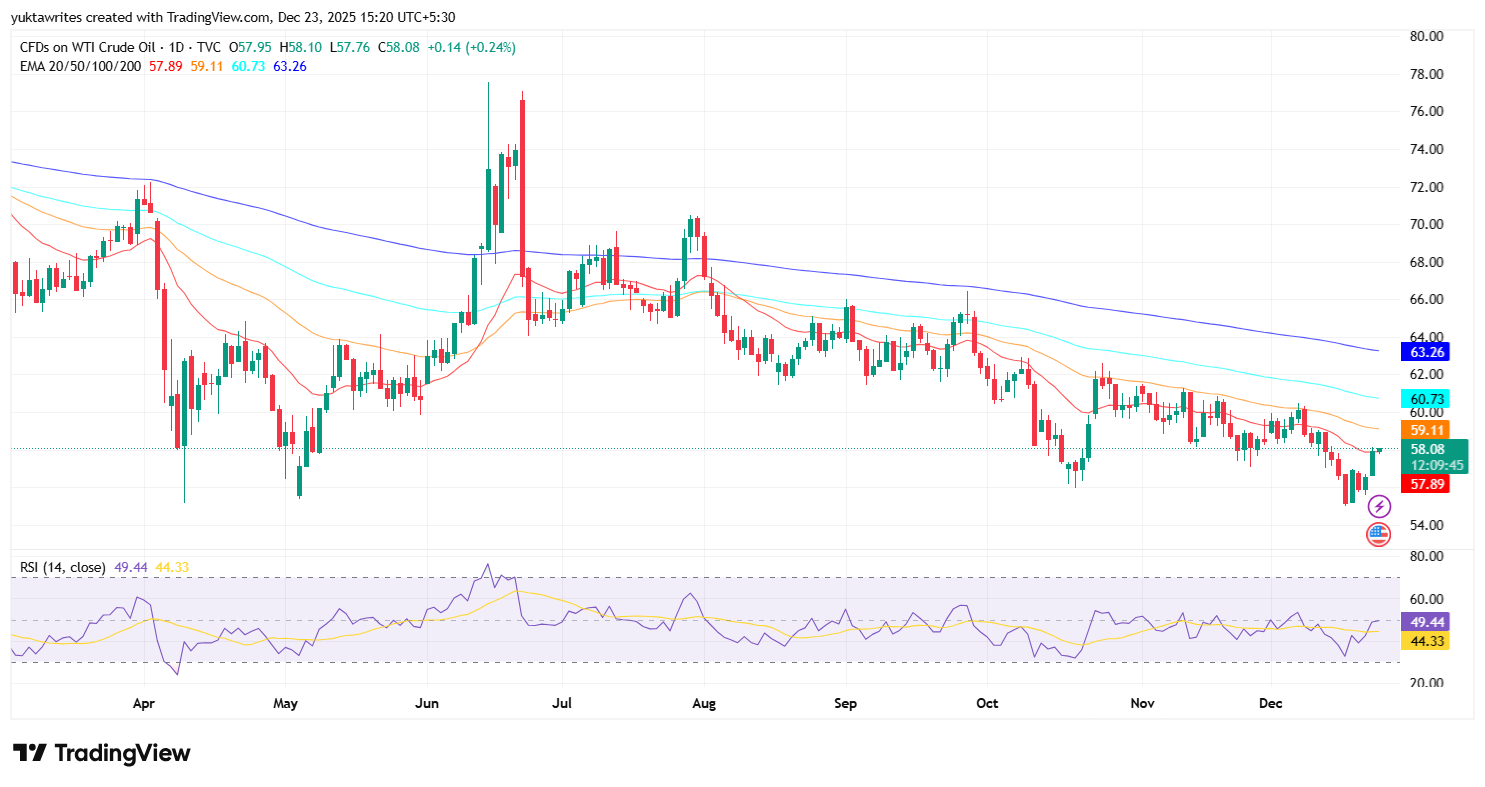
WTI crude oil price dynamics (Source: TradingView)
Momentum indicators align with this restrained outlook. The daily RSI has recovered toward the mid-range after dipping earlier in December, signaling that downside momentum has cooled but not reversed. Such readings are typical of corrective pauses rather than trend transitions. As long as RSI remains capped below higher momentum thresholds, rallies are likely to encounter selling interest rather than develop into sustained breakouts.
Shorter-term charts explain why the advance has slowed. On the 30-minute timeframe, WTI has climbed along a rising short-term structure supported by Supertrend and Parabolic SAR signals that flipped positive during the bounce. However, price is now pressing into a narrow resistance band near $58.2 to $58.4, where upside momentum has repeatedly faded. The tightening range suggests buyers are becoming more selective while sellers wait for confirmation before reasserting control.
Geopolitics provides a floor as surplus fears cap ambition
Geopolitical developments remain the primary source of near-term support. U.S. enforcement actions targeting Venezuelan oil shipments have reintroduced a modest supply-risk premium, even though Venezuela’s exports represent a limited share of global output. The symbolic impact has been more influential than the volume itself, highlighting the fragility of certain supply channels.
At the same time, ongoing Ukrainian strikes on Russian-linked energy infrastructure along the Black Sea corridor have kept traders alert to escalation risks in a region critical for global energy flows. These factors help explain why prices have stabilized despite weak underlying structure, as geopolitical hedging demand offsets some macro pessimism.
However, longer-term headwinds continue to dominate sentiment. Expectations of a growing global surplus next year, combined with uneven demand signals from major economies, have limited the market’s willingness to chase rallies. This imbalance between short-term risk premiums and longer-term supply expectations has produced incremental, corrective advances rather than impulsive upside moves supported by strong volume.
Geopolitical support and stubborn technical resistance
From a technical perspective, the $59–$60 zone remains pivotal. A decisive break and hold above this area would allow WTI to challenge descending medium-term averages and improve the technical outlook. Failure to do so would leave prices vulnerable to renewed selling, with downside risks re-emerging toward the $56 handle if geopolitical tensions ease or demand concerns resurface.
Previously, WTI’s ability to hold above the mid-$56 area was identified as critical for preventing a deeper breakdown. That support has so far held, validating the view that geopolitics can provide a temporary floor. However, without a clear reclaim of key resistance levels, the broader structure still favors range-bound trade rather than trend recovery.
In essence, crude oil is trading at the intersection of short-term risk hedging and long-term surplus fears. Geopolitical uncertainty is providing support, but technical resistance and supply expectations are capping upside ambition. Until one of these forces decisively outweighs the other, WTI is likely to remain confined to a volatile but constrained range as the year draws to a close.















-
 Afghanistan
-
 Albania
-
 Algeria
-
 Angola
-
 Argentina
-
 Armenia
-
 Australia
-
 Austria
-
 Azerbaijan
-
 Bahamas
-
 Bahrain
-
 Bangladesh
-
 Belarus
-
 Belgium
-
 Bolivia
-
 Botswana
-
 Brazil
-
 Brunei
-
 Bulgaria
-
 Cambodia
-
 Cameroon
-
 Canada
-
 Chile
Chile
-
 China
China
-
 Colombia
-
 Congo
Congo
-
 Costa Rica
-
 Cote d'Ivoire
-
 Croatia
-
 Cuba
Cuba
-
 Cyprus
-
 Czechia
-
 DR Congo
-
 Denmark
-
 Dominican Republic
-
 Ecuador
-
 Egypt
Egypt
-
 El Salvador
-
 Estonia
-
 Eswatini
-
 Ethiopia
-
 Finland
-
 France
-
 Georgia
-
 Germany
-
 Ghana
Ghana
-
 Greece
-
 Haiti
Haiti
-
 Hong Kong
-
 Hungary
-
 India
India
-
 Indonesia
-
 Iran, Islamic republic
-
 Iraq
Iraq
-
 Ireland
-
 Israel
-
 Italy
Italy
-
 Jamaica
-
 Japan
Japan
-
 Jordan
-
 Kazakhstan
-
 Kenya
Kenya
-
 Korea
Korea
-
 Kuwait
-
 Kyrgyzstan
-
 Laos
Laos
-
 Latvia
-
 Lebanon
-
 Lesotho
-
 Libya
Libya
-
 Lithuania
-
 Luxembourg
-
 Madagascar
-
 Malaysia
-
 Malta
Malta
-
 Mauritius
-
 Mexico
-
 Moldova
-
 Mongolia
-
 Montenegro
-
 Morocco
-
 Mozambique
-
 Myanmar
-
 Namibia
-
 Nepal
Nepal
-
 Netherlands
-
 New Zealand
-
 Nigeria
-
 North Macedonia
-
 Norway
-
 Oman
Oman
-
 Pakistan
-
 Palestine
-
 Panama
-
 Papua New Guinea
-
 Paraguay
-
 Peru
Peru
-
 Philippines
-
 Poland
-
 Portugal
-
 Puerto Rico
-
 Qatar
Qatar
-
 Reunion
-
 Romania
-
 Rwanda
-
 Saudi Arabia
-
 Serbia
-
 Singapore
-
 Slovakia
-
 Slovenia
-
 Somalia
-
 South Africa
-
 Spain
Spain
-
 Sri Lanka
-
 Sweden
-
 Switzerland
-
 Syria
Syria
-
 Taiwan
-
 Tajikistan
-
 Tanzania
-
 Thailand
-
 Trinidad and Tobago
-
 Tunisia
-
 Turkey
-
 UAE
UAE
-
 Uganda
-
 Ukraine
-
 United Kingdom
-
United States
-
 Uruguay
-
 Uzbekistan
-
 Venezuela
-
 Vietnam
-
 Yemen
Yemen
-
 Zambia
-
 Zimbabwe
- Forex
- Crypto












