
Apple stock price steadies near $266 as traders respond to risk sentiment

Apple (AAPL) shares edged higher this Tuesday, holding above a closely watched support area as investors balanced a fresh turn in U.S. trade policy against a market that has become increasingly sensitive to small moves in interest rates.
Highlights
- Apple traded around $266, extending a modest rebound after a volatile stretch for megacap tech.
- Policy headlines kept the spotlight on how tariffs could filter into costs and demand, even as the initial rate was set lower than first signaled.
- Traders kept $260 in view as the near-term line that has shaped dip-buying and stop placement in recent sessions.
Price action stays tethered to levels, not momentum
Apple was last near $266 this Tuesday, up modestly on the session as the stock continued to orbit the mid-$260 area that has acted as a decision zone for short-term accounts.The broader tape stayed rate-aware. The U.S. 10-year Treasury yield hovered around 4.03%, leaving equities to trade off incremental shifts in discount-rate pressure rather than a single dominant catalyst.
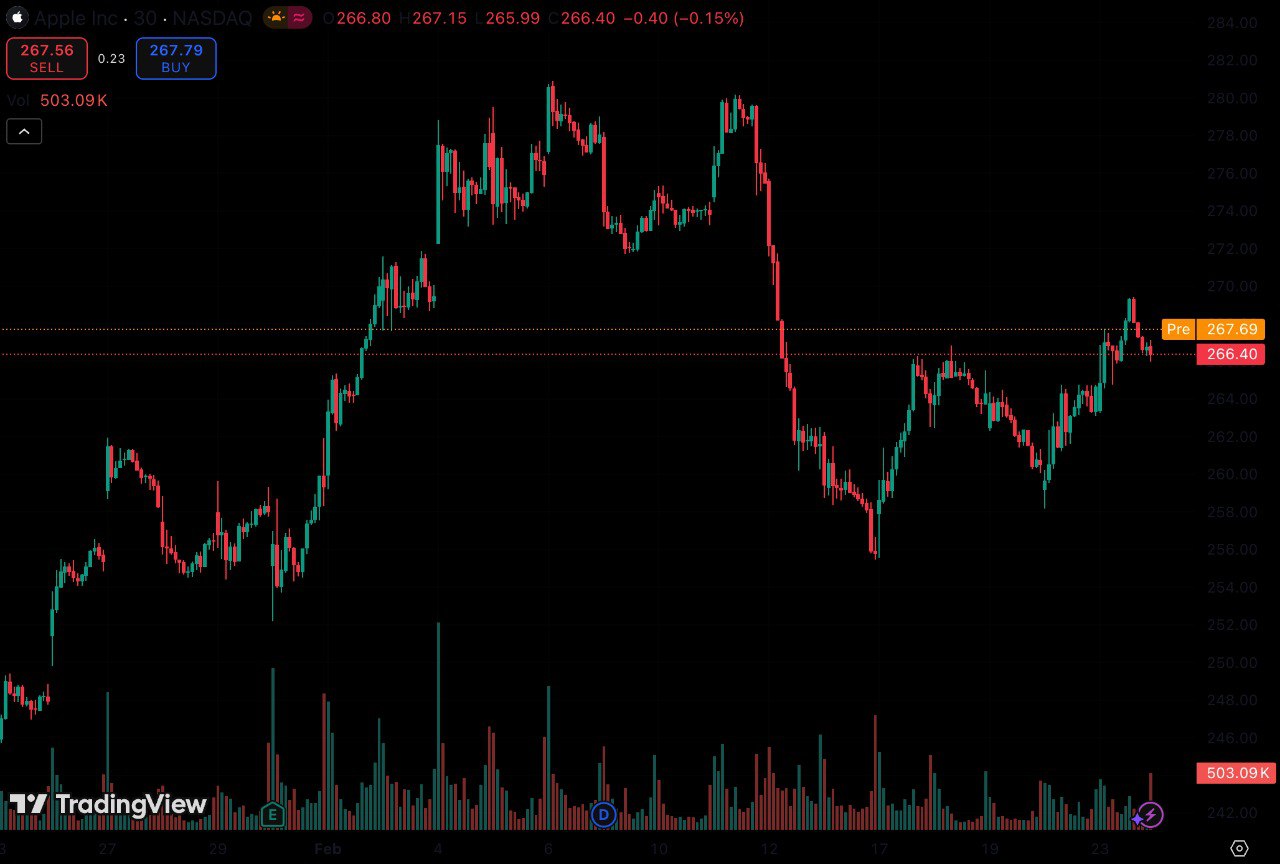
APPL price dynamics (January - February 2026). Source: TradingView.
Technically, traders tend to see the setup as level-driven: holding above $260 keeps the latest bounce intact, while a slip back through that area would raise the odds of a retest toward the mid-$250s, where buyers have previously shown up.
Policy and rates set the tone
Tariffs are important for Apple less as a longer-term input into expectations for margins and demand. If companies and consumers start delaying upgrades or pushing back on prices, investors will build that into their forecasts.
Rates are still the daily volume knob. When bond yields are steady, investors usually accept higher valuations for big, cash-rich tech. When yields rise fast, those same stocks can reprice lower as the market asks for more proof that growth will hold up.
Company catalysts in focus
On the Apple-specific calendar, investors are watching for early-March product-related news flow, which can influence near-term positioning even when it does not change long-run earnings power.
AI remains a recurring narrative driver. Reporting in February kept attention on whether some Siri-related upgrades could land later than previously expected, reinforcing the idea that Apple’s feature cadence, not just its hardware cycle, can move sentiment at the margin.
Regulation stayed in the background but did not disappear. Europe’s Digital Markets Act continues to reshape iOS distribution rules, and recent coverage of alternative app-store options underscored how platform policy can influence the services debate over time.
Week data watch
Macro traders are also looking past the immediate tariff headlines to the next PCE inflation update, the Fed’s preferred inflation gauge, scheduled for March 13, which can shift expectations for the path of rates into month-end.
Even without a same-day release, “PCE week” framing tends to raise sensitivity to any data that nudges rate pricing, because a higher-for-longer interpretation can lift yields and pressure valuation-heavy equities.
For Apple, that makes the near-term mix straightforward: a steady yield backdrop supports the stock’s attempt to hold above $260, while any renewed spike in rates or policy uncertainty could quickly turn the trade back into a test of lower support zones.
Meanwhile, Apple shares halted their decline last week and ended the seven-day period with a modest gain of about 1%, as the company announced a product presentation in early March that could impact the stock price.









-
 Afghanistan
-
 Albania
-
 Algeria
-
 Angola
-
 Argentina
-
 Armenia
-
 Australia
-
 Austria
-
 Azerbaijan
-
 Bahamas
-
 Bahrain
-
 Bangladesh
-
 Belarus
-
 Belgium
-
 Bolivia
-
 Botswana
-
 Brazil
-
 Brunei
-
 Bulgaria
-
 Cambodia
-
 Cameroon
-
 Canada
-
 Chile
Chile
-
 China
China
-
 Colombia
-
 Congo
Congo
-
 Costa Rica
-
 Cote d'Ivoire
-
 Croatia
-
 Cuba
Cuba
-
 Cyprus
-
 Czechia
-
 DR Congo
-
 Denmark
-
 Dominican Republic
-
 Ecuador
-
 Egypt
Egypt
-
 El Salvador
-
 Estonia
-
 Eswatini
-
 Ethiopia
-
 Finland
-
 France
-
 Georgia
-
 Germany
-
 Ghana
Ghana
-
 Greece
-
 Haiti
Haiti
-
 Hong Kong
-
 Hungary
-
 India
India
-
 Indonesia
-
 Iran, Islamic republic
-
 Iraq
Iraq
-
 Ireland
-
 Israel
-
 Italy
Italy
-
 Jamaica
-
 Japan
Japan
-
 Jordan
-
 Kazakhstan
-
 Kenya
Kenya
-
 Korea
Korea
-
 Kuwait
-
 Kyrgyzstan
-
 Laos
Laos
-
 Latvia
-
 Lebanon
-
 Lesotho
-
 Libya
Libya
-
 Lithuania
-
 Luxembourg
-
 Madagascar
-
 Malaysia
-
 Malta
Malta
-
 Mauritius
-
 Mexico
-
 Moldova
-
 Mongolia
-
 Montenegro
-
 Morocco
-
 Mozambique
-
 Myanmar
-
 Namibia
-
 Nepal
Nepal
-
 Netherlands
-
 New Zealand
-
 Nigeria
-
 North Macedonia
-
 Norway
-
 Oman
Oman
-
 Pakistan
-
 Palestine
-
 Panama
-
 Papua New Guinea
-
 Paraguay
-
 Peru
Peru
-
 Philippines
-
 Poland
-
 Portugal
-
 Puerto Rico
-
 Qatar
Qatar
-
 Reunion
-
 Romania
-
 Rwanda
-
 Saudi Arabia
-
 Serbia
-
 Singapore
-
 Slovakia
-
 Slovenia
-
 Somalia
-
 South Africa
-
 Spain
Spain
-
 Sri Lanka
-
 Sweden
-
 Switzerland
-
 Syria
Syria
-
 Taiwan
-
 Tajikistan
-
 Tanzania
-
 Thailand
-
 Trinidad and Tobago
-
 Tunisia
-
 Turkey
-
 UAE
UAE
-
 Uganda
-
 Ukraine
-
 United Kingdom
-
United States
-
 Uruguay
-
 Uzbekistan
-
 Venezuela
-
 Vietnam
-
 Yemen
Yemen
-
 Zambia
-
 Zimbabwe
- Forex
- Crypto











