

Tesla stock falls 5.8% despite Musk's plan to build two chip factories
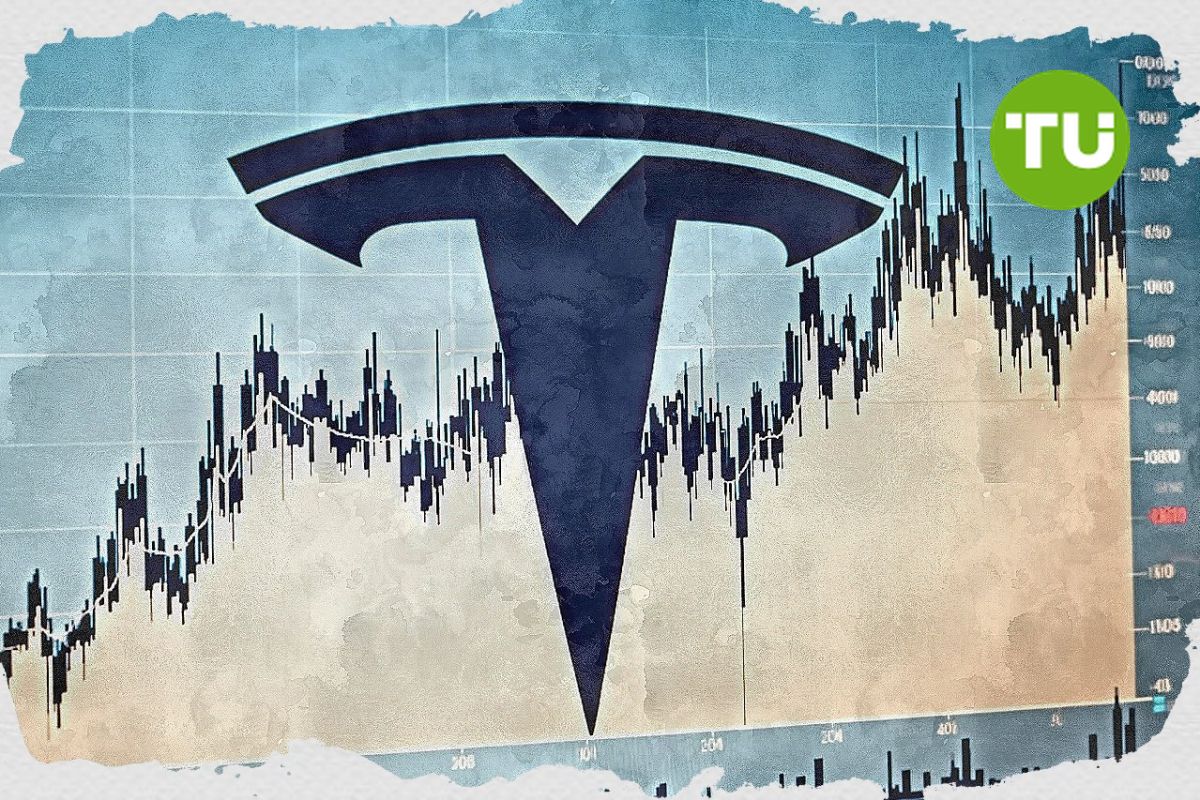
Positive news around Tesla does not have a significant impact on TSLA dynamics. As of March 23, Tesla stock is trading at $358.71, down 5.8% over the past 24 hours. The shares were rejected from the $400 resistance zone, confirming the short-term bearish structure.
Highlights
- Tesla shares have entered a downtrend, breaking below key technical levels with the possibility of further decline toward $340 if selling pressure persists.
- Elon Musk’s Terafab plan to build chip factories with SpaceX contributes to the development of Tesla’s long-term AI and supply chain strategy but introduces significant execution and capital risks.
- Near-term sentiment remains twofold as markets prioritize technical weakness and uncertainty over the long-term strategic upside.
Price action over the past week shows a sequence of lower highs and bears’ growing dominance. The stock has also approached the lower bound of its recent trading range. The immediate support is observed around $355–360. A break below this area may lead to testing the next key support at $340. It is followed by a deeper structural level near the 200-day moving average around $330.
Momentum indicators confirm the negative dynamics. The Relative Strength Index has dropped toward the low-40s. This implies weakening demand without reaching oversold territory. This suggests there is still possibility of further downside before technical exhaustion reaches its maximum. Volume trends also point to distribution, with heavier selling pressure on down sessions.

Tesla stock performance (January 2026 – March 2026). Source: TradingView.
To reverse the bearish setup, Tesla may need to reclaim $380 in the near term. A more meaningful trend shift may be confirmed only above $400. Until then, the technical outlook remains skewed to the downside.
Terafab strategy expands into dual-fab AI infrastructure
Elon Musk has significantly expanded the scope of Tesla’s semiconductor ambitions. This confirms that the proposed “Terafab” complex in Austin will consist of two dedicated chip fabrication plants. Each facility will focus on a single chip design: one tailored for Tesla’s core ecosystem, and another aimed at powering artificial intelligence infrastructure. The latter includes data centers and space-based applications. This marks a shift from Tesla’s earlier chip strategy toward a vertically integrated AI hardware model.
A key new element is SpaceX’s involvement, which remained undisclosed previously. The integration reflects Musk’s effort to align Tesla, SpaceX, and xAI into a computing and AI ecosystem. Musk described existing global chip production capacity as being insufficient to meet the future needs of his companies. He stated that internal production tends to become a necessity rather than an option.
The scale of the project is substantial, with Musk targeting output of one terawatt of computing capacity annually. This is twice as high as the current total U.S. capacity. However, the absence of a clear timeline and Musk’s history of delayed execution cause market uncertainty. While the initiative reinforces Tesla’s long-term positioning in AI and robotics, it also raises immediate concerns around capital intensity and other issues.
Price outlook suggests further downside toward $340
The short-term outlook for Tesla remains fragile, and the most probable scenario refers to continued consolidation with a downward bias. If the $355–360 support zone fails to hold, the next target lies at $340. This represents a key technical pivot and prior demand area. This implies an additional 4–6% downside risk from current levels.
In a more bearish scenario, Tesla may extend losses toward the $320–330 region. This aligns with the 200-day moving average. This level would likely attract stronger buying interest and serve as a medium-term support base.
Tesla will continue relying on Nvidia chips in the near term while developing its own next-generation AI5 processor. This reflects a strategy to gradually reduce dependency through vertical integration without disrupting its current AI infrastructure.








-
 Afghanistan
-
 Albania
-
 Algeria
-
 Angola
-
 Argentina
-
 Armenia
-
 Australia
-
 Austria
-
 Azerbaijan
-
 Bahamas
-
 Bahrain
-
 Bangladesh
-
 Belarus
-
 Belgium
-
 Bolivia
-
 Botswana
-
 Brazil
-
 Brunei
-
 Bulgaria
-
 Cambodia
-
 Cameroon
-
 Canada
-
 Chile
Chile
-
 China
China
-
 Colombia
-
 Congo
Congo
-
 Costa Rica
-
 Cote d'Ivoire
-
 Croatia
-
 Cuba
Cuba
-
 Cyprus
-
 Czechia
-
 DR Congo
-
 Denmark
-
 Dominican Republic
-
 Ecuador
-
 Egypt
Egypt
-
 El Salvador
-
 Estonia
-
 Eswatini
-
 Ethiopia
-
 Finland
-
 France
-
 Georgia
-
 Germany
-
 Ghana
Ghana
-
 Greece
-
 Haiti
Haiti
-
 Hong Kong
-
 Hungary
-
 India
India
-
 Indonesia
-
 Iran, Islamic republic
-
 Iraq
Iraq
-
 Ireland
-
 Israel
-
 Italy
Italy
-
 Jamaica
-
 Japan
Japan
-
 Jordan
-
 Kazakhstan
-
 Kenya
Kenya
-
 Korea
Korea
-
 Kuwait
-
 Kyrgyzstan
-
 Laos
Laos
-
 Latvia
-
 Lebanon
-
 Lesotho
-
 Libya
Libya
-
 Lithuania
-
 Luxembourg
-
 Madagascar
-
 Malaysia
-
 Malta
Malta
-
 Mauritius
-
 Mexico
-
 Moldova
-
 Mongolia
-
 Montenegro
-
 Morocco
-
 Mozambique
-
 Myanmar
-
 Namibia
-
 Nepal
Nepal
-
 Netherlands
-
 New Zealand
-
 Nigeria
-
 North Macedonia
-
 Norway
-
 Oman
Oman
-
 Pakistan
-
 Palestine
-
 Panama
-
 Papua New Guinea
-
 Paraguay
-
 Peru
Peru
-
 Philippines
-
 Poland
-
 Portugal
-
 Puerto Rico
-
 Qatar
Qatar
-
 Reunion
-
 Romania
-
 Rwanda
-
 Saudi Arabia
-
 Serbia
-
 Singapore
-
 Slovakia
-
 Slovenia
-
 Somalia
-
 South Africa
-
 Spain
Spain
-
 Sri Lanka
-
 Sweden
-
 Switzerland
-
 Syria
Syria
-
 Taiwan
-
 Tajikistan
-
 Tanzania
-
 Thailand
-
 Trinidad and Tobago
-
 Tunisia
-
 Turkey
-
 UAE
UAE
-
 Uganda
-
 Ukraine
-
 United Kingdom
-
United States
-
 Uruguay
-
 Uzbekistan
-
 Venezuela
-
 Vietnam
-
 Yemen
Yemen
-
 Zambia
-
 Zimbabwe
- Forex
- Crypto












