
Nvidia's rally heads into crucial test next week
After months of relentless gains, investors are beginning to question whether the current valuations of the largest AI companies are justified by their future financial performance.
Additional pressure on the sector is coming from elevated U.S. Treasury yields, the risk of tighter Federal Reserve policy, and the year's largest IPO SpaceX — which is temporarily drawing liquidity away from the technology sector.
The coming week will be another important test for Nvidia. The last time the stock declined for four consecutive weeks was in November 2025. That period was followed by consolidation and a renewed rally. The key question now is whether Nvidia can repeat that pattern.
Bearish divergence puts Nvidia's rally to the test
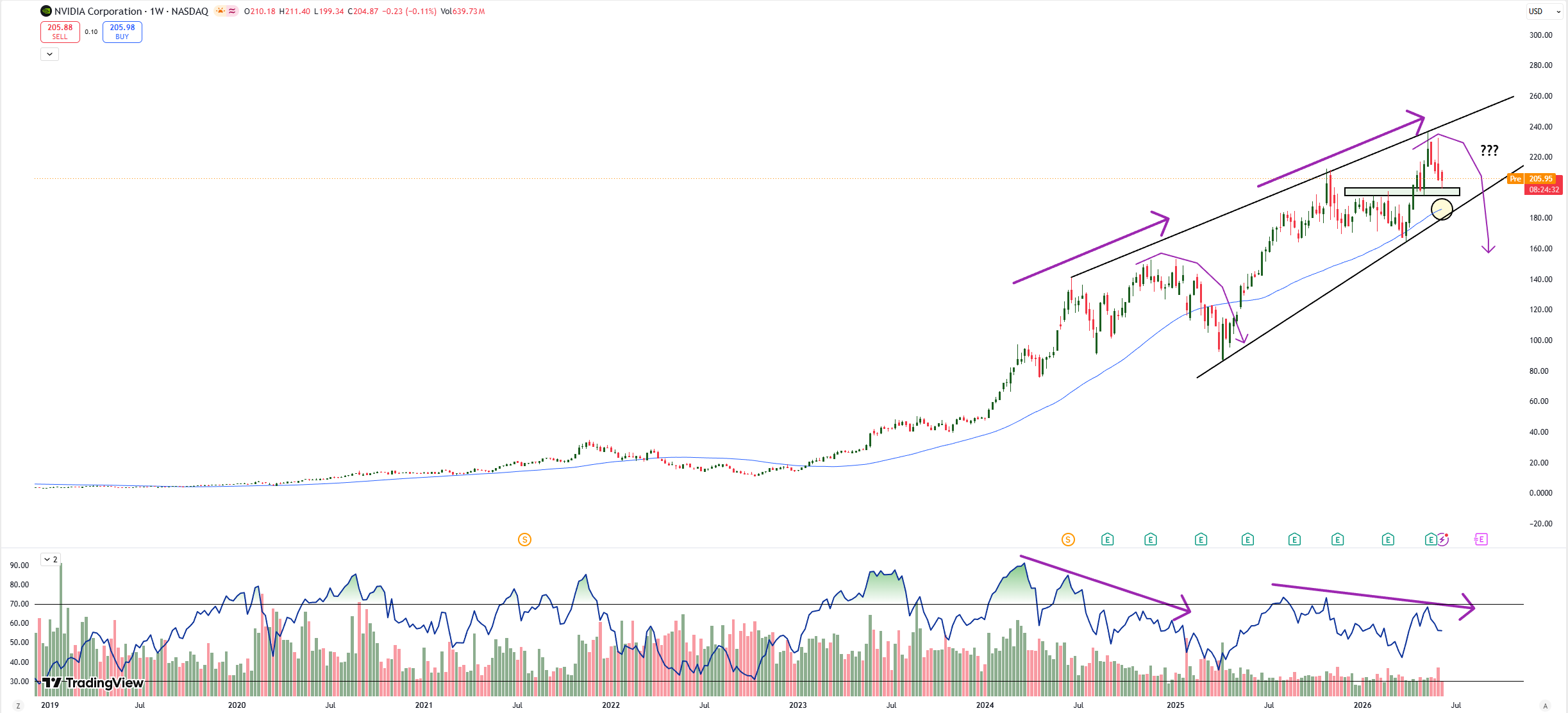
From a technical perspective, Nvidia is showing several bearish signals on the weekly chart.A long-term rising wedge — a classic trend reversal pattern — has formed over recent months.
In addition, the RSI clearly displays a bearish divergence. The previous time a similar divergence appeared, Nvidia shares eventually declined by more than 40%. That divergence developed over roughly nine months, which is similar to the current setup.
The key support zone for next week lies between $195 and $200. A break below this area would open the path toward the 50-week simple moving average (SMA) near $186, where a major trendline support is also located.
However, such a scenario appears unlikely in the short term and should be viewed as a medium-term target. A more probable outcome is a period of consolidation within the $205–$215 range as the market takes a breather after months of gains.
Investors demand proof, not promises
A significant portion of earnings growth reported by major technology companies in recent quarters has come not from core business operations but from the revaluation of stakes in private companies such as OpenAI, Anthropic, and SpaceX.
In addition, corporate profits have benefited from tax incentives and accelerated depreciation policies, which temporarily reduced tax expenses for many companies.
Investors are beginning to recognize that some of the factors supporting earnings growth and AI-sector valuations may have been one-off benefits rather than sustainable long-term drivers.
For Nvidia, this means that even strong quarterly results may no longer generate the same market reaction seen over the past two years.
The company's next earnings report, scheduled for August 26, could become a critical test of whether current AI-sector valuations are supported by underlying financial performance.




Latest NVDA News






-
 Afghanistan
-
 Albania
-
 Algeria
-
 Angola
-
 Argentina
-
 Armenia
-
 Australia
-
 Austria
-
 Azerbaijan
-
 Bahamas
-
 Bahrain
-
 Bangladesh
-
 Belarus
-
 Belgium
-
 Bolivia
-
 Botswana
-
 Brazil
-
 Brunei
-
 Bulgaria
-
 Cambodia
-
 Cameroon
-
 Canada
-
 Chile
Chile
-
 China
China
-
 Colombia
-
 Congo
Congo
-
 Costa Rica
-
 Cote d'Ivoire
-
 Croatia
-
 Cuba
Cuba
-
 Cyprus
-
 Czechia
-
 DR Congo
-
 Denmark
-
 Dominican Republic
-
 Ecuador
-
 Egypt
Egypt
-
 El Salvador
-
 Estonia
-
 Eswatini
-
 Ethiopia
-
 Finland
-
 France
-
 Georgia
-
 Germany
-
 Ghana
Ghana
-
 Greece
-
 Haiti
Haiti
-
 Hong Kong
-
 Hungary
-
 India
India
-
 Indonesia
-
 Iran, Islamic republic
-
 Iraq
Iraq
-
 Ireland
-
 Israel
-
 Italy
Italy
-
 Jamaica
-
 Japan
Japan
-
 Jordan
-
 Kazakhstan
-
 Kenya
Kenya
-
 Korea
Korea
-
 Kuwait
-
 Kyrgyzstan
-
 Laos
Laos
-
 Latvia
-
 Lebanon
-
 Lesotho
-
 Libya
Libya
-
 Lithuania
-
 Luxembourg
-
 Madagascar
-
 Malaysia
-
 Malta
Malta
-
 Mauritius
-
 Mexico
-
 Moldova
-
 Mongolia
-
 Montenegro
-
 Morocco
-
 Mozambique
-
 Myanmar
-
 Namibia
-
 Nepal
Nepal
-
 Netherlands
-
 New Zealand
-
 Nigeria
-
 North Macedonia
-
 Norway
-
 Oman
Oman
-
 Pakistan
-
 Palestine
-
 Panama
-
 Papua New Guinea
-
 Paraguay
-
 Peru
Peru
-
 Philippines
-
 Poland
-
 Portugal
-
 Puerto Rico
-
 Qatar
Qatar
-
 Reunion
-
 Romania
-
 Rwanda
-
 Saudi Arabia
-
 Serbia
-
 Singapore
-
 Slovakia
-
 Slovenia
-
 Somalia
-
 South Africa
-
 Spain
Spain
-
 Sri Lanka
-
 Sweden
-
 Switzerland
-
 Syria
Syria
-
 Taiwan
-
 Tajikistan
-
 Tanzania
-
 Thailand
-
 Trinidad and Tobago
-
 Tunisia
-
 Turkey
-
 UAE
UAE
-
 Uganda
-
 Ukraine
-
 United Kingdom
-
United States
-
 Uruguay
-
 Uzbekistan
-
 Venezuela
-
 Vietnam
-
 Yemen
Yemen
-
 Zambia
-
 Zimbabwe
- Forex
- Crypto












