
Azure cloud growth slowdown pressures Microsoft stock lower

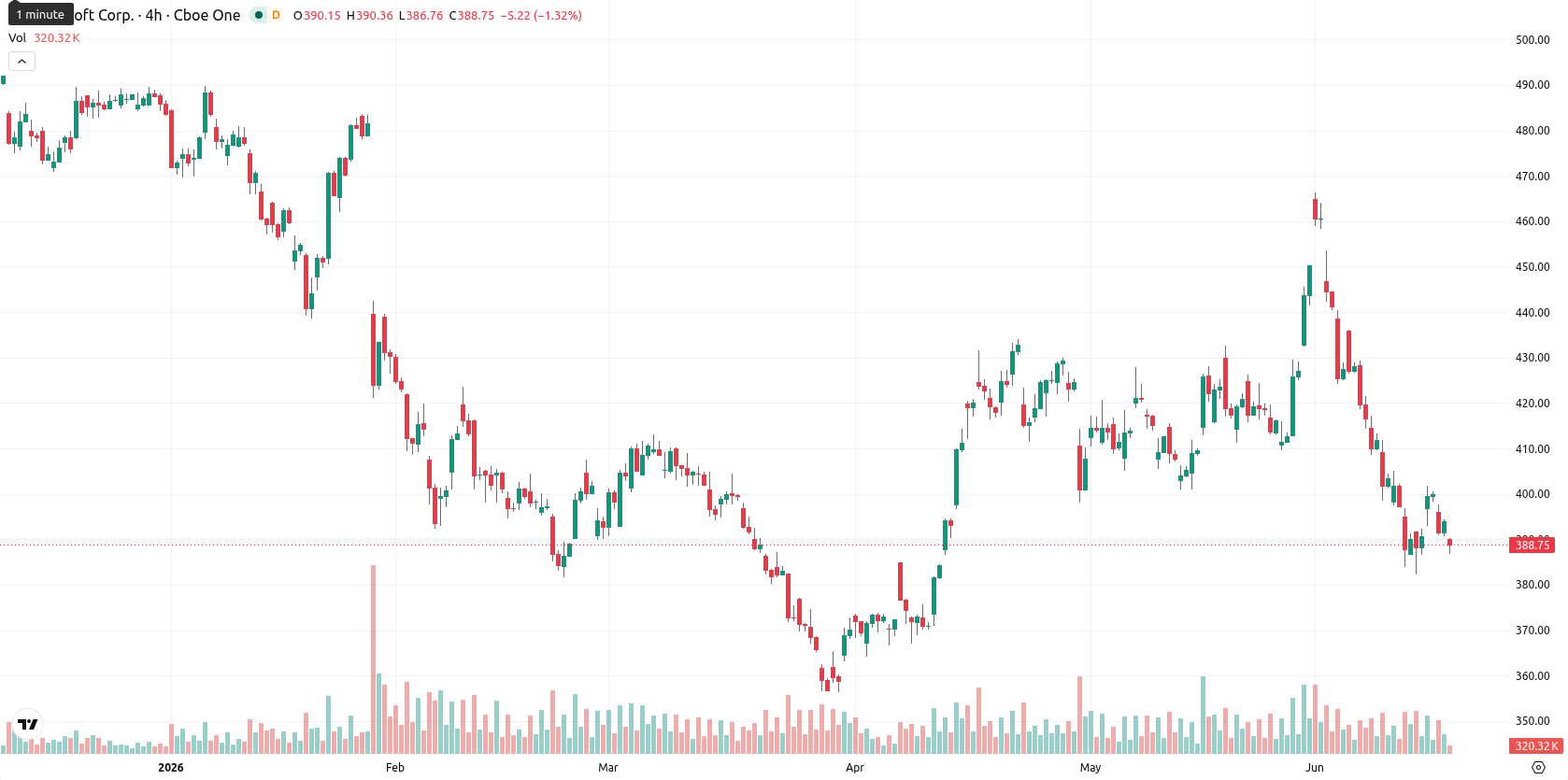
Microsoft Corp. (MSFT) stock is trading at $392.98 after falling 1.7% on the day, holding below its key moving averages. The current setup points to sustained selling momentum against a backdrop of moderate volatility.
 388.66
401.75
388.66
401.75
Highlights
- Microsoft's latest earnings showed Azure cloud growth slowing sharply as AI infrastructure investments surged, pressuring margins and raising sustainability concerns.
- A shareholder class action was filed over undisclosed Azure and AI expenditure risks, increasing regulatory and legal uncertainty for Microsoft.
- MSFT trades below key moving averages with strong downside momentum; a high-probability decline is expected within the $381.80 to $404.17 range unless immediate resistance is breached.
Margin concerns and legal risk as Azure growth slows, AI costs rise
Microsoft's latest quarterly earnings, released on January 29, revealed a sharp deceleration in Azure cloud growth and significantly increased AI infrastructure spending as resources were redirected to research and development. These results signaled both margin pressure and concerns over the sustainability of Microsoft’s core growth drivers, directly influencing investor sentiment. Additionally, on June 12, a shareholder class action lawsuit was filed in Seattle federal court, alleging that Microsoft failed to adequately disclose Azure performance and AI capital expenditure strains, heightening the prospect of regulatory scrutiny and legal risk for the company.
Bearish bias and contained selling as momentum signals diverge
MSFT is currently trading beneath its MA-20, MA-50, and MA-200 levels. On the daily timeframe, the Ichimoku Kijun sits at $424.29, now acting as immediate resistance, while the $381.80 level provides support for the near term. Momentum indicators such as MACD and ADX both display a Sell bias with moderate volatility. Oscillators including RSI and CCI remain in Sell territory. BBP also shows the market as oversold, confirming seller dominance during intraday sessions. Stoch RSI, however, points to a potential oversold bounce, while the Awesome Oscillator is neutral. Notably, MSFT opened with a sizable gap of 7.33 points and settled mid-range on the day, suggesting bearish but contained selling activity. Divergence in Stoch RSI's brief Buy signal contrasts with the otherwise negative momentum picture.
Further downside risk likely as stock trades within lower range
In the next 2–3 trading days, MSFT is expected to trade between $381.80 and $404.17, reflecting typical volatility bands at current levels. The most likely scenario is for the stock to stay in a sideways range, with a significantly higher probability of further declines compared to an upward move. A bullish move would require a break above immediate resistance at the Kijun level, while a close below $381.80 would suggest increased downside risk.
Earlier, analysts noted that while Microsoft remained a leading AI story with a broadly constructive long-term outlook, short-term sentiment was weighed down by rising capital expenditures, questions around AI monetization, and headline risks in cloud and gaming segments. The latest earnings-driven slowdown in Azure growth and fresh legal challenges now add pressure, making sustained price stabilization above immediate resistance a critical signal for any reversal of current downside momentum.





Latest Microsoft News









-
 Afghanistan
-
 Albania
-
 Algeria
-
 Angola
-
 Argentina
-
 Armenia
-
 Australia
-
 Austria
-
 Azerbaijan
-
 Bahamas
-
 Bahrain
-
 Bangladesh
-
 Belarus
-
 Belgium
-
 Bolivia
-
 Botswana
-
 Brazil
-
 Brunei
-
 Bulgaria
-
 Cambodia
-
 Cameroon
-
 Canada
-
 Chile
Chile
-
 China
China
-
 Colombia
-
 Congo
Congo
-
 Costa Rica
-
 Cote d'Ivoire
-
 Croatia
-
 Cuba
Cuba
-
 Cyprus
-
 Czechia
-
 DR Congo
-
 Denmark
-
 Dominican Republic
-
 Ecuador
-
 Egypt
Egypt
-
 El Salvador
-
 Estonia
-
 Eswatini
-
 Ethiopia
-
 Finland
-
 France
-
 Georgia
-
 Germany
-
 Ghana
Ghana
-
 Greece
-
 Haiti
Haiti
-
 Hong Kong
-
 Hungary
-
 India
India
-
 Indonesia
-
 Iran, Islamic republic
-
 Iraq
Iraq
-
 Ireland
-
 Israel
-
 Italy
Italy
-
 Jamaica
-
 Japan
Japan
-
 Jordan
-
 Kazakhstan
-
 Kenya
Kenya
-
 Korea
Korea
-
 Kuwait
-
 Kyrgyzstan
-
 Laos
Laos
-
 Latvia
-
 Lebanon
-
 Lesotho
-
 Libya
Libya
-
 Lithuania
-
 Luxembourg
-
 Madagascar
-
 Malaysia
-
 Malta
Malta
-
 Mauritius
-
 Mexico
-
 Moldova
-
 Mongolia
-
 Montenegro
-
 Morocco
-
 Mozambique
-
 Myanmar
-
 Namibia
-
 Nepal
Nepal
-
 Netherlands
-
 New Zealand
-
 Nigeria
-
 North Macedonia
-
 Norway
-
 Oman
Oman
-
 Pakistan
-
 Palestine
-
 Panama
-
 Papua New Guinea
-
 Paraguay
-
 Peru
Peru
-
 Philippines
-
 Poland
-
 Portugal
-
 Puerto Rico
-
 Qatar
Qatar
-
 Reunion
-
 Romania
-
 Rwanda
-
 Saudi Arabia
-
 Serbia
-
 Singapore
-
 Slovakia
-
 Slovenia
-
 Somalia
-
 South Africa
-
 Spain
Spain
-
 Sri Lanka
-
 Sweden
-
 Switzerland
-
 Syria
Syria
-
 Taiwan
-
 Tajikistan
-
 Tanzania
-
 Thailand
-
 Trinidad and Tobago
-
 Tunisia
-
 Turkey
-
 UAE
UAE
-
 Uganda
-
 Ukraine
-
 United Kingdom
-
United States
-
 Uruguay
-
 Uzbekistan
-
 Venezuela
-
 Vietnam
-
 Yemen
Yemen
-
 Zambia
-
 Zimbabwe
- Forex
- Crypto












