


AI-driven chip demand is reshaping the competitive order across the semiconductor sector, pushing Micron to the top of Wall Street's margin rankings. The rally also lifts Qualcomm and turns attention to SK Hynix's planned Nasdaq ADR listing, while easing U.S.-Iran tensions pull oil prices lower.
Highlights
- Micron posts an 84.9% gross margin in its latest quarter, surpassing Meta's 81.9% and Nvidia's 75%, with shares jumping 15% on AI-driven demand.
- Qualcomm rises 15% after raising its fiscal 2029 non-handset revenue forecast to $40 billion, as Meta adopts its Dragonfly C1000 CPU for agentic AI use starting 2028.
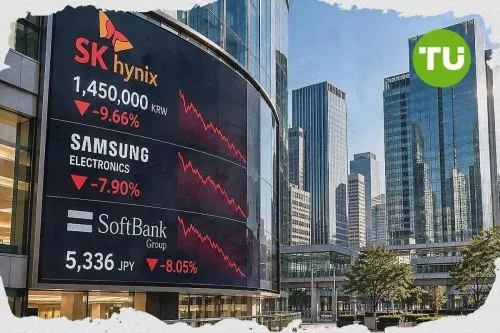
- SK Hynix files for a Nasdaq ADR listing potentially worth up to $29.4 billion, with shares up 11% after overtaking Samsung Electronics in market value.
Chipmakers gain on margins, forecasts and listing plans
As reported by CNBC, Micron posts a gross margin of 84.9% in its latest quarter, up from 74.9% in the prior period and 39% a year earlier, overtaking Meta's latest 81.9% and Nvidia's 75%. Its shares jump 15% on Wednesday as demand for high-bandwidth memory continues to benefit from the buildout of AI infrastructure.Qualcomm also rises 15% after raising its forecast for non-handset revenue in fiscal 2029 to $40 billion from a previous projection of $22 billion. The company says it is pushing further into data centers with its Dragonfly C1000 central processing unit, which Meta is set to use when production begins in 2028, with the chip positioned for agentic AI applications and energy efficiency.
In South Korea, SK Hynix files for a Nasdaq ADR listing that could be worth up to $29.4 billion, reportedly the second-largest U.S. share sale on record after SpaceX. The move comes after the company briefly surpasses Samsung Electronics as Seoul's most valuable firm, and its shares rise as much as 11% in Thursday trading.
Oil retreat and Iran funding debate cloud wider market backdrop
Outside technology, oil prices continue to fall as tensions between the U.S. and Iran ease and ship traffic resumes through the Strait of Hormuz. More than 20 oil tankers carrying 35 million barrels have exited the waterway since the two sides agree to open the sea lane, and U.S. crude futures drop below $70 for the first time since March.President Donald Trump says Iran tells him there will be no tolls, insurance costs or other charges for ships using the strait. He also says unfrozen Iranian assets will be used to buy U.S. agricultural products, a position repeated by Treasury Secretary Scott Bessent.
Iranian officials reject the idea that Washington or its partners will dictate how the country spends those assets, saying any farm purchases depend on price and quality rather than U.S.-imposed terms. The White House also sends Congress a request for $87.6 billion in supplemental funding for the Iran war and farm aid, a proposal that faces immediate opposition from congressional Democrats.
In our earlier coverage of Micron’s AI-driven memory squeeze, we explained how surging demand for high-bandwidth memory was tightening supply and pushing prices higher across data centers and devices. That piece highlighted Micron’s record 84.9% gross margin alongside sharply higher revenue and profits, and noted the company’s view that tight conditions could persist beyond 2027, supported by longer-term customer agreements.





Latest SK Hynix News



-
 Afghanistan
-
 Albania
-
 Algeria
-
 Angola
-
 Argentina
-
 Armenia
-
 Australia
-
 Austria
-
 Azerbaijan
-
 Bahamas
-
 Bahrain
-
 Bangladesh
-
 Belarus
-
 Belgium
-
 Bolivia
-
 Botswana
-
 Brazil
-
 Brunei
-
 Bulgaria
-
 Cambodia
-
 Cameroon
-
 Canada
-
 Chile
Chile
-
 China
China
-
 Colombia
-
 Congo
Congo
-
 Costa Rica
-
 Cote d'Ivoire
-
 Croatia
-
 Cuba
Cuba
-
 Cyprus
-
 Czechia
-
 DR Congo
-
 Denmark
-
 Dominican Republic
-
 Ecuador
-
 Egypt
Egypt
-
 El Salvador
-
 Estonia
-
 Eswatini
-
 Ethiopia
-
 Finland
-
 France
-
 Georgia
-
 Germany
-
 Ghana
Ghana
-
 Greece
-
 Haiti
Haiti
-
 Hong Kong
-
 Hungary
-
 India
India
-
 Indonesia
-
 Iran, Islamic republic
-
 Iraq
Iraq
-
 Ireland
-
 Israel
-
 Italy
Italy
-
 Jamaica
-
 Japan
Japan
-
 Jordan
-
 Kazakhstan
-
 Kenya
Kenya
-
 Korea
Korea
-
 Kuwait
-
 Kyrgyzstan
-
 Laos
Laos
-
 Latvia
-
 Lebanon
-
 Lesotho
-
 Libya
Libya
-
 Lithuania
-
 Luxembourg
-
 Madagascar
-
 Malaysia
-
 Malta
Malta
-
 Mauritius
-
 Mexico
-
 Moldova
-
 Mongolia
-
 Montenegro
-
 Morocco
-
 Mozambique
-
 Myanmar
-
 Namibia
-
 Nepal
Nepal
-
 Netherlands
-
 New Zealand
-
 Nigeria
-
 North Macedonia
-
 Norway
-
 Oman
Oman
-
 Pakistan
-
 Palestine
-
 Panama
-
 Papua New Guinea
-
 Paraguay
-
 Peru
Peru
-
 Philippines
-
 Poland
-
 Portugal
-
 Puerto Rico
-
 Qatar
Qatar
-
 Reunion
-
 Romania
-
 Rwanda
-
 Saudi Arabia
-
 Serbia
-
 Singapore
-
 Slovakia
-
 Slovenia
-
 Somalia
-
 South Africa
-
 Spain
Spain
-
 Sri Lanka
-
 Sweden
-
 Switzerland
-
 Syria
Syria
-
 Taiwan
-
 Tajikistan
-
 Tanzania
-
 Thailand
-
 Trinidad and Tobago
-
 Tunisia
-
 Turkey
-
 UAE
UAE
-
 Uganda
-
 Ukraine
-
 United Kingdom
-
United States
-
 Uruguay
-
 Uzbekistan
-
 Venezuela
-
 Vietnam
-
 Yemen
Yemen
-
 Zambia
-
 Zimbabwe
- Forex
- Crypto












