
WTI crude oil holds near $58 as supply glut fears deepen and sellers retain control

WTI crude oil continued its slide on Wednesday, hovering just above $58 per barrel after breaking below key technical and psychological support zones. The selloff, which drove prices to their lowest level since May, reflects both a structural breakdown on the charts and growing pessimism around the global supply-demand outlook.
Highlights
- WTI crude trades just above $58, its lowest since May.
- IEA projects a 4 million bpd surplus for 2026, fueling bearish sentiment.
- Resistance at $61.50 remains key to reversing short-term pressure.
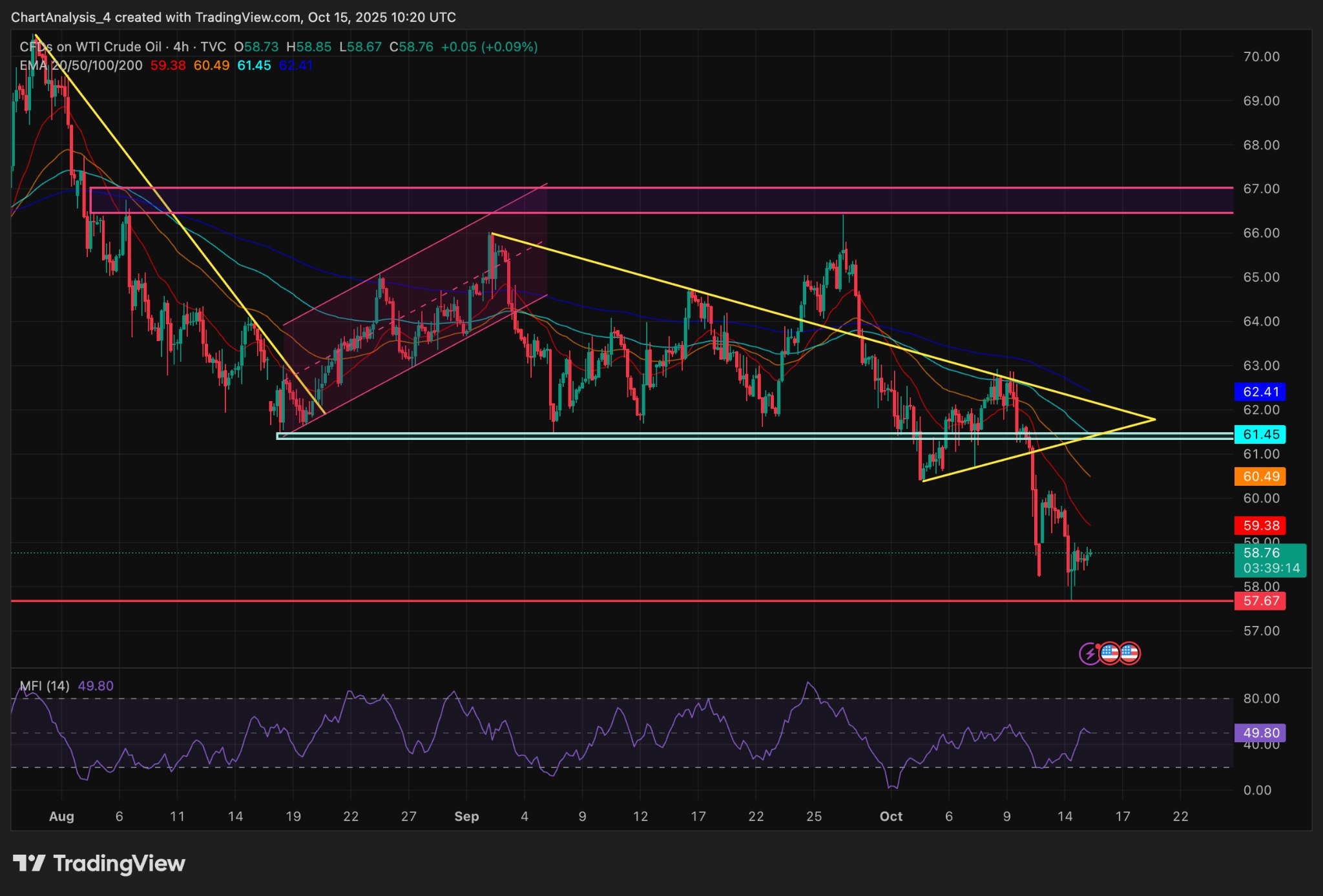
WTI price dynamics (Source: TradingView)
Market sentiment has weakened further following warnings from the International Energy Agency (IEA) that supply could outpace demand by nearly 4 million barrels per day next year.
Technical breakdown intensifies
WTI’s technical picture points to a decisive shift in momentum. Crude had been consolidating within a symmetrical triangle throughout late September, but the breakdown through both trendline and moving average support confirmed a bearish reversal. The 20-day EMA ($59.38), 50-day EMA ($60.49), and 100-day EMA ($61.45) have all turned into overhead resistance levels, while the 200-day EMA ($62.41) now marks the top of a heavy supply zone.
Failure to reclaim these levels has left prices vulnerable to further downside. The Money Flow Index (MFI) at 49.8 underscores the lack of follow-through buying, as rebounds above $60 have repeatedly failed. A break below $58 would open the path toward $57.67 and potentially deeper losses near $55, while recovery attempts must clear $61.50 to neutralize the current downtrend.
Macro drivers reinforce bearish tone
Beyond the charts, macroeconomic headwinds are compounding oil’s weakness. The IEA’s projection of a record surplus has dampened hopes of a supply-driven recovery, while ongoing U.S.-China trade tensions continue to weigh on global consumption expectations. The agency cited rising OPEC+ production and slowing industrial activity as key contributors to the anticipated oversupply.
Meanwhile, easing geopolitical risks in the Middle East have further eroded the risk premium that previously supported prices. Recent diplomatic progress, including prisoner exchanges and regional de-escalation, has removed one of the last bullish narratives from the market. Traders are now turning their attention to weekly U.S. inventory data for signs of demand resilience, though early indications suggest stockpiles remain elevated.
Outlook and previously discussed context
WTI crude remains pinned near a critical juncture. The $58 level has provided temporary stability, but persistent selling pressure and a deteriorating macro backdrop leave the market vulnerable to fresh lows. Unless prices reclaim $61.50 and reestablish momentum above key EMAs, the path of least resistance remains to the downside.
Previously, we noted that WTI’s structure was weakening as it failed to sustain above $61, and that a break beneath $60 could trigger a slide toward $58–$56. That outlook continues to play out, with the current consolidation likely serving as a pause within a broader bearish phase. For now, traders remain cautious, watching whether upcoming U.S. inventory figures and global supply data offer any signal of stabilization.





Latest WTI News









-
 Afghanistan
-
 Albania
-
 Algeria
-
 Angola
-
 Argentina
-
 Armenia
-
 Australia
-
 Austria
-
 Azerbaijan
-
 Bahamas
-
 Bahrain
-
 Bangladesh
-
 Belarus
-
 Belgium
-
 Bolivia
-
 Botswana
-
 Brazil
-
 Brunei
-
 Bulgaria
-
 Cambodia
-
 Cameroon
-
 Canada
-
 Chile
Chile
-
 China
China
-
 Colombia
-
 Congo
Congo
-
 Costa Rica
-
 Cote d'Ivoire
-
 Croatia
-
 Cuba
Cuba
-
 Cyprus
-
 Czechia
-
 DR Congo
-
 Denmark
-
 Dominican Republic
-
 Ecuador
-
 Egypt
Egypt
-
 El Salvador
-
 Estonia
-
 Eswatini
-
 Ethiopia
-
 Finland
-
 France
-
 Georgia
-
 Germany
-
 Ghana
Ghana
-
 Greece
-
 Haiti
Haiti
-
 Hong Kong
-
 Hungary
-
 India
India
-
 Indonesia
-
 Iran, Islamic republic
-
 Iraq
Iraq
-
 Ireland
-
 Israel
-
 Italy
Italy
-
 Jamaica
-
 Japan
Japan
-
 Jordan
-
 Kazakhstan
-
 Kenya
Kenya
-
 Korea
Korea
-
 Kuwait
-
 Kyrgyzstan
-
 Laos
Laos
-
 Latvia
-
 Lebanon
-
 Lesotho
-
 Libya
Libya
-
 Lithuania
-
 Luxembourg
-
 Madagascar
-
 Malaysia
-
 Malta
Malta
-
 Mauritius
-
 Mexico
-
 Moldova
-
 Mongolia
-
 Montenegro
-
 Morocco
-
 Mozambique
-
 Myanmar
-
 Namibia
-
 Nepal
Nepal
-
 Netherlands
-
 New Zealand
-
 Nigeria
-
 North Macedonia
-
 Norway
-
 Oman
Oman
-
 Pakistan
-
 Palestine
-
 Panama
-
 Papua New Guinea
-
 Paraguay
-
 Peru
Peru
-
 Philippines
-
 Poland
-
 Portugal
-
 Puerto Rico
-
 Qatar
Qatar
-
 Reunion
-
 Romania
-
 Rwanda
-
 Saudi Arabia
-
 Serbia
-
 Singapore
-
 Slovakia
-
 Slovenia
-
 Somalia
-
 South Africa
-
 Spain
Spain
-
 Sri Lanka
-
 Sweden
-
 Switzerland
-
 Syria
Syria
-
 Taiwan
-
 Tajikistan
-
 Tanzania
-
 Thailand
-
 Trinidad and Tobago
-
 Tunisia
-
 Turkey
-
 UAE
UAE
-
 Uganda
-
 Ukraine
-
 United Kingdom
-
United States
-
 Uruguay
-
 Uzbekistan
-
 Venezuela
-
 Vietnam
-
 Yemen
Yemen
-
 Zambia
-
 Zimbabwe
- Forex
- Crypto












