
WTI crude oil sinks to $57.3 as oversupply fears deepen and geopolitical risk premium fades

West Texas Intermediate (WTI) crude oil futures extended their decline Monday, falling to $57.3 per barrel and marking their lowest levels in six months. The drop comes amid mounting oversupply concerns following the International Energy Agency’s (IEA) latest report projecting a substantial market surplus by 2026, driven by higher OPEC+ production.
Highlights
- WTI crude falls to $57.3, its lowest since April, as IEA warns of oversupply risks.
- Easing Middle East tensions erase part of crude’s geopolitical premium.
- Technical charts confirm bearish momentum with support near $55.5–56.0.
Easing geopolitical tensions in the Middle East, where Israel and Hamas reaffirmed their ceasefire commitments, also contributed to the loss of the risk premium that had previously supported prices.
Oversupply narrative dominates sentiment
The IEA’s projection of a growing supply surplus has reinforced the bearish narrative gripping oil markets. Traders continue to price in rising output from OPEC+ nations, particularly as Saudi Arabia and Russia maintain their current production targets while smaller producers gradually restore capacity. The resulting supply expansion is clashing with lackluster global demand growth, further amplified by slowing industrial activity in China and Europe.
Meanwhile, the geopolitical backdrop has shifted from escalation to moderation. The reaffirmation of the Israel-Hamas ceasefire has removed a significant risk element from energy markets, prompting investors to trim long positions. Political developments in Eastern Europe also bear watching. A recent Ukrainian drone strike that disrupted a major Russian gas-processing facility added a short-term supply shock, but its impact has been muted by the broader bearish tone.
Market participants are now eyeing an upcoming meeting between U.S. President Trump and Russian President Putin in Hungary, which could influence crude sentiment depending on whether the talks yield progress on de-escalation or sanctions relief. Renewed friction between Washington and Beijing, however, continues to cloud the demand outlook as trade tensions threaten to slow manufacturing and energy consumption.
Technical structure remains firmly bearish
From a technical perspective, WTI crude remains under persistent selling pressure. The 4-hour chart shows a clearly defined descending channel that has contained price action since late September. Key moving averages reinforce resistance, with the 20-day exponential moving average (EMA) at $57.3 and the 50-day EMA at $58.6 acting as immediate caps. The 100- and 200-day EMAs, clustered around $60.0 and $61.3 respectively, form additional layers of overhead resistance.
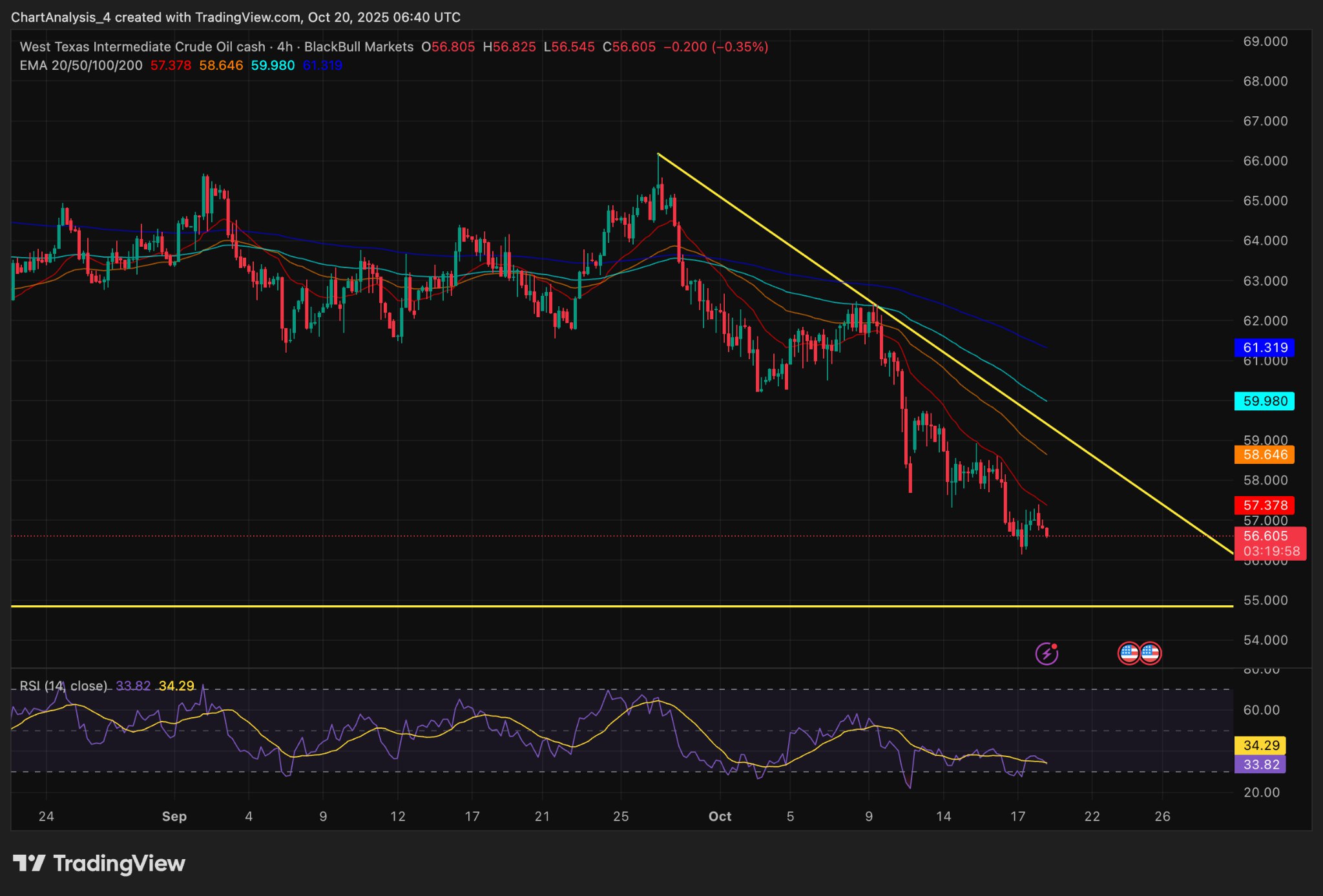
WTI price dynamics (Source: TradingView)
Momentum indicators confirm this bearish bias. The Relative Strength Index (RSI) is hovering near 34, signaling oversold conditions but also underscoring the strength of the downtrend. Unless WTI can reclaim the $58.5–$59.0 resistance zone on a daily close, any rebounds are likely to be short-lived. On the downside, traders are closely watching the $55.5–$56.0 area for potential support, with a decisive break below that range opening the door to $54, last seen in April.
Outlook
As previously discussed, WTI crude remains trapped between conflicting forces: rising supply, fragile demand, and sporadic geopolitical disruptions. The near-term outlook continues to lean bearish unless prices can stabilize above the $59–$60 region. Traders will closely monitor OPEC+ output signals and U.S.–Russia diplomatic developments for fresh direction.
If the current downtrend persists, the market could test deeper lows in the coming sessions, potentially forcing producers to reassess output strategies. However, any surprise cuts or renewed geopolitical flare-ups could offer short-lived relief. For now, with technicals aligned against a rebound, WTI’s struggle to regain footing above $58 underscores the market’s broader skepticism about near-term recovery.





Latest WTI News










-
 Afghanistan
-
 Albania
-
 Algeria
-
 Angola
-
 Argentina
-
 Armenia
-
 Australia
-
 Austria
-
 Azerbaijan
-
 Bahamas
-
 Bahrain
-
 Bangladesh
-
 Belarus
-
 Belgium
-
 Bolivia
-
 Botswana
-
 Brazil
-
 Brunei
-
 Bulgaria
-
 Cambodia
-
 Cameroon
-
 Canada
-
 Chile
Chile
-
 China
China
-
 Colombia
-
 Congo
Congo
-
 Costa Rica
-
 Cote d'Ivoire
-
 Croatia
-
 Cuba
Cuba
-
 Cyprus
-
 Czechia
-
 DR Congo
-
 Denmark
-
 Dominican Republic
-
 Ecuador
-
 Egypt
Egypt
-
 El Salvador
-
 Estonia
-
 Eswatini
-
 Ethiopia
-
 Finland
-
 France
-
 Georgia
-
 Germany
-
 Ghana
Ghana
-
 Greece
-
 Haiti
Haiti
-
 Hong Kong
-
 Hungary
-
 India
India
-
 Indonesia
-
 Iran, Islamic republic
-
 Iraq
Iraq
-
 Ireland
-
 Israel
-
 Italy
Italy
-
 Jamaica
-
 Japan
Japan
-
 Jordan
-
 Kazakhstan
-
 Kenya
Kenya
-
 Korea
Korea
-
 Kuwait
-
 Kyrgyzstan
-
 Laos
Laos
-
 Latvia
-
 Lebanon
-
 Lesotho
-
 Libya
Libya
-
 Lithuania
-
 Luxembourg
-
 Madagascar
-
 Malaysia
-
 Malta
Malta
-
 Mauritius
-
 Mexico
-
 Moldova
-
 Mongolia
-
 Montenegro
-
 Morocco
-
 Mozambique
-
 Myanmar
-
 Namibia
-
 Nepal
Nepal
-
 Netherlands
-
 New Zealand
-
 Nigeria
-
 North Macedonia
-
 Norway
-
 Oman
Oman
-
 Pakistan
-
 Palestine
-
 Panama
-
 Papua New Guinea
-
 Paraguay
-
 Peru
Peru
-
 Philippines
-
 Poland
-
 Portugal
-
 Puerto Rico
-
 Qatar
Qatar
-
 Reunion
-
 Romania
-
 Rwanda
-
 Saudi Arabia
-
 Serbia
-
 Singapore
-
 Slovakia
-
 Slovenia
-
 Somalia
-
 South Africa
-
 Spain
Spain
-
 Sri Lanka
-
 Sweden
-
 Switzerland
-
 Syria
Syria
-
 Taiwan
-
 Tajikistan
-
 Tanzania
-
 Thailand
-
 Trinidad and Tobago
-
 Tunisia
-
 Turkey
-
 UAE
UAE
-
 Uganda
-
 Ukraine
-
 United Kingdom
-
United States
-
 Uruguay
-
 Uzbekistan
-
 Venezuela
-
 Vietnam
-
 Yemen
Yemen
-
 Zambia
-
 Zimbabwe
- Forex
- Crypto












