
Nvidia stock drops below $186 amid AI fatigue
As of November 14, Nvidia stock is trading at $185.92, down 4% over the past 24 hours. Price action has entered a consolidation phase, establishing a short-term range between $180 and $205 — now acting as key support and resistance levels respectively.
Highlights
- Nvidia is trading near $186, consolidating between key support at $180 and resistance at $205.
- Oppenheimer has raised its price target to $265, citing strong AI-related demand and a substantial order backlog.
- While the long-term trend remains bullish, short-term momentum is weakening, and a breakout will require stronger volume confirmation.
The 50-day simple moving average (SMA) is currently positioned near $190, acting as immediate overhead resistance. Meanwhile, the 200-day SMA lies lower in the $160–$170 zone, providing a deeper base of technical support. This technical structure confirms that while the medium-term trend remains bullish, short-term momentum is weakening. Momentum indicators paint a neutral picture. The Relative Strength Index (RSI) is sitting close to the 50 mark, reflecting equilibrium between buying and selling pressure.
The MACD histogram has flattened out, confirming the lack of directional bias in recent sessions. This neutral setup suggests traders are in wait-and-see mode, likely anticipating a catalyst such as earnings or guidance updates. Immediate downside support is seen between $180 and $185. A decisive break below $180 would risk triggering a deeper retracement toward the $165–$170 area. Conversely, a breakout above $205 could re-ignite bullish momentum, paving the way toward $230 or higher. Until a breakout occurs, NVDA is likely to continue consolidating within its current range.
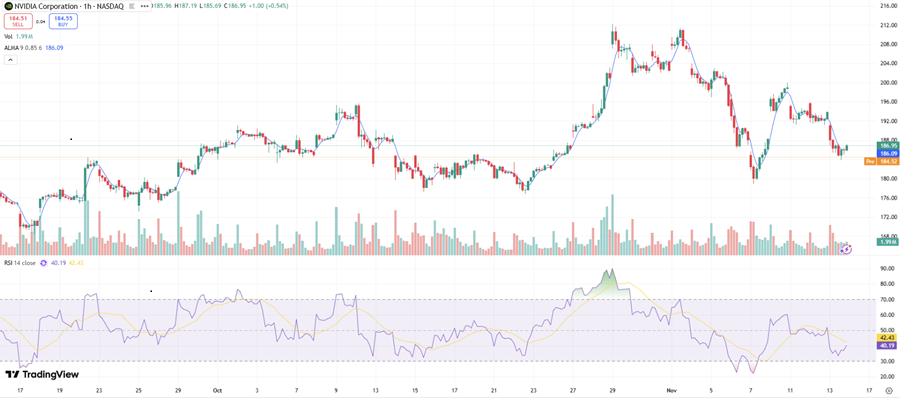
Nvidia stock price dynamics (September 2025 - November 2025). Source: TradingView
Nvidia’s recent volume profile reinforces the consolidation narrative. The spike to over 207 million shares traded suggests heightened participation near the lower end of the current range, likely reflecting a combination of institutional repositioning and retail dip-buying. However, the lack of sustained follow-through on subsequent sessions points to an absence of conviction.
AI momentum fuels analyst upgrade
Investor sentiment around Nvidia remains strongly bullish, underpinned by accelerating demand for AI infrastructure. Oppenheimer recently raised its 12-month price target on Nvidia from $225 to $265, citing the company’s unmatched leadership in high-end GPU solutions for artificial intelligence. According to the note, Nvidia is "best positioned to win in AI," supported by a substantial product backlog and rising data center orders.
The firm estimates Nvidia’s cumulative AI-related orders exceed $500 billion, suggesting multi-quarter revenue visibility and robust forward demand. This bullish stance reflects a broader market consensus. Many analysts anticipate strong performance from Nvidia’s upcoming earnings, particularly in the data center segment, which is expected to remain the primary growth engine through 2025.
Still, there are risks. Regulatory uncertainty, especially around advanced chip exports to China, remains a headwind. Additionally, the valuation is demanding — Nvidia trades at a forward P/E above 35, reflecting already-high expectations. Any earnings miss or forward guidance disappointment could trigger a sharp pullback, as investors recalibrate growth assumptions.
Price prediction and scenarios
In the base-case scenario, Nvidia’s stock is likely to move toward the $250–$265 range over the next three to six months. This assumes steady revenue growth, another beat-and-raise quarter, and no major regulatory shocks. A move to $265 would imply approximately 40 percent upside from current levels.
On the downside, if Nvidia's earnings disappoint or if export restrictions begin to materially impact revenue from international markets, the stock could drop below $180. A breakdown through that level would likely bring the $160–$170 support zone into play. This would represent a correction of around 15 percent and may present a new buying opportunity depending on broader market conditions.
Nvidia’s $4.5 trillion valuation reflects strong investor belief in its AI leadership, but sky-high expectations are raising concerns about whether real-world AI adoption can keep pace. Ongoing U.S.–China trade tensions and broader macroeconomic risks add further uncertainty to the outlook.






-
 Afghanistan
-
 Albania
-
 Algeria
-
 Angola
-
 Argentina
-
 Armenia
-
 Australia
-
 Austria
-
 Azerbaijan
-
 Bahamas
-
 Bahrain
-
 Bangladesh
-
 Belarus
-
 Belgium
-
 Bolivia
-
 Botswana
-
 Brazil
-
 Brunei
-
 Bulgaria
-
 Cambodia
-
 Cameroon
-
 Canada
-
 Chile
Chile
-
 China
China
-
 Colombia
-
 Congo
Congo
-
 Costa Rica
-
 Cote d'Ivoire
-
 Croatia
-
 Cuba
Cuba
-
 Cyprus
-
 Czechia
-
 DR Congo
-
 Denmark
-
 Dominican Republic
-
 Ecuador
-
 Egypt
Egypt
-
 El Salvador
-
 Estonia
-
 Eswatini
-
 Ethiopia
-
 Finland
-
 France
-
 Georgia
-
 Germany
-
 Ghana
Ghana
-
 Greece
-
 Haiti
Haiti
-
 Hong Kong
-
 Hungary
-
 India
India
-
 Indonesia
-
 Iran, Islamic republic
-
 Iraq
Iraq
-
 Ireland
-
 Israel
-
 Italy
Italy
-
 Jamaica
-
 Japan
Japan
-
 Jordan
-
 Kazakhstan
-
 Kenya
Kenya
-
 Korea
Korea
-
 Kuwait
-
 Kyrgyzstan
-
 Laos
Laos
-
 Latvia
-
 Lebanon
-
 Lesotho
-
 Libya
Libya
-
 Lithuania
-
 Luxembourg
-
 Madagascar
-
 Malaysia
-
 Malta
Malta
-
 Mauritius
-
 Mexico
-
 Moldova
-
 Mongolia
-
 Montenegro
-
 Morocco
-
 Mozambique
-
 Myanmar
-
 Namibia
-
 Nepal
Nepal
-
 Netherlands
-
 New Zealand
-
 Nigeria
-
 North Macedonia
-
 Norway
-
 Oman
Oman
-
 Pakistan
-
 Palestine
-
 Panama
-
 Papua New Guinea
-
 Paraguay
-
 Peru
Peru
-
 Philippines
-
 Poland
-
 Portugal
-
 Puerto Rico
-
 Qatar
Qatar
-
 Reunion
-
 Romania
-
 Rwanda
-
 Saudi Arabia
-
 Serbia
-
 Singapore
-
 Slovakia
-
 Slovenia
-
 Somalia
-
 South Africa
-
 Spain
Spain
-
 Sri Lanka
-
 Sweden
-
 Switzerland
-
 Syria
Syria
-
 Taiwan
-
 Tajikistan
-
 Tanzania
-
 Thailand
-
 Trinidad and Tobago
-
 Tunisia
-
 Turkey
-
 UAE
UAE
-
 Uganda
-
 Ukraine
-
 United Kingdom
-
United States
-
 Uruguay
-
 Uzbekistan
-
 Venezuela
-
 Vietnam
-
 Yemen
Yemen
-
 Zambia
-
 Zimbabwe
- Forex
- Crypto












