

GameStop shares drop about 11.5% after $1.4 billion debt-for-equity deal triggers selling

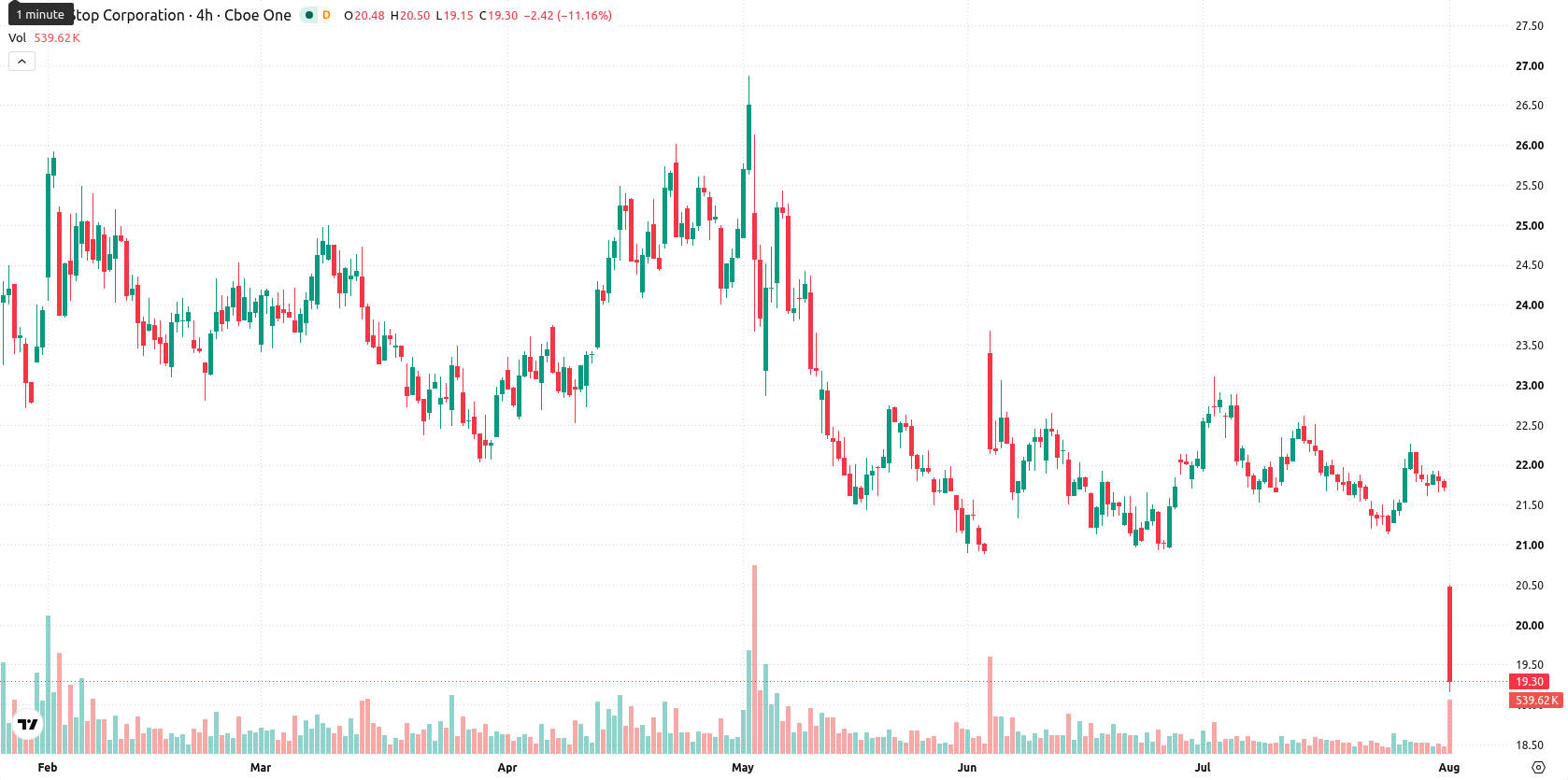
GameStop Corp. (GME) dropped 11.56% following news of a $1.4 billion debt-for-equity swap, which raised concerns about share dilution and triggered heavy selling. The decline is reinforced by GME trading well below all key moving averages, confirming broad-based downside momentum.
 27.53
27.53
27.53
27.53
Highlights
- GameStop reduced $1.4 billion in convertible note debt by swapping it for new Class A common stock through private agreements.
- The transaction eliminates cash outflows but introduces shareholder dilution, with the dilution amount to be finalized after a 35-day VWAP period.
- Technical signals indicate persistent bearish momentum, with price likely consolidating between $18.85 support and $21.80 resistance and a high risk of further downside.
Equity issued, debt reduced as noteholders accept stock exchange
GameStop executed a $1.4 billion debt-for-equity swap, exchanging convertible senior notes for shares of Class A common stock through privately negotiated deals with some noteholders. This move reduces the company’s outstanding debt, but results in shareholder dilution, with the final amount depending on the average VWAP over a 35-day reference period. No cash was involved in this transaction, and the precise dilution will be known once the period ends.
All technical signals align bearish as momentum weakens further
GameStop is trading below its 20-day, 50-day, and 200-day moving averages ($21.88, $21.85, $22.65), reinforcing broad-based downside pressure across short-, medium-, and long-term trends. The nearest resistance sits at $19.55, with support identified near $18.85; the broader bearish structure is confirmed by the alignment of the 50-day average below the 200-day. Momentum readings show the MACD on a strong sell signal, and the Average Directional Index (ADX) remains low, indicating weak trend strength. The Relative Strength Index (RSI) stands at 47.96 with a sell forecast, and Stochastic RSI also calls for further downside, while the Commodity Channel Index (CCI) is neutral. Bull/Bear Power (BBP) is slightly positive at 0.06, pointing to marginal intraday buyer dominance despite most signals favoring sellers. Price is sitting near the session’s low, and intraday volatility stands at 1.77%. Persistent bearish pressure after the open reflects negative momentum indicated by oscillators and most trend signals.
Earlier, analysts noted a shift toward renewed downside risk in GameStop as technical and sentiment factors weighed on the stock. The latest debt-for-equity swap intensifies these pressures, highlighting the importance of monitoring whether support near $18.85 can hold as traders brace for potential further declines.





Latest GameStop News






-
 Afghanistan
-
 Albania
-
 Algeria
-
 Angola
-
 Argentina
-
 Armenia
-
 Australia
-
 Austria
-
 Azerbaijan
-
 Bahamas
-
 Bahrain
-
 Bangladesh
-
 Belarus
-
 Belgium
-
 Bolivia
-
 Botswana
-
 Brazil
-
 Brunei
-
 Bulgaria
-
 Cambodia
-
 Cameroon
-
 Canada
-
 Chile
Chile
-
 China
China
-
 Colombia
-
 Congo
Congo
-
 Costa Rica
-
 Cote d'Ivoire
-
 Croatia
-
 Cuba
Cuba
-
 Cyprus
-
 Czechia
-
 DR Congo
-
 Denmark
-
 Dominican Republic
-
 Ecuador
-
 Egypt
Egypt
-
 El Salvador
-
 Estonia
-
 Eswatini
-
 Ethiopia
-
 Finland
-
 France
-
 Georgia
-
 Germany
-
 Ghana
Ghana
-
 Greece
-
 Haiti
Haiti
-
 Hong Kong
-
 Hungary
-
 India
India
-
 Indonesia
-
 Iran, Islamic republic
-
 Iraq
Iraq
-
 Ireland
-
 Israel
-
 Italy
Italy
-
 Jamaica
-
 Japan
Japan
-
 Jordan
-
 Kazakhstan
-
 Kenya
Kenya
-
 Korea
Korea
-
 Kuwait
-
 Kyrgyzstan
-
 Laos
Laos
-
 Latvia
-
 Lebanon
-
 Lesotho
-
 Libya
Libya
-
 Lithuania
-
 Luxembourg
-
 Madagascar
-
 Malaysia
-
 Malta
Malta
-
 Mauritius
-
 Mexico
-
 Moldova
-
 Mongolia
-
 Montenegro
-
 Morocco
-
 Mozambique
-
 Myanmar
-
 Namibia
-
 Nepal
Nepal
-
 Netherlands
-
 New Zealand
-
 Nigeria
-
 North Macedonia
-
 Norway
-
 Oman
Oman
-
 Pakistan
-
 Palestine
-
 Panama
-
 Papua New Guinea
-
 Paraguay
-
 Peru
Peru
-
 Philippines
-
 Poland
-
 Portugal
-
 Puerto Rico
-
 Qatar
Qatar
-
 Reunion
-
 Romania
-
 Rwanda
-
 Saudi Arabia
-
 Serbia
-
 Singapore
-
 Slovakia
-
 Slovenia
-
 Somalia
-
 South Africa
-
 Spain
Spain
-
 Sri Lanka
-
 Sweden
-
 Switzerland
-
 Syria
Syria
-
 Taiwan
-
 Tajikistan
-
 Tanzania
-
 Thailand
-
 Trinidad and Tobago
-
 Tunisia
-
 Turkey
-
 UAE
UAE
-
 Uganda
-
 Ukraine
-
 United Kingdom
-
United States
-
 Uruguay
-
 Uzbekistan
-
 Venezuela
-
 Vietnam
-
 Yemen
Yemen
-
 Zambia
-
 Zimbabwe
- Forex
- Crypto












