
Bitcoin price prediction: BTC trades near $88,800 amid persistent geopolitical uncertainty

Bitcoin is trading near $88,811 after extending a controlled rebound, posting a 1.3% gain over the past day. The asset is holding a market capitalization near $1.77 trillion with 24-hour trading volume around $32.49 billion, while price action remains active between $86,937 and $89,195. Market sentiment is being shaped by persistent geopolitical uncertainty, a shift toward post conflict frameworks, and structural strategic rivalry, creating an environment where downside shocks are contained but conviction remains cautious.
Highlights
- Middle East focus shifts from active conflict toward post conflict governance and security sequencing.
- Ukraine conflict moves deeper into legal and financial pressure rather than diplomatic negotiation.
- Asia and emerging markets highlight governance and internal stability risks over direct military escalation.
Bitcoin is attempting to stabilize near $88,811 as geopolitical developments reduce immediate shock risk but reinforce long term uncertainty. Investors are adjusting to a world where conflicts are managed rather than resolved, keeping risk premia elevated and upside participation selective.
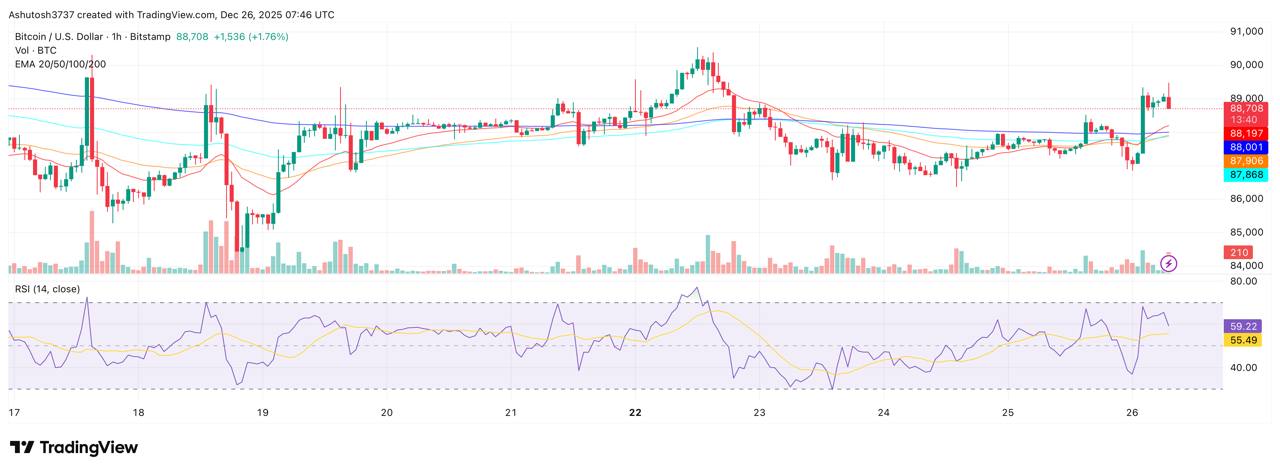
Bitcoin price dynamics (Source: TradingView)
Bitcoin stabilizes as geopolitics move from escalation to structural pressure
The Middle East remains a key geopolitical anchor, but today’s developments emphasized political sequencing over battlefield escalation. Israeli and US officials confirmed discussions are now centered on Gaza’s post conflict governance and security oversight rather than ceasefire mechanics. This implies that near term military calm is being assumed while long term political risk remains unresolved. Parallel progress on Gulf-led infrastructure and trade coordination reinforced a split dynamic where economic integration advances even as security risks persist. For markets, this lowers immediate volatility risk but embeds uncertainty into longer-term pricing.
In Europe, the Ukraine conflict showed no movement toward negotiation. Instead, attention shifted to institutional escalation, with European policymakers advancing legal frameworks to deploy frozen Russian assets. Russia’s response framed such actions as permanent violations of international norms, increasing the risk of retaliatory legal and economic measures over time. This keeps the conflict locked in a prolonged pressure phase rather than a kinetic escalation, sustaining geopolitical risk without triggering abrupt market reactions.
Geopolitical focus in Asia turned inward. Governments across East Asia emphasized safeguards around executive authority, election integrity, and internal security following recent political shocks. This signals growing concern that instability may arise from domestic governance stress rather than interstate conflict. For Bitcoin, this introduces a different risk layer where political continuity and institutional credibility matter more than traditional military flashpoints.
Emerging markets added another dimension of fragility. Several regions experienced governance reviews, contract suspensions, and security reassessments linked to political transitions. While not immediately market-moving, the clustering of these events reinforces caution around long-duration capital deployment and global supply chain exposure. This type of slow-moving institutional risk often weighs on sentiment without producing sudden selloffs.
Analysts highlight persistent tension without immediate catalysts
Anton Kharitonov notes that geopolitical risk has shifted from headline escalation to embedded structural pressure, keeping risk premia elevated without forcing abrupt repricing.
Viktoras Karapetyants explains that post conflict frameworks and institutional escalation encourage defensive positioning rather than speculative risk-taking.
Jainam Mehta adds that fragmentation across regions limits Bitcoin’s ability to decouple from broader risk sentiment despite reduced shock probability.
Technical view shows stabilization within a broader range
Bitcoin is trading near $88,811, with the 20 EMA around $88,300 acting as near term support and the 50 EMA near $89,050 forming immediate resistance. The 100 EMA near $90,200 remains a key upside threshold that must be reclaimed to restore a stronger bullish structure. The RSI near 53 reflects neutral to improving momentum consistent with consolidation. A sustained move above $89,500 would improve near term stability, while a break below $87,500 could return the price toward the lower end of the range.
Background and earlier analysis
In earlier analysis, Bitcoin’s movement was shaped by defensive positioning amid unresolved global tensions. Today’s geopolitical environment aligns with that pattern. Conflicts are increasingly managed through legal, institutional, and political frameworks rather than military escalation. This reduces the probability of sudden shocks but extends uncertainty over a longer horizon, keeping Bitcoin locked in consolidation with selective upside participation.














-
 Afghanistan
-
 Albania
-
 Algeria
-
 Angola
-
 Argentina
-
 Armenia
-
 Australia
-
 Austria
-
 Azerbaijan
-
 Bahamas
-
 Bahrain
-
 Bangladesh
-
 Belarus
-
 Belgium
-
 Bolivia
-
 Botswana
-
 Brazil
-
 Brunei
-
 Bulgaria
-
 Cambodia
-
 Cameroon
-
 Canada
-
 Chile
Chile
-
 China
China
-
 Colombia
-
 Congo
Congo
-
 Costa Rica
-
 Cote d'Ivoire
-
 Croatia
-
 Cuba
Cuba
-
 Cyprus
-
 Czechia
-
 DR Congo
-
 Denmark
-
 Dominican Republic
-
 Ecuador
-
 Egypt
Egypt
-
 El Salvador
-
 Estonia
-
 Eswatini
-
 Ethiopia
-
 Finland
-
 France
-
 Georgia
-
 Germany
-
 Ghana
Ghana
-
 Greece
-
 Haiti
Haiti
-
 Hong Kong
-
 Hungary
-
 India
India
-
 Indonesia
-
 Iran, Islamic republic
-
 Iraq
Iraq
-
 Ireland
-
 Israel
-
 Italy
Italy
-
 Jamaica
-
 Japan
Japan
-
 Jordan
-
 Kazakhstan
-
 Kenya
Kenya
-
 Korea
Korea
-
 Kuwait
-
 Kyrgyzstan
-
 Laos
Laos
-
 Latvia
-
 Lebanon
-
 Lesotho
-
 Libya
Libya
-
 Lithuania
-
 Luxembourg
-
 Madagascar
-
 Malaysia
-
 Malta
Malta
-
 Mauritius
-
 Mexico
-
 Moldova
-
 Mongolia
-
 Montenegro
-
 Morocco
-
 Mozambique
-
 Myanmar
-
 Namibia
-
 Nepal
Nepal
-
 Netherlands
-
 New Zealand
-
 Nigeria
-
 North Macedonia
-
 Norway
-
 Oman
Oman
-
 Pakistan
-
 Palestine
-
 Panama
-
 Papua New Guinea
-
 Paraguay
-
 Peru
Peru
-
 Philippines
-
 Poland
-
 Portugal
-
 Puerto Rico
-
 Qatar
Qatar
-
 Reunion
-
 Romania
-
 Rwanda
-
 Saudi Arabia
-
 Serbia
-
 Singapore
-
 Slovakia
-
 Slovenia
-
 Somalia
-
 South Africa
-
 Spain
Spain
-
 Sri Lanka
-
 Sweden
-
 Switzerland
-
 Syria
Syria
-
 Taiwan
-
 Tajikistan
-
 Tanzania
-
 Thailand
-
 Trinidad and Tobago
-
 Tunisia
-
 Turkey
-
 UAE
UAE
-
 Uganda
-
 Ukraine
-
 United Kingdom
-
United States
-
 Uruguay
-
 Uzbekistan
-
 Venezuela
-
 Vietnam
-
 Yemen
Yemen
-
 Zambia
-
 Zimbabwe
- Forex
- Crypto












