
Bitcoin trades lower as U.S.-Iran tensions escalate
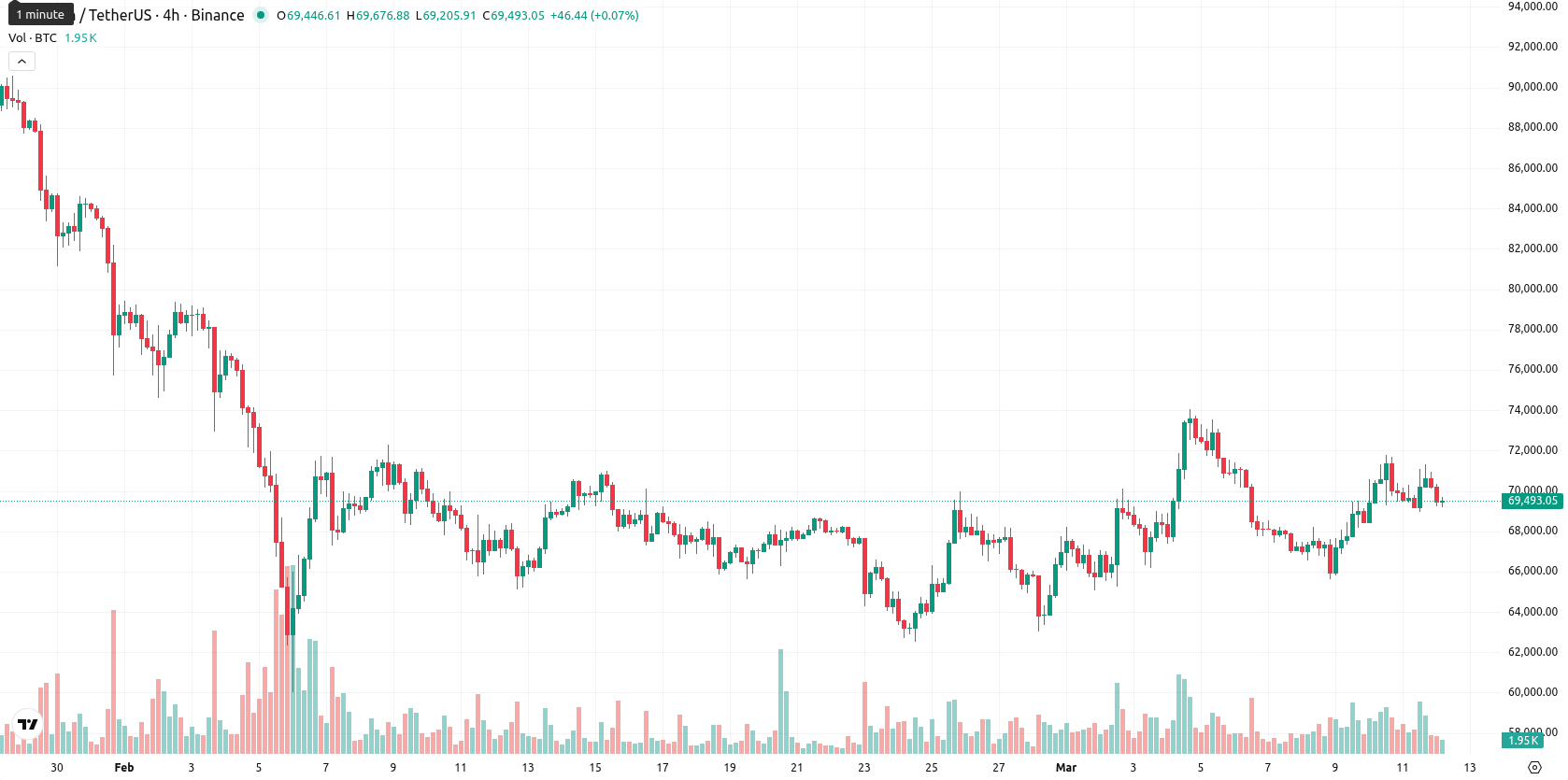
Bitcoin (BTC) is trading at $69,474.51 after slipping 0.65% for the day. The price remains above the MA-20 ($67,861.35), below the MA-50 ($72,874.86), and well below the MA-200 ($94,756.00), reflecting mixed signals across short- and medium-term trends under longer-term selling pressure.
 64275.38
66445.93
64275.38
66445.93
Highlights
- Heightened U.S.-Iran tensions threaten disruption of the Strait of Hormuz, risking sharp oil price surges and amplifying global inflation pressures.
- Intensified regulatory scrutiny on crypto flows, driven by US investigations into Iranian sanctions evasion, could restrict Bitcoin's cross-border liquidity and market access.
- Technical signals project increased downside risk for Bitcoin, with likely sideways trading between $62,000 and $74,000 absent a strong momentum shift by buyers.
Liquidity risk rises as geopolitical tensions and regulation disrupt crypto flows
On Wednesday, surging geopolitical tensions stemming from the ongoing US-Iran conflict severely disrupted global oil flows, with Iranian military actions threatening the security of key shipping routes such as the Strait of Hormuz. Iran has warned that oil could rise to $200 per barrel if hostilities escalate, amplifying worldwide inflation risks and impacting global liquidity—a primary macroeconomic threat to Bitcoin by potentially restricting risk asset flows. The expansion of the war has triggered increased volatility across financial markets, with Bitcoin and other cryptoassets subjected to abrupt liquidity fluctuations due to their correlation with risk-off sentiment and their use by sanctioned states seeking to bypass traditional financial channels. The United States Department of Justice has initiated investigations into alleged crypto-based sanctions evasion by Iran, increasing the threat of further regulatory and enforcement actions targeting crypto infrastructure. The combination of geopolitical instability, regulatory scrutiny over digital asset flows, and persistent inflation risk continues to generate significant exogenous threats to Bitcoin's liquidity, legality, and global market accessibility.
Short-term support holds as momentum signals conflict and volatility stays low
Technical analysis shows BTC is currently trading above the MA-20 but remains below the MA-50 and significantly under the MA-200, which highlights short-term support with sustained longer-term pressure. The Ichimoku Kijun level at $68,280.14 is acting as immediate support. Momentum signals are split: MACD is indicating a strong sell, the ADX shows ongoing bearish momentum, and the RSI is neutral at 51.87. CCI and BBP are overbought, Stoch RSI is neutral, and the Awesome Oscillator gives a neutral reading, together pointing to low volatility and no clear near-term direction despite recent modest declines.
Downside bias grows as rally hinges on break above resistance
Over the next five trading days, the typical volatility band is projected between $62,000 and $74,000. The probability of an upward move is low (below 20%), and further declines are more likely. The base case is for BTC to consolidate within a wide range near current levels. A bullish scenario would require a firm breakout above $72,875, while loss of support at $68,280 could accelerate a move toward $62,000, with prevailing signals moderately favoring the downside unless buyers re-emerge.
Last time, analysts noted that Bitcoin was consolidating above short-term averages while remaining below key medium- and long-term trend indicators, reflecting ongoing bearish momentum despite some recent buying activity. Technical signals, including the MACD and ADX, pointed to persistent downside risk, with range-bound trading likely to persist as resistance remains overhead and support near the Ichimoku Kijun level.




Latest Bitcoin News






-
 Afghanistan
-
 Albania
-
 Algeria
-
 Angola
-
 Argentina
-
 Armenia
-
 Australia
-
 Austria
-
 Azerbaijan
-
 Bahamas
-
 Bahrain
-
 Bangladesh
-
 Belarus
-
 Belgium
-
 Bolivia
-
 Botswana
-
 Brazil
-
 Brunei
-
 Bulgaria
-
 Cambodia
-
 Cameroon
-
 Canada
-
 Chile
Chile
-
 China
China
-
 Colombia
-
 Congo
Congo
-
 Costa Rica
-
 Cote d'Ivoire
-
 Croatia
-
 Cuba
Cuba
-
 Cyprus
-
 Czechia
-
 DR Congo
-
 Denmark
-
 Dominican Republic
-
 Ecuador
-
 Egypt
Egypt
-
 El Salvador
-
 Estonia
-
 Eswatini
-
 Ethiopia
-
 Finland
-
 France
-
 Georgia
-
 Germany
-
 Ghana
Ghana
-
 Greece
-
 Haiti
Haiti
-
 Hong Kong
-
 Hungary
-
 India
India
-
 Indonesia
-
 Iran, Islamic republic
-
 Iraq
Iraq
-
 Ireland
-
 Israel
-
 Italy
Italy
-
 Jamaica
-
 Japan
Japan
-
 Jordan
-
 Kazakhstan
-
 Kenya
Kenya
-
 Korea
Korea
-
 Kuwait
-
 Kyrgyzstan
-
 Laos
Laos
-
 Latvia
-
 Lebanon
-
 Lesotho
-
 Libya
Libya
-
 Lithuania
-
 Luxembourg
-
 Madagascar
-
 Malaysia
-
 Malta
Malta
-
 Mauritius
-
 Mexico
-
 Moldova
-
 Mongolia
-
 Montenegro
-
 Morocco
-
 Mozambique
-
 Myanmar
-
 Namibia
-
 Nepal
Nepal
-
 Netherlands
-
 New Zealand
-
 Nigeria
-
 North Macedonia
-
 Norway
-
 Oman
Oman
-
 Pakistan
-
 Palestine
-
 Panama
-
 Papua New Guinea
-
 Paraguay
-
 Peru
Peru
-
 Philippines
-
 Poland
-
 Portugal
-
 Puerto Rico
-
 Qatar
Qatar
-
 Reunion
-
 Romania
-
 Rwanda
-
 Saudi Arabia
-
 Serbia
-
 Singapore
-
 Slovakia
-
 Slovenia
-
 Somalia
-
 South Africa
-
 Spain
Spain
-
 Sri Lanka
-
 Sweden
-
 Switzerland
-
 Syria
Syria
-
 Taiwan
-
 Tajikistan
-
 Tanzania
-
 Thailand
-
 Trinidad and Tobago
-
 Tunisia
-
 Turkey
-
 UAE
UAE
-
 Uganda
-
 Ukraine
-
 United Kingdom
-
United States
-
 Uruguay
-
 Uzbekistan
-
 Venezuela
-
 Vietnam
-
 Yemen
Yemen
-
 Zambia
-
 Zimbabwe
- Forex
- Crypto












