
Bitcoin holds steady after rising US Treasury yields increase holding costs

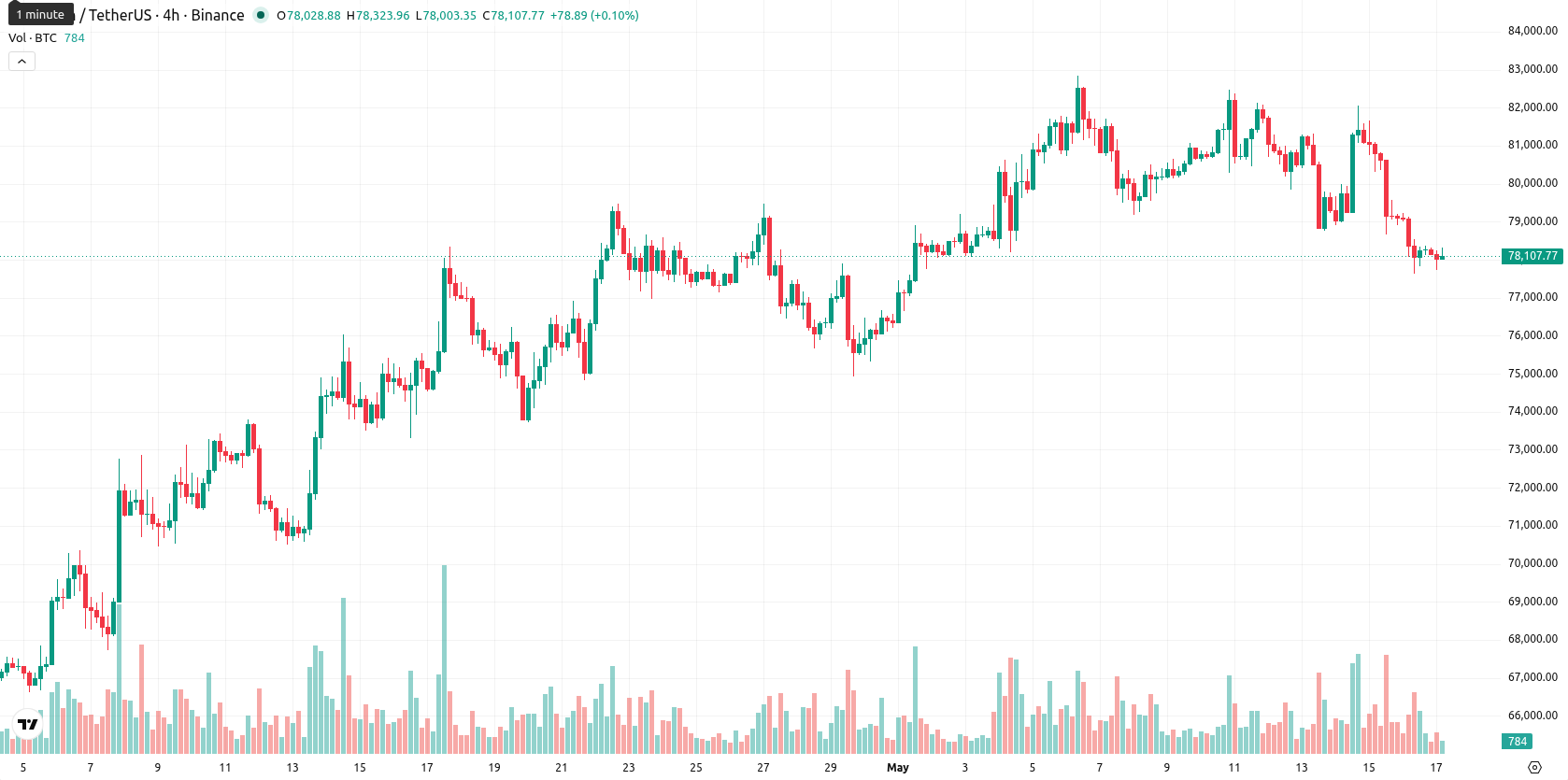
Bitcoin (BTC) is trading at $78,105.39, down 0.70% today. The asset remains below its key short-term levels but is still holding above an important medium-term moving average.
 63874
64394.44
63874
64394.44
Highlights
- US-Israel-Iran military tensions triggered significant outflows from Bitcoin as investors shed risk amid acute geopolitical instability.
- Rising US Treasury yields and renewed inflation fears increased the opportunity cost of holding Bitcoin, intensifying persistent institutional selling.
- Technically, Bitcoin faces immediate resistance near $78,800 and support at $75,200, with momentum signals bearish and a likely short-term range of $74,200–$82,000.
Institutional outflows rise as geopolitical risks and inflation accelerate
On May 16, the threat of US and Israeli military escalation against Iran triggered widespread risk aversion, driving significant outflows from Bitcoin and other cryptocurrencies as investors reduced exposure to speculative assets amid heightened geopolitical instability. Soaring oil prices above $105 per barrel, in connection with these tensions, further reinforced fears of renewed global inflationary pressures. Bitcoin has experienced further stress as rising US Treasury yields and persistent inflation have increased the opportunity cost of holding non-yielding assets, contributing to additional institutional outflows. The broader context of renewed geopolitical and macroeconomic threats has sharply undermined liquidity and sentiment in the BTC market.
Momentum weakens as buyers lose ground at key technical barriers
BTC is currently positioned below the SMA-20 at $79,332.02 and the Ichimoku Kijun level at $78,835.79, while remaining above the SMA-50 at $75,204.39. The $78,835.79 level serves as immediate technical resistance, and the zone from $75,200 to $76,000 marks medium-term support. The D1 MACD shows strong buying momentum, but both RSI at 49.21 and CCI at -44.93 are tilted negative. The ADX on the daily timeframe is at 23.45, illustrating a trend that is developing but not strongly established. Stoch RSI and Bull/Bear Power both indicate oversold conditions, with sellers prevailing in the latest session, while the Awesome Oscillator is neutral and does not confirm the daily weakness seen elsewhere.
Downside bias grows as rebound probability remains low on technicals
Over the next five trading days, BTC is expected to fluctuate within a typical volatility band of $74,200 to $82,000 relative to the current price. Scenario modeling assigns a low probability (less than 20%) to a price rebound, while a further short-term decline is more likely given the underlying trend and momentum signals, particularly the bearish weekly MACD and RSI. The base case anticipates sideways movement between established resistance at $78,800–$79,300 and support at $75,200–$76,000. If BTC breaks above $78,835.79, upward targets shift toward the $81,000s, whereas a drop below $75,200 could open the way toward the $74,000s.
Earlier, analysts noted that despite institutional interest and regulatory developments, Bitcoin's price action remained constrained by persistent volatility and market uncertainty. The recent escalation of geopolitical risks and related market stress reinforces a defensive tone for BTC, making the $75,200–$76,000 zone critical for traders to monitor as the primary support against further declines.





Latest Bitcoin News










-
 Afghanistan
-
 Albania
-
 Algeria
-
 Angola
-
 Argentina
-
 Armenia
-
 Australia
-
 Austria
-
 Azerbaijan
-
 Bahamas
-
 Bahrain
-
 Bangladesh
-
 Belarus
-
 Belgium
-
 Bolivia
-
 Botswana
-
 Brazil
-
 Brunei
-
 Bulgaria
-
 Cambodia
-
 Cameroon
-
 Canada
-
 Chile
Chile
-
 China
China
-
 Colombia
-
 Congo
Congo
-
 Costa Rica
-
 Cote d'Ivoire
-
 Croatia
-
 Cuba
Cuba
-
 Cyprus
-
 Czechia
-
 DR Congo
-
 Denmark
-
 Dominican Republic
-
 Ecuador
-
 Egypt
Egypt
-
 El Salvador
-
 Estonia
-
 Eswatini
-
 Ethiopia
-
 Finland
-
 France
-
 Georgia
-
 Germany
-
 Ghana
Ghana
-
 Greece
-
 Haiti
Haiti
-
 Hong Kong
-
 Hungary
-
 India
India
-
 Indonesia
-
 Iran, Islamic republic
-
 Iraq
Iraq
-
 Ireland
-
 Israel
-
 Italy
Italy
-
 Jamaica
-
 Japan
Japan
-
 Jordan
-
 Kazakhstan
-
 Kenya
Kenya
-
 Korea
Korea
-
 Kuwait
-
 Kyrgyzstan
-
 Laos
Laos
-
 Latvia
-
 Lebanon
-
 Lesotho
-
 Libya
Libya
-
 Lithuania
-
 Luxembourg
-
 Madagascar
-
 Malaysia
-
 Malta
Malta
-
 Mauritius
-
 Mexico
-
 Moldova
-
 Mongolia
-
 Montenegro
-
 Morocco
-
 Mozambique
-
 Myanmar
-
 Namibia
-
 Nepal
Nepal
-
 Netherlands
-
 New Zealand
-
 Nigeria
-
 North Macedonia
-
 Norway
-
 Oman
Oman
-
 Pakistan
-
 Palestine
-
 Panama
-
 Papua New Guinea
-
 Paraguay
-
 Peru
Peru
-
 Philippines
-
 Poland
-
 Portugal
-
 Puerto Rico
-
 Qatar
Qatar
-
 Reunion
-
 Romania
-
 Rwanda
-
 Saudi Arabia
-
 Serbia
-
 Singapore
-
 Slovakia
-
 Slovenia
-
 Somalia
-
 South Africa
-
 Spain
Spain
-
 Sri Lanka
-
 Sweden
-
 Switzerland
-
 Syria
Syria
-
 Taiwan
-
 Tajikistan
-
 Tanzania
-
 Thailand
-
 Trinidad and Tobago
-
 Tunisia
-
 Turkey
-
 UAE
UAE
-
 Uganda
-
 Ukraine
-
 United Kingdom
-
United States
-
 Uruguay
-
 Uzbekistan
-
 Venezuela
-
 Vietnam
-
 Yemen
Yemen
-
 Zambia
-
 Zimbabwe
- Forex
- Crypto












