
A16zcrypto report 2025 shows crypto market maturity and growth

The crypto division of venture capital firm a16z has released its 2025 State of Crypto report, highlighting industry growth, global expansion, institutional adoption, the strengthening of stablecoins, convergence with AI, and other key developments.
This is the second edition of the a16zcrypto report. The previous one was published three years ago, when “the industry was still in its infancy,” and since then, crypto has undergone major transformations.
Quality growth outpaces financial metrics
Researchers note that despite a prolonged downturn and political uncertainty, the market size has doubled over the past few years. Blockchains now process over 3,400 transactions per second — a 100x increase compared to five years ago.
Over $175 billion is held in Bitcoin and Ethereum exchange-traded products, while stablecoins facilitate $46 trillion in annual transaction volume ($9 trillion adjusted), rivaling Visa and PayPal.
Traditional financial giants such as Visa, BlackRock, Fidelity, and JPMorgan Chase, along with fintech competitors PayPal, Stripe, and Robinhood, have launched or integrated crypto products — a clear sign of the industry’s penetration into the global financial system.
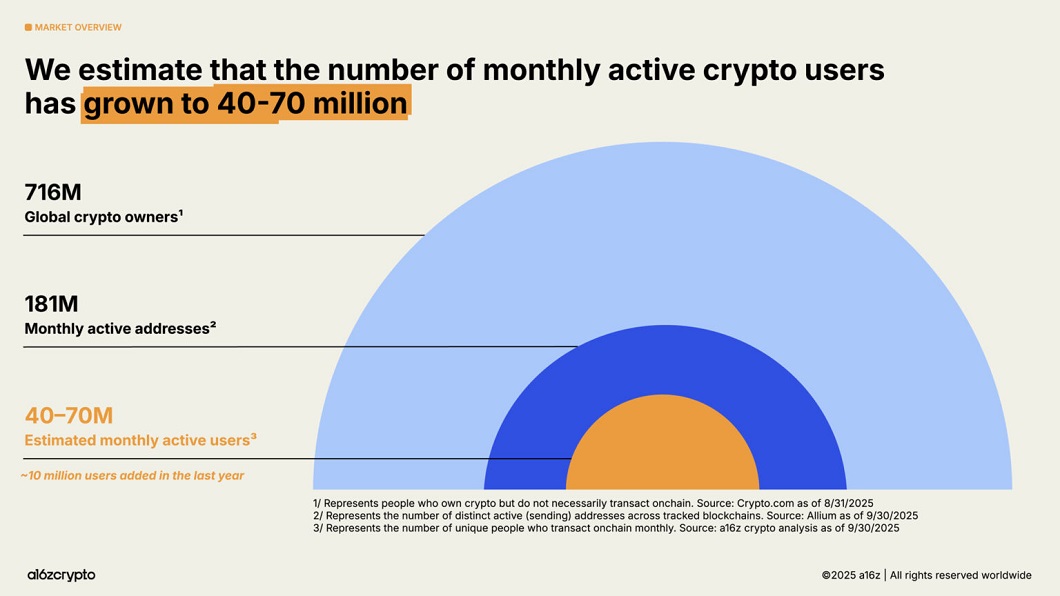
The number of users of various cryptocurrencies. Source: a16z
In 2025, the total crypto market capitalization surpassed $4 trillion for the first time, while the number of mobile wallet users hit record highs, up 20% year-over-year.
“We estimate around 40–70 million active crypto users — up by 10 million from last year — based on our updated methodology,” the report says.
These figures contrast with an estimated 716 million people owning crypto (up 16% YoY), yet only a fraction actively transact on-chain — about 181 million monthly active addresses, down 18% from the previous year.This gap between passive holders and active users represents a major opportunity for builders to engage existing crypto owners more effectively.
The maturity phase has arrived
According to a16zcrypto, as blockchains scale, fee markets evolve, and new apps emerge, metrics reflecting real economic activity become more important — particularly “real economic value”, showing how much users actually pay to use blockchains.
Currently, Hyperliquid and Solana account for 53% of all revenue-generating activity, a significant shift from the former dominance of Bitcoin and Ethereum.
Developer activity remains concentrated in Bitcoin, Ethereum (and its L2s), and Solana — with Solana seeing a 78% surge in developer interest over the past two years, making it one of the fastest-growing ecosystems.
A key ongoing trend is the rise of multichain platforms, which will likely drive greater stablecoin usage for cross-border payments, particularly in regions with volatile fiat currencies.
As we wrote, Crypto Foundations are slowing progress, says a16z legal head















-
 Afghanistan
-
 Albania
-
 Algeria
-
 Angola
-
 Argentina
-
 Armenia
-
 Australia
-
 Austria
-
 Azerbaijan
-
 Bahamas
-
 Bahrain
-
 Bangladesh
-
 Belarus
-
 Belgium
-
 Bolivia
-
 Botswana
-
 Brazil
-
 Brunei
-
 Bulgaria
-
 Cambodia
-
 Cameroon
-
 Canada
-
 Chile
Chile
-
 China
China
-
 Colombia
-
 Congo
Congo
-
 Costa Rica
-
 Cote d'Ivoire
-
 Croatia
-
 Cuba
Cuba
-
 Cyprus
-
 Czechia
-
 DR Congo
-
 Denmark
-
 Dominican Republic
-
 Ecuador
-
 Egypt
Egypt
-
 El Salvador
-
 Estonia
-
 Eswatini
-
 Ethiopia
-
 Finland
-
 France
-
 Georgia
-
 Germany
-
 Ghana
Ghana
-
 Greece
-
 Haiti
Haiti
-
 Hong Kong
-
 Hungary
-
 India
India
-
 Indonesia
-
 Iran, Islamic republic
-
 Iraq
Iraq
-
 Ireland
-
 Israel
-
 Italy
Italy
-
 Jamaica
-
 Japan
Japan
-
 Jordan
-
 Kazakhstan
-
 Kenya
Kenya
-
 Korea
Korea
-
 Kuwait
-
 Kyrgyzstan
-
 Laos
Laos
-
 Latvia
-
 Lebanon
-
 Lesotho
-
 Libya
Libya
-
 Lithuania
-
 Luxembourg
-
 Madagascar
-
 Malaysia
-
 Malta
Malta
-
 Mauritius
-
 Mexico
-
 Moldova
-
 Mongolia
-
 Montenegro
-
 Morocco
-
 Mozambique
-
 Myanmar
-
 Namibia
-
 Nepal
Nepal
-
 Netherlands
-
 New Zealand
-
 Nigeria
-
 North Macedonia
-
 Norway
-
 Oman
Oman
-
 Pakistan
-
 Palestine
-
 Panama
-
 Papua New Guinea
-
 Paraguay
-
 Peru
Peru
-
 Philippines
-
 Poland
-
 Portugal
-
 Puerto Rico
-
 Qatar
Qatar
-
 Reunion
-
 Romania
-
 Rwanda
-
 Saudi Arabia
-
 Serbia
-
 Singapore
-
 Slovakia
-
 Slovenia
-
 Somalia
-
 South Africa
-
 Spain
Spain
-
 Sri Lanka
-
 Sweden
-
 Switzerland
-
 Syria
Syria
-
 Taiwan
-
 Tajikistan
-
 Tanzania
-
 Thailand
-
 Trinidad and Tobago
-
 Tunisia
-
 Turkey
-
 UAE
UAE
-
 Uganda
-
 Ukraine
-
 United Kingdom
-
United States
-
 Uruguay
-
 Uzbekistan
-
 Venezuela
-
 Vietnam
-
 Yemen
Yemen
-
 Zambia
-
 Zimbabwe
- Forex
- Crypto












