
Microsoft stock trades lower as technicals reinforce strong seller dominance

Microsoft Corporation (MSFT) is trading well below the 20-, 50-, and 200-day moving averages ($438.18, $464.42, and $487.29), signaling strong, sustained pressure from sellers across all major timeframes. Wednesday’s move was a mild drop to $401.51, down 0.77% from the previous close, with the price hovering near session lows and exhibiting moderate intraday volatility, underlining negative technical sentiment.
 391.74
417.16
391.74
417.16
Highlights
- Microsoft faces elevated geopolitical and regulatory risks as it expands international cloud operations, with heightened vulnerability from Russia-Ukraine conflict and EU sanctions impacting European service reliability.
- US tariff uncertainty on semiconductor imports, particularly AI chips from TSMC, could disrupt Microsoft's supply chain and increase capital expenditure, constraining profitability and investment flexibility.
- Microsoft shares trade well below the 20-, 50-, and 200-day moving averages; sustained selling pressure and negative momentum signal an 80%+ probability of further declines toward the $390–$410 range.
Geopolitical and regulatory threats intensify amid cloud sector expansion
Microsoft faces elevated geopolitical and regulatory risks linked to its expanding international cloud operations, particularly as it strengthens sovereign cloud partnerships with strategic partners such as Capgemini in France. The ongoing conflict between Russia and Ukraine, accompanied by state-sponsored hybrid warfare, exposes critical infrastructure in Europe to potential cyber or physical attacks that threaten cloud service reliability and operational continuity. Regulatory uncertainty around U.S. tariffs on semiconductor imports, especially critical AI chips supplied by TSMC, could disrupt Microsoft's supply chain and increase capital expenditure, impacting profitability and strategic investment flexibility. Escalating EU sanctions targeting Russian-linked entities and ongoing cybersecurity threats heighten the need for resilience against disruptions orchestrated by or targeting nation-states, directly affecting Microsoft's service delivery and customer trust in key jurisdictions.
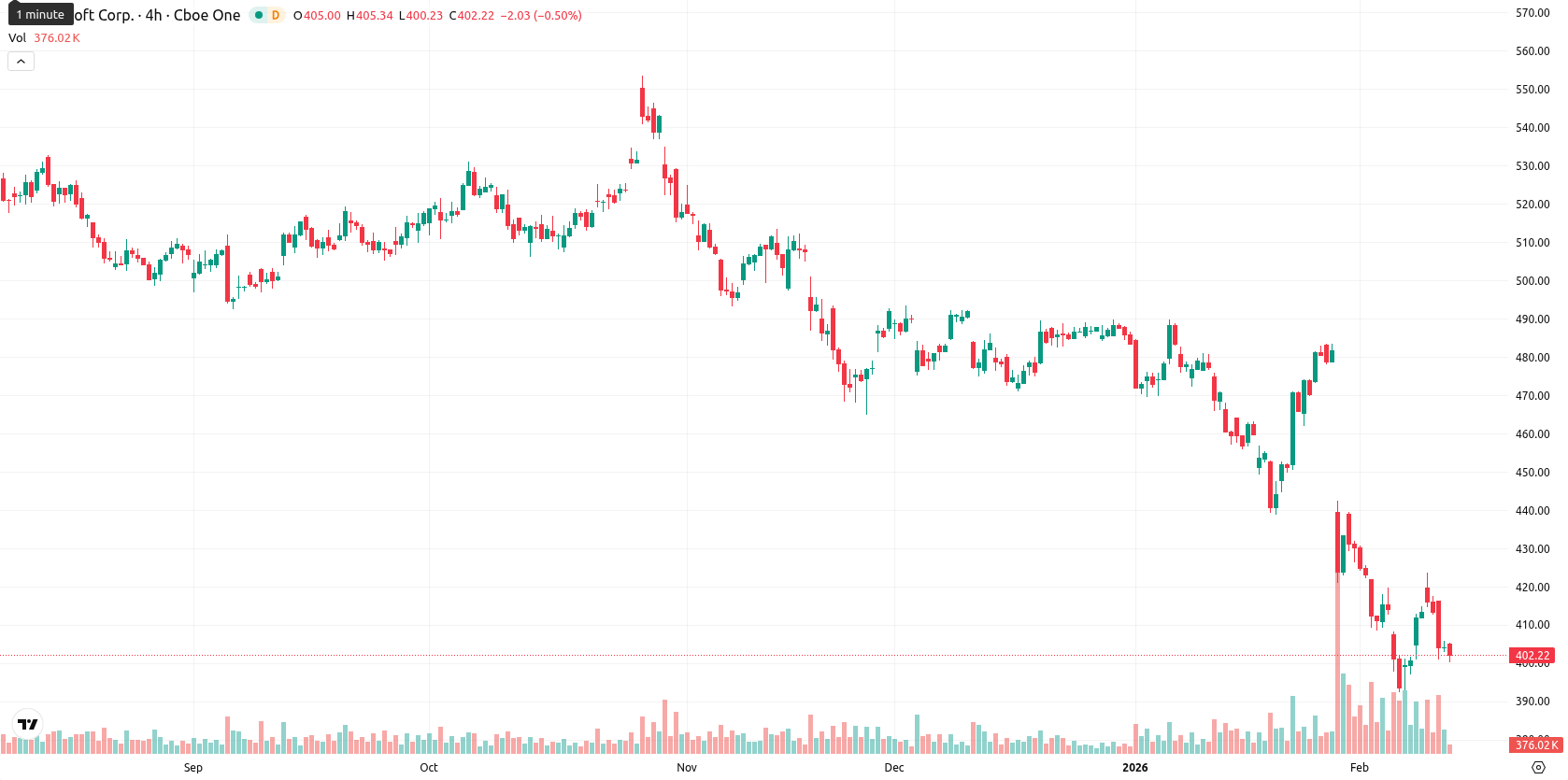
Bearish technical signals as support erodes and momentum remains negative
Technically, MSFT trades well below the 20-, 50-, and 200-day moving averages ($438.18, $464.42, and $487.29), reinforcing a bearish outlook in both the short and longer term. Dynamic resistance is marked by the Ichimoku Kijun level at $441.01, while no significant support from moving averages is currently present near the market price. Momentum indicators like MACD and ADX underscore persistent selling pressure, with further confirmation from oversold readings in RSI, Stochastic RSI, and CCI on both daily and weekly timeframes. Bull/Bear Power indicates clear seller dominance, and the Awesome Oscillator remains neutral, providing no opposition to the prevailing downtrend.
Continued weakness favored as volatility bands limit upside potential
In the short term, MSFT is expected to see continued weakness. The typical volatility band is likely to be confined between $390 and $410, with an over 80% probability of further declines and sideways consolidation within this range. Should buyers mount a recovery and clear the $441 resistance, an advance toward the upper $410s is possible. However, if sellers break below $390, further downside toward $380 could unfold, though price action currently favors continued weakness within the existing range.
Previously it was reported that Microsoft Corporation is exhibiting pronounced downward momentum, trading well below its key short-, medium-, and long-term moving averages, with bearish indicators confirmed by MACD, ADX, and near-oversold RSI readings. The stock faces persistent seller pressure with no immediate dynamic support, resistance at the Ichimoku Kijun level, and elevated volatility, suggesting a high likelihood of further declines in the near term.





Latest Microsoft News










-
 Afghanistan
-
 Albania
-
 Algeria
-
 Angola
-
 Argentina
-
 Armenia
-
 Australia
-
 Austria
-
 Azerbaijan
-
 Bahamas
-
 Bahrain
-
 Bangladesh
-
 Belarus
-
 Belgium
-
 Bolivia
-
 Botswana
-
 Brazil
-
 Brunei
-
 Bulgaria
-
 Cambodia
-
 Cameroon
-
 Canada
-
 Chile
Chile
-
 China
China
-
 Colombia
-
 Congo
Congo
-
 Costa Rica
-
 Cote d'Ivoire
-
 Croatia
-
 Cuba
Cuba
-
 Cyprus
-
 Czechia
-
 DR Congo
-
 Denmark
-
 Dominican Republic
-
 Ecuador
-
 Egypt
Egypt
-
 El Salvador
-
 Estonia
-
 Eswatini
-
 Ethiopia
-
 Finland
-
 France
-
 Georgia
-
 Germany
-
 Ghana
Ghana
-
 Greece
-
 Haiti
Haiti
-
 Hong Kong
-
 Hungary
-
 India
India
-
 Indonesia
-
 Iran, Islamic republic
-
 Iraq
Iraq
-
 Ireland
-
 Israel
-
 Italy
Italy
-
 Jamaica
-
 Japan
Japan
-
 Jordan
-
 Kazakhstan
-
 Kenya
Kenya
-
 Korea
Korea
-
 Kuwait
-
 Kyrgyzstan
-
 Laos
Laos
-
 Latvia
-
 Lebanon
-
 Lesotho
-
 Libya
Libya
-
 Lithuania
-
 Luxembourg
-
 Madagascar
-
 Malaysia
-
 Malta
Malta
-
 Mauritius
-
 Mexico
-
 Moldova
-
 Mongolia
-
 Montenegro
-
 Morocco
-
 Mozambique
-
 Myanmar
-
 Namibia
-
 Nepal
Nepal
-
 Netherlands
-
 New Zealand
-
 Nigeria
-
 North Macedonia
-
 Norway
-
 Oman
Oman
-
 Pakistan
-
 Palestine
-
 Panama
-
 Papua New Guinea
-
 Paraguay
-
 Peru
Peru
-
 Philippines
-
 Poland
-
 Portugal
-
 Puerto Rico
-
 Qatar
Qatar
-
 Reunion
-
 Romania
-
 Rwanda
-
 Saudi Arabia
-
 Serbia
-
 Singapore
-
 Slovakia
-
 Slovenia
-
 Somalia
-
 South Africa
-
 Spain
Spain
-
 Sri Lanka
-
 Sweden
-
 Switzerland
-
 Syria
Syria
-
 Taiwan
-
 Tajikistan
-
 Tanzania
-
 Thailand
-
 Trinidad and Tobago
-
 Tunisia
-
 Turkey
-
 UAE
UAE
-
 Uganda
-
 Ukraine
-
 United Kingdom
-
United States
-
 Uruguay
-
 Uzbekistan
-
 Venezuela
-
 Vietnam
-
 Yemen
Yemen
-
 Zambia
-
 Zimbabwe
- Forex
- Crypto












