
Tesla stock consolidates at $414 as Morgan Stanley flags long-term energy upside

As of February 17, Tesla stock is trading at $414.51, down 0.7% in the past 24 hours. The shares remain in a consolidation phase after failing to sustain momentum above the $420–$425 resistance zone earlier this month.
Highlights
- Tesla stock is consolidating near $414, with $400 acting as key support and $450 as major resistance.
- Morgan Stanley sees substantial long-term upside from Tesla’s planned 100 GW solar expansion, estimating up to $50 billion in potential equity value.
- The project could generate $25 billion in revenue once scaled but requires significant capital investment and execution discipline.
From a technical perspective, the $400 psychological level has emerged as immediate support, reinforced by prior breakout structure seen in January. A decisive break below $400 would expose the $380 region, which aligns with previous swing lows and congestion from late Q4 trading.
On the upside, resistance is clearly defined near $435, followed by a stronger barrier at $450. A daily close above $450 would likely trigger momentum buying and open the path toward $480 in the short term. The 50-day moving average remains above the 200-day moving average, maintaining a broader bullish structure despite recent pullbacks. However, price is currently hovering close to the 50-day MA, suggesting weakening short-term momentum.
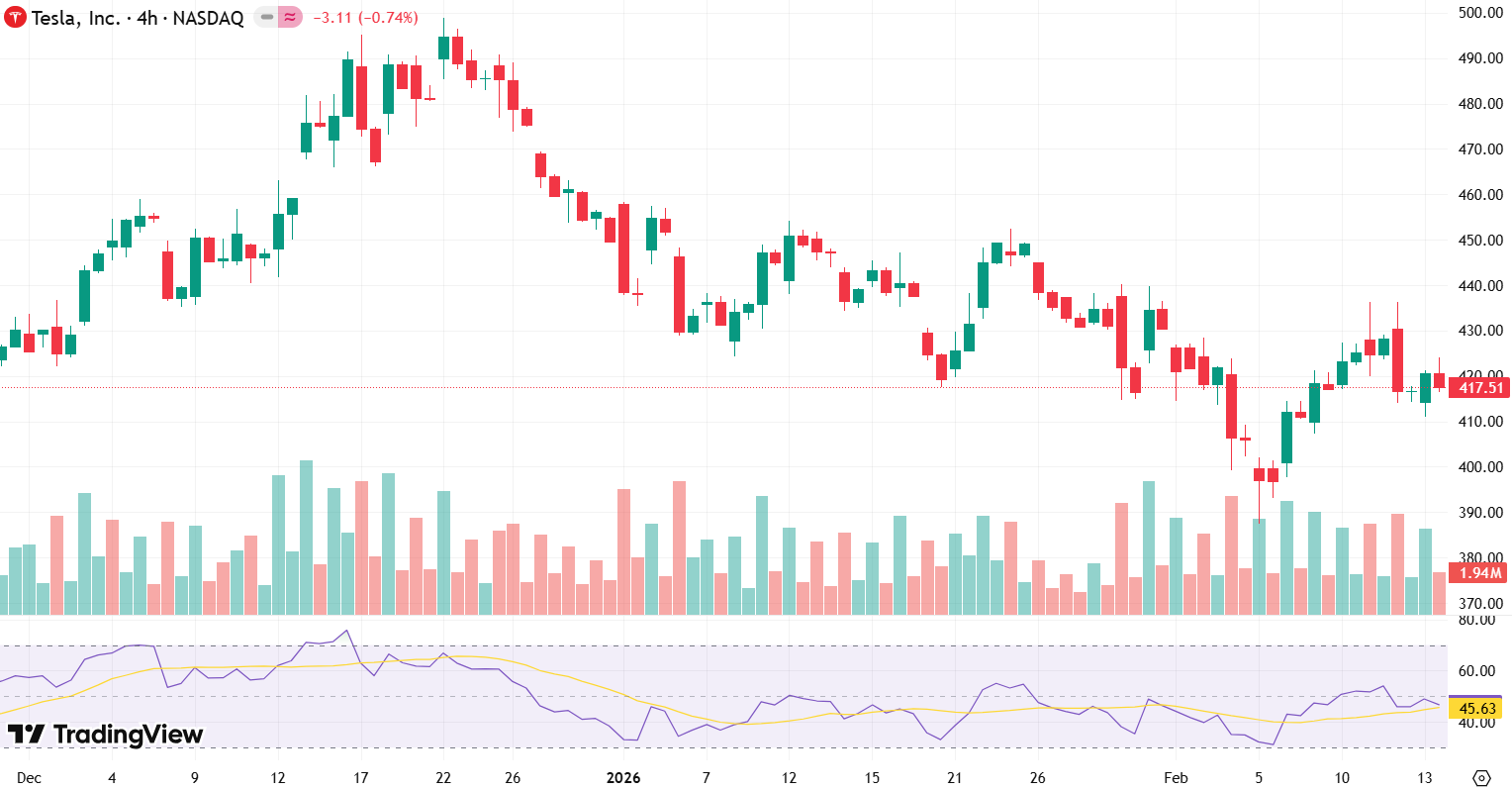
Tesla stock price dynamics (December 2025 - February 2026). Source: TradingView
The Relative Strength Index (RSI) is neutral, hovering near the mid-40s to low-50s zone, indicating neither overbought nor oversold conditions. Volume has moderated during the latest decline, signaling controlled selling rather than aggressive distribution. For now, Tesla remains range-bound between $400 and $450, with traders awaiting a catalyst to determine the next directional move.
Solar strategy pivots toward space-powered data centers
Tesla’s plan to build 100 gigawatts of solar manufacturing capacity reflects a long-term strategic shift shaped by geopolitics, supply chain resilience, and accelerating power demand from next-generation data centers, according to Morgan Stanley. Analyst Andrew Percoco notes that the capital allocation decision is not simply about expanding terrestrial solar exposure, but about deepening vertical integration across Tesla’s energy ecosystem. By strengthening in-house manufacturing, Tesla could reduce geopolitical dependency risks while positioning its energy division as a strategic growth engine rather than a secondary business line.
Morgan Stanley estimates that Tesla’s solar ambitions could add $25–$50 billion in equity value, equivalent to roughly $6–$14 per share, to its Tesla Energy valuation, which the bank currently assesses at $140 billion. Once fully scaled, Tesla Solar could generate approximately $25 billion in annual revenue and contribute $3–$4 billion in incremental EBIT. Importantly, this potential upside is not included in Tesla’s 2026 capital expenditure guidance, as the 100 GW build-out may require $30–$70 billion in investment. The scale of required capital underscores the magnitude of the bet and explains why execution credibility will be critical for investor confidence.
The most distinctive element of the strategy lies in its intended end market. Morgan Stanley believes a significant portion of the 100 GW capacity would power data centers in space, with a smaller share allocated to terrestrial facilities. This aligns with Elon Musk’s broader ambition to deploy solar-powered computing infrastructure beyond Earth, mitigating energy bottlenecks that could constrain AI and advanced computing growth. While the global solar market currently faces oversupply, Tesla’s planned output would largely target specialized, high-demand applications, potentially insulating it from conventional supply-demand cycles and commoditized pricing pressures.
Break above $450 or retest of $380
In the short term, Tesla’s trajectory depends on whether buyers defend the $400 support zone. Holding above this level could allow a rebound toward $435 and potentially $450, while a confirmed breakout above $450 may open the way to $480. Conversely, a break below $400 would likely accelerate losses toward $380, with a deeper slide exposing $350 as the next downside target.
Base-case scenario for the next four to six weeks favors continued consolidation between $400 and $450, with a slight bullish bias provided macro conditions remain stable. A decisive catalyst, either in earnings guidance or tangible updates on the solar manufacturing timeline, will likely determine whether Tesla resumes its broader uptrend or enters a deeper corrective phase.
Tesla is integrating its vehicles more deeply into Tencent’s ecosystem, enabling WeChat-linked services, intelligent navigation, and localized cloud-based features tailored to Chinese consumers. The move strengthens Tesla’s competitive position in China, where software integration is becoming a key differentiator against rivals such as BYD, Nio, and XPeng.





Latest Tesla News








-
 Afghanistan
-
 Albania
-
 Algeria
-
 Angola
-
 Argentina
-
 Armenia
-
 Australia
-
 Austria
-
 Azerbaijan
-
 Bahamas
-
 Bahrain
-
 Bangladesh
-
 Belarus
-
 Belgium
-
 Bolivia
-
 Botswana
-
 Brazil
-
 Brunei
-
 Bulgaria
-
 Cambodia
-
 Cameroon
-
 Canada
-
 Chile
Chile
-
 China
China
-
 Colombia
-
 Congo
Congo
-
 Costa Rica
-
 Cote d'Ivoire
-
 Croatia
-
 Cuba
Cuba
-
 Cyprus
-
 Czechia
-
 DR Congo
-
 Denmark
-
 Dominican Republic
-
 Ecuador
-
 Egypt
Egypt
-
 El Salvador
-
 Estonia
-
 Eswatini
-
 Ethiopia
-
 Finland
-
 France
-
 Georgia
-
 Germany
-
 Ghana
Ghana
-
 Greece
-
 Haiti
Haiti
-
 Hong Kong
-
 Hungary
-
 India
India
-
 Indonesia
-
 Iran, Islamic republic
-
 Iraq
Iraq
-
 Ireland
-
 Israel
-
 Italy
Italy
-
 Jamaica
-
 Japan
Japan
-
 Jordan
-
 Kazakhstan
-
 Kenya
Kenya
-
 Korea
Korea
-
 Kuwait
-
 Kyrgyzstan
-
 Laos
Laos
-
 Latvia
-
 Lebanon
-
 Lesotho
-
 Libya
Libya
-
 Lithuania
-
 Luxembourg
-
 Madagascar
-
 Malaysia
-
 Malta
Malta
-
 Mauritius
-
 Mexico
-
 Moldova
-
 Mongolia
-
 Montenegro
-
 Morocco
-
 Mozambique
-
 Myanmar
-
 Namibia
-
 Nepal
Nepal
-
 Netherlands
-
 New Zealand
-
 Nigeria
-
 North Macedonia
-
 Norway
-
 Oman
Oman
-
 Pakistan
-
 Palestine
-
 Panama
-
 Papua New Guinea
-
 Paraguay
-
 Peru
Peru
-
 Philippines
-
 Poland
-
 Portugal
-
 Puerto Rico
-
 Qatar
Qatar
-
 Reunion
-
 Romania
-
 Rwanda
-
 Saudi Arabia
-
 Serbia
-
 Singapore
-
 Slovakia
-
 Slovenia
-
 Somalia
-
 South Africa
-
 Spain
Spain
-
 Sri Lanka
-
 Sweden
-
 Switzerland
-
 Syria
Syria
-
 Taiwan
-
 Tajikistan
-
 Tanzania
-
 Thailand
-
 Trinidad and Tobago
-
 Tunisia
-
 Turkey
-
 UAE
UAE
-
 Uganda
-
 Ukraine
-
 United Kingdom
-
United States
-
 Uruguay
-
 Uzbekistan
-
 Venezuela
-
 Vietnam
-
 Yemen
Yemen
-
 Zambia
-
 Zimbabwe
- Forex
- Crypto












