
RTX stock price forecast: Range develops near $203 following pullback
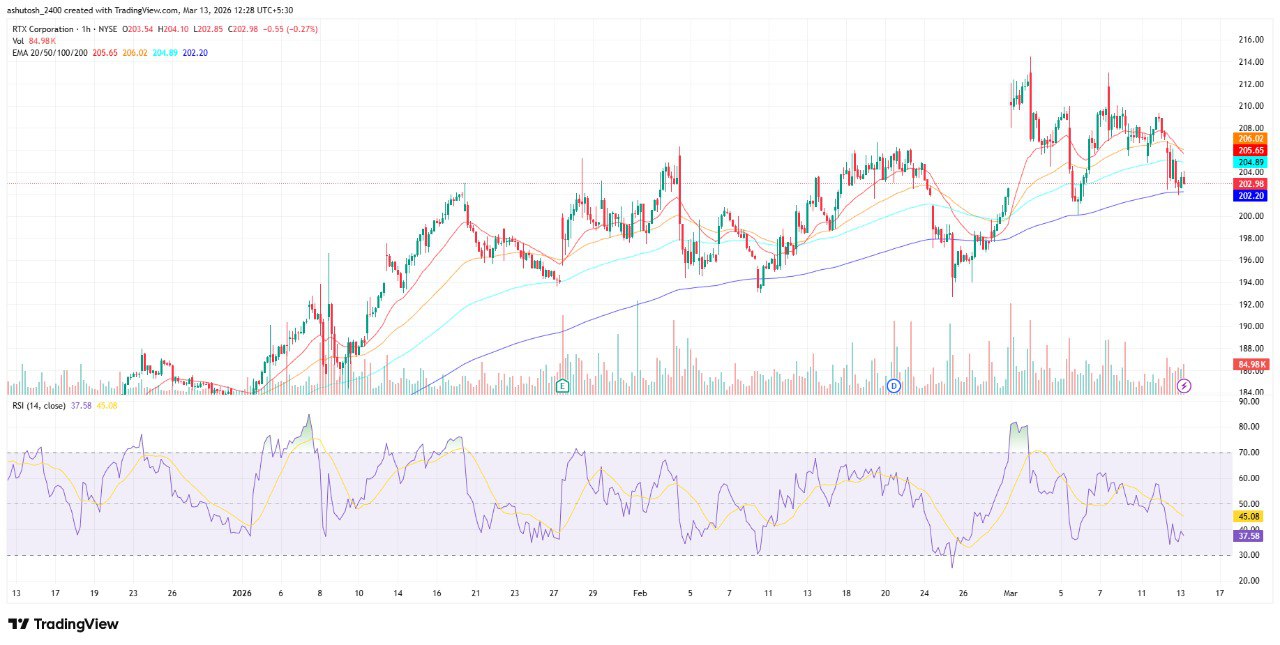
RTX shares are trading around the $203 mark after pulling back from a recent rally that saw them peak at $214 earlier this month. The increase in selling activity coincided with the shares dipping below $208, which led to a slowdown in their price momentum. Recently, the shares have stabilized within the $202-$203 range, where there has been noticeable buying interest for RTX shares.
Highlights
- The price is right now hovering around the range of 202 to 203 dollars.
- The RSI is floating in the upper 30s to lower 40s. This is an indication that the strength is waning after the recent drop.
- There is a sense of resistance around the range of 205 to 206 dollars. A stronger support level is also forming around 200 dollars.
RTX shares are currently hovering near significant moving averages on the hourly chart. The 20-period EMA is holding steady around $205.65, while the 50-period EMA is slightly higher at $206.02. These levels create temporary resistance above today’s price action. As the stock looks for stability, these zones are limiting upward movement. The 100-period EMA is positioned at $204.89, just above the current price, and the 200-period EMA is lower at approximately $202.20. Together, these levels define a range that has contained recent trading activity.
RTX price dynamics (Source: TradingView)
After a strong run, RTX shares are experiencing a correction. In early March, the shares reached a high of $214 but have been gradually losing steam since then. Once the price fell below $208, it started losing steam even faster. Currently, it is experiencing a stabilization phase in the $202-$203 price range, where it could possibly receive some support.
The Relative Strength Index (RSI) is between 37 and 45. This means that the momentum is falling since the RSI was increasing in the last period. When the stock price falls, if the RSI is between 37 and 45, it means that traders are taking a break before they determine their next course of action.
Defense demand continues to support thelong-term outlook
RTX powers forward through divisions focused on jet engines, guided weapons, flight electronics, and cutting-edge military tech. Government budgets fuel its momentum, rising defense outlays, and multi-year deals keep work flowing steadily their way.Political friction between nations has pushed some areas to spend more on defense. Because of that shift, gear like smart weapons, rocket systems, and high-altitude parts sees stronger interest. Firms, including RTX, find their offerings pulled into these plans more often now. What's happening globally quietly lines up with what they build.
Fleet expansions by airlines now feed into aerospace gains, thanks to rising demand for air travel worldwide. Recovery in passenger numbers lifts production needs, creating openings across the sector slowly but steadily.
Key levels to watch as consolidation develops
RTX stays above the $202 support zone; it might try pushing higher toward $205 to $206. Should it break past that range and stay there, buyers may step in again. Reaching beyond that opens room for a climb back to $210.On the downside, a drop toward $196 becomes more likely. A slip under that level shakes the foundation, opening room for further decline.
RTX holds steady income through military deals. Its position grows stronger where jet engine innovation meets high-end aviation tech. Long-range financial health ties closely to these evolving systems rather than short-term shifts.
In our previous analysis of RTX, we observed that the $202 region had begun acting as a structural support level after the stock retreated from the $214. Staying above that area keeps the wider trading range intact, hinting that the current flat stretch might just be a rest instead of weakness setting in.





Latest RTX News







-
 Afghanistan
-
 Albania
-
 Algeria
-
 Angola
-
 Argentina
-
 Armenia
-
 Australia
-
 Austria
-
 Azerbaijan
-
 Bahamas
-
 Bahrain
-
 Bangladesh
-
 Belarus
-
 Belgium
-
 Bolivia
-
 Botswana
-
 Brazil
-
 Brunei
-
 Bulgaria
-
 Cambodia
-
 Cameroon
-
 Canada
-
 Chile
Chile
-
 China
China
-
 Colombia
-
 Congo
Congo
-
 Costa Rica
-
 Cote d'Ivoire
-
 Croatia
-
 Cuba
Cuba
-
 Cyprus
-
 Czechia
-
 DR Congo
-
 Denmark
-
 Dominican Republic
-
 Ecuador
-
 Egypt
Egypt
-
 El Salvador
-
 Estonia
-
 Eswatini
-
 Ethiopia
-
 Finland
-
 France
-
 Georgia
-
 Germany
-
 Ghana
Ghana
-
 Greece
-
 Haiti
Haiti
-
 Hong Kong
-
 Hungary
-
 India
India
-
 Indonesia
-
 Iran, Islamic republic
-
 Iraq
Iraq
-
 Ireland
-
 Israel
-
 Italy
Italy
-
 Jamaica
-
 Japan
Japan
-
 Jordan
-
 Kazakhstan
-
 Kenya
Kenya
-
 Korea
Korea
-
 Kuwait
-
 Kyrgyzstan
-
 Laos
Laos
-
 Latvia
-
 Lebanon
-
 Lesotho
-
 Libya
Libya
-
 Lithuania
-
 Luxembourg
-
 Madagascar
-
 Malaysia
-
 Malta
Malta
-
 Mauritius
-
 Mexico
-
 Moldova
-
 Mongolia
-
 Montenegro
-
 Morocco
-
 Mozambique
-
 Myanmar
-
 Namibia
-
 Nepal
Nepal
-
 Netherlands
-
 New Zealand
-
 Nigeria
-
 North Macedonia
-
 Norway
-
 Oman
Oman
-
 Pakistan
-
 Palestine
-
 Panama
-
 Papua New Guinea
-
 Paraguay
-
 Peru
Peru
-
 Philippines
-
 Poland
-
 Portugal
-
 Puerto Rico
-
 Qatar
Qatar
-
 Reunion
-
 Romania
-
 Rwanda
-
 Saudi Arabia
-
 Serbia
-
 Singapore
-
 Slovakia
-
 Slovenia
-
 Somalia
-
 South Africa
-
 Spain
Spain
-
 Sri Lanka
-
 Sweden
-
 Switzerland
-
 Syria
Syria
-
 Taiwan
-
 Tajikistan
-
 Tanzania
-
 Thailand
-
 Trinidad and Tobago
-
 Tunisia
-
 Turkey
-
 UAE
UAE
-
 Uganda
-
 Ukraine
-
 United Kingdom
-
United States
-
 Uruguay
-
 Uzbekistan
-
 Venezuela
-
 Vietnam
-
 Yemen
Yemen
-
 Zambia
-
 Zimbabwe
- Forex
- Crypto












