
Tesla stock slips to $302 as Musk and Wood tout $10 trillion AI future

As of August 4, Tesla stock is trading at $302.63, down 1.8 percent over the past 24 hours.
This pullback reflects pressure on the stock following weaker-than-expected quarterly earnings and investor concerns around vehicle deliveries.
Highlights
- Tesla is trading below key moving averages, signaling continued short-term weakness with support near $290 and resistance around $320.
- Investor focus is shifting toward long-term AI potential, including robotaxis and humanoid robots, which Elon Musk and Cathie Wood claim could add $10 trillion to global GDP.
- Near-term price direction will depend on balancing weak financials against optimism around Tesla’s autonomous technology rollout.
Tesla (TSLA) remains in a short-term downtrend after retreating from June highs above $260 to levels around $300. The stock is trading below both its 50-day and 200-day moving averages — currently near $320 and $316 respectively — a bearish signal that reflects recent selling pressure. However, this also means that any break above those levels could trigger a technical recovery.
Support levels for TSLA are currently clustered between $290 and $295, based on price action from mid-July and late June, where the stock found buying interest. A failure to hold above $290 would likely trigger stops and push the stock toward the next major support zone at $270. Resistance lies near $320 (the 50-day moving average) and then $330, which has acted as a psychological ceiling during recent rally attempts.
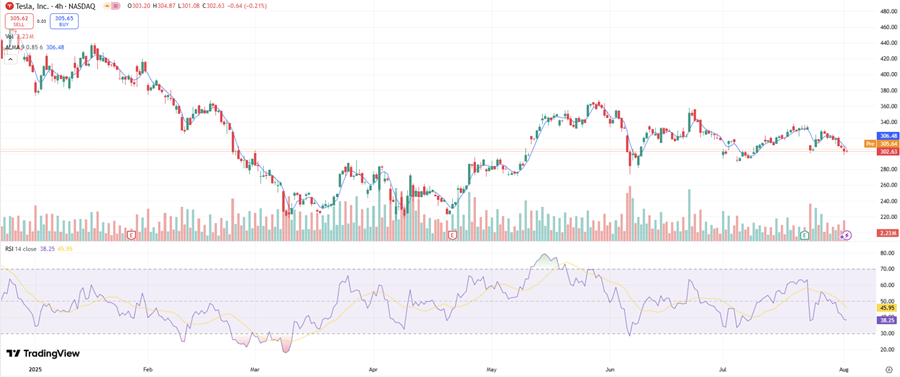
Tesla stock price dynamics (June 2025 - August 2025). Source: TradingView
TSLA's daily volume remains robust, with an average of around 98 million shares traded. Volatility is elevated, with an average true range of nearly $4.70 per day. Options pricing also suggests continued expectations for significant price swings. Overall, technical momentum remains neutral to slightly bearish unless bulls regain control above $320.
Market context and news commentary
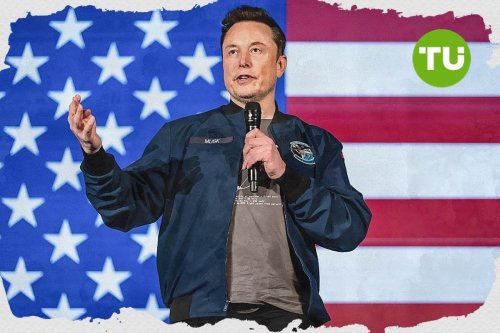
Recent headlines have reignited investor interest in Tesla's long-term AI strategy. According to a joint statement by Elon Musk and ARK Invest CEO Cathie Wood, Tesla’s AI and autonomous driving projects could eventually contribute up to $10 trillion to global GDP, driven by full-scale rollout of robotaxi services and humanoid robots. Wood emphasized Tesla as the “biggest AI project on Earth,” projecting that Tesla's stock could reach $2,600 by 2029 under optimistic assumptions of robotaxi and AI-driven margins.
Tesla has already initiated limited testing of robotaxis in Austin, Texas, using a small fleet of autonomous Model Ys supervised by humans. Expansion plans aim for as many as 1,000 robotaxis in select cities within 12 months. Elon Musk has reiterated that full self-driving (FSD) capability remains Tesla’s key differentiator — a strategic pivot away from traditional vehicle sales and toward software-driven recurring revenue.
Beyond autonomy, Musk also placed significant emphasis on Tesla’s Optimus humanoid robot. Mass production is anticipated by late 2025 or early 2026, and Musk envisions industrial and household robots as a major revenue pillar, potentially rivaling or exceeding vehicle sales in value. While these projections are speculative, they have resonated with long-term investors focused on disruptive innovation.
Price forecast and scenarios
Looking forward, Tesla’s short-term price direction will likely hinge on investor confidence in its AI story versus ongoing weakness in core automotive operations. If TSLA maintains support above $290 and finds momentum around robotaxi expansion or improved FSD capabilities, a rebound to $320–$330 is achievable in the next 3–5 weeks.
However, a clear upside break of $330, supported by AI-related news (e.g., Optimus demo progress or additional city rollouts of robotaxis), could propel the stock toward $350–$360, retracing previous highs from early 2024. But if broader market risk-off sentiment returns or Tesla delivers another disappointing quarter, a breakdown below $290 would expose the stock to a drop toward $270–$275.
Tesla's Q2 2025 results showed a 23% drop in EPS and a 12% revenue decline year-over-year, with deliveries of 384,122 units missing expectations. Investor sentiment weakened further due to fading U.S. EV tax credits and growing international tariffs.




Latest Tesla News








-
 Afghanistan
-
 Albania
-
 Algeria
-
 Angola
-
 Argentina
-
 Armenia
-
 Australia
-
 Austria
-
 Azerbaijan
-
 Bahamas
-
 Bahrain
-
 Bangladesh
-
 Belarus
-
 Belgium
-
 Bolivia
-
 Botswana
-
 Brazil
-
 Brunei
-
 Bulgaria
-
 Cambodia
-
 Cameroon
-
 Canada
-
 Chile
Chile
-
 China
China
-
 Colombia
-
 Congo
Congo
-
 Costa Rica
-
 Cote d'Ivoire
-
 Croatia
-
 Cuba
Cuba
-
 Cyprus
-
 Czechia
-
 DR Congo
-
 Denmark
-
 Dominican Republic
-
 Ecuador
-
 Egypt
Egypt
-
 El Salvador
-
 Estonia
-
 Eswatini
-
 Ethiopia
-
 Finland
-
 France
-
 Georgia
-
 Germany
-
 Ghana
Ghana
-
 Greece
-
 Haiti
Haiti
-
 Hong Kong
-
 Hungary
-
 India
India
-
 Indonesia
-
 Iran, Islamic republic
-
 Iraq
Iraq
-
 Ireland
-
 Israel
-
 Italy
Italy
-
 Jamaica
-
 Japan
Japan
-
 Jordan
-
 Kazakhstan
-
 Kenya
Kenya
-
 Korea
Korea
-
 Kuwait
-
 Kyrgyzstan
-
 Laos
Laos
-
 Latvia
-
 Lebanon
-
 Lesotho
-
 Libya
Libya
-
 Lithuania
-
 Luxembourg
-
 Madagascar
-
 Malaysia
-
 Malta
Malta
-
 Mauritius
-
 Mexico
-
 Moldova
-
 Mongolia
-
 Montenegro
-
 Morocco
-
 Mozambique
-
 Myanmar
-
 Namibia
-
 Nepal
Nepal
-
 Netherlands
-
 New Zealand
-
 Nigeria
-
 North Macedonia
-
 Norway
-
 Oman
Oman
-
 Pakistan
-
 Palestine
-
 Panama
-
 Papua New Guinea
-
 Paraguay
-
 Peru
Peru
-
 Philippines
-
 Poland
-
 Portugal
-
 Puerto Rico
-
 Qatar
Qatar
-
 Reunion
-
 Romania
-
 Rwanda
-
 Saudi Arabia
-
 Serbia
-
 Singapore
-
 Slovakia
-
 Slovenia
-
 Somalia
-
 South Africa
-
 Spain
Spain
-
 Sri Lanka
-
 Sweden
-
 Switzerland
-
 Syria
Syria
-
 Taiwan
-
 Tajikistan
-
 Tanzania
-
 Thailand
-
 Trinidad and Tobago
-
 Tunisia
-
 Turkey
-
 UAE
UAE
-
 Uganda
-
 Ukraine
-
 United Kingdom
-
United States
-
 Uruguay
-
 Uzbekistan
-
 Venezuela
-
 Vietnam
-
 Yemen
Yemen
-
 Zambia
-
 Zimbabwe
- Forex
- Crypto












