
LVMH stock consolidates at €472 as retail growth slows in key markets

As of August 18, LVMH stock is trading at €472.50, down 0.75% in the past 24 hours, reflecting ongoing weakness in the luxury segment and investor caution regarding margin sustainability.
Highlights
- LVMH is trading near €472, below key moving averages, indicating ongoing technical weakness.
- Luxury demand remains resilient among high-net-worth consumers, but broader market caution is limiting upside.
- The stock is likely to remain range-bound in the near term, with support at €470 and resistance near €490.
From a moving average perspective, the short-term trend remains negative. The stock trades below its 50-day moving average of €489 and significantly below its 200-day moving average of €519, confirming the presence of a sustained downtrend. Momentum indicators such as the Relative Strength Index (RSI) have dipped below 45, suggesting that LVMH is not yet in oversold territory but is approaching it. Volume has also declined modestly, indicating a lack of strong buying conviction at current levels.
Support is clearly seen near €470, which has held on multiple recent tests since late July. A breakdown below this level could lead to a move toward €460, where next-line demand may emerge. Resistance is located at €485, with a breakout above that zone required to initiate any meaningful short-covering or rebound.
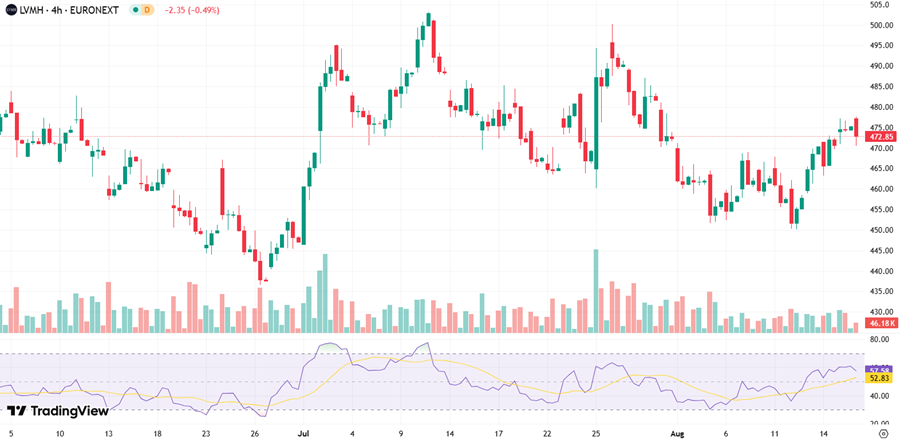
LVMH stock price dynamics (June 2025 - August 2025). Source: TradingView
Despite the weak technical posture, the stock’s valuation remains relatively resilient. LVMH trades at a forward P/E ratio of around 20.5x, which is in line with its 5-year average. However, the PEG ratio is now above 3.0, indicating earnings growth may not be sufficient to justify the current valuation if macro conditions deteriorate.
Luxury resilience offsets wine and spirits crisis
Investor sentiment toward LVMH is currently defined by two opposing dynamics. On one hand, demand for experiential luxury remains strong, driven by a resilient high-net-worth consumer base in the U.S., China, and the Middle East. LVMH’s aggressive expansion into experiential retail, such as the launch of a flagship Louis Vuitton store in Shanghai designed like an ocean liner, continues to generate strong brand engagement. Meanwhile, LVMH’s Fashion & Leather Goods division, led by Louis Vuitton and Dior, reported stable growth in H1 2025, reinforcing the group's ability to preserve pricing power despite economic headwinds.
On the other hand, a sharp deterioration in the Wines & Spirits segment is raising red flags. Moët Hennessy has transitioned from generating over €1 billion in annual cash flow in 2019 to burning €1.5 billion in 2024. The causes include over-aggressive pricing strategies, internal cultural conflicts, and costly acquisitions that have failed to deliver returns. This underperformance has led some analysts to question the segment’s long-term strategic fit within the group.
Additionally, recent discussions around potentially spinning off the Wines & Spirits division have not yet materialized, leading to investor uncertainty. LVMH CEO Bernard Arnault has so far remained committed to integrating the spirits business, despite internal calls for operational separation.
Price forecast and risk scenarios
Looking forward, LVMH’s price action is likely to remain range-bound until clear evidence emerges of either a rebound in spirits profitability or further deterioration in consumer sentiment. Volatility may remain elevated in the short term as traders react to macro data and sector-specific headlines.
In the bullish case, if the group executes successfully on retail expansion and the HNW segment remains resilient, LVMH could reclaim its 50-day moving average and test the €500 level. A strong Q3 performance in Fashion & Leather Goods would provide the necessary catalyst for this move.
LVMH’s 2025 underperformance is partly driven by revived U.S.-EU trade tensions, with new tariffs adding pressure to luxury import costs. Even with a cap at 15%, the policy shift could cost luxury firms up to €7.5 billion annually, weighing on margins and pricing strategies.













-
 Afghanistan
-
 Albania
-
 Algeria
-
 Angola
-
 Argentina
-
 Armenia
-
 Australia
-
 Austria
-
 Azerbaijan
-
 Bahamas
-
 Bahrain
-
 Bangladesh
-
 Belarus
-
 Belgium
-
 Bolivia
-
 Botswana
-
 Brazil
-
 Brunei
-
 Bulgaria
-
 Cambodia
-
 Cameroon
-
 Canada
-
 Chile
Chile
-
 China
China
-
 Colombia
-
 Congo
Congo
-
 Costa Rica
-
 Cote d'Ivoire
-
 Croatia
-
 Cuba
Cuba
-
 Cyprus
-
 Czechia
-
 DR Congo
-
 Denmark
-
 Dominican Republic
-
 Ecuador
-
 Egypt
Egypt
-
 El Salvador
-
 Estonia
-
 Eswatini
-
 Ethiopia
-
 Finland
-
 France
-
 Georgia
-
 Germany
-
 Ghana
Ghana
-
 Greece
-
 Haiti
Haiti
-
 Hong Kong
-
 Hungary
-
 India
India
-
 Indonesia
-
 Iran, Islamic republic
-
 Iraq
Iraq
-
 Ireland
-
 Israel
-
 Italy
Italy
-
 Jamaica
-
 Japan
Japan
-
 Jordan
-
 Kazakhstan
-
 Kenya
Kenya
-
 Korea
Korea
-
 Kuwait
-
 Kyrgyzstan
-
 Laos
Laos
-
 Latvia
-
 Lebanon
-
 Lesotho
-
 Libya
Libya
-
 Lithuania
-
 Luxembourg
-
 Madagascar
-
 Malaysia
-
 Malta
Malta
-
 Mauritius
-
 Mexico
-
 Moldova
-
 Mongolia
-
 Montenegro
-
 Morocco
-
 Mozambique
-
 Myanmar
-
 Namibia
-
 Nepal
Nepal
-
 Netherlands
-
 New Zealand
-
 Nigeria
-
 North Macedonia
-
 Norway
-
 Oman
Oman
-
 Pakistan
-
 Palestine
-
 Panama
-
 Papua New Guinea
-
 Paraguay
-
 Peru
Peru
-
 Philippines
-
 Poland
-
 Portugal
-
 Puerto Rico
-
 Qatar
Qatar
-
 Reunion
-
 Romania
-
 Rwanda
-
 Saudi Arabia
-
 Serbia
-
 Singapore
-
 Slovakia
-
 Slovenia
-
 Somalia
-
 South Africa
-
 Spain
Spain
-
 Sri Lanka
-
 Sweden
-
 Switzerland
-
 Syria
Syria
-
 Taiwan
-
 Tajikistan
-
 Tanzania
-
 Thailand
-
 Trinidad and Tobago
-
 Tunisia
-
 Turkey
-
 UAE
UAE
-
 Uganda
-
 Ukraine
-
 United Kingdom
-
United States
-
 Uruguay
-
 Uzbekistan
-
 Venezuela
-
 Vietnam
-
 Yemen
Yemen
-
 Zambia
-
 Zimbabwe
- Forex
- Crypto












