
Nvidia stock drops 3.1% amid statement touting lead over Google in AI race

As of November 26, Nvidia stock is trading at $176.86, down 3.1% in the last 24 hours. The recent decline comes as part of a broader pullback in high-growth AI equities and amid renewed competitive concerns triggered by Google’s advancements in custom AI chips.
Highlights
- Nvidia shares dropped 3.1% after reports that Meta may buy Google’s custom AI chips.
- The company responded by asserting it remains a generation ahead and continues to supply Google.
- Investors are watching closely as competition in the AI chip market intensifies.
Technically, Nvidia remains in a consolidation pattern, with shares fluctuating between $170 and $200 in recent weeks. NVDA is now trading below its recent swing high of $212.19, which marks the 52-week peak, and sits roughly 17% off those highs. Over the past month, the stock has encountered repeated resistance around the $200 level — a psychological barrier that aligns with prior congestion zones from August. Meanwhile, the downside has so far been cushioned by a key support cluster between $170 and $172. Should this support range break, the next level to watch would be around $162, coinciding with the 50-day moving average and a minor volume gap.
The longer-term technical posture remains bullish, with the 200-day moving average trending upward near the $155 level. This level is considered a strong longer-term support zone should a deeper correction unfold. Short-term momentum indicators, such as the Relative Strength Index (RSI), are cooling from overbought territory, currently hovering near neutral readings, which reflects an indecisive trading environment.
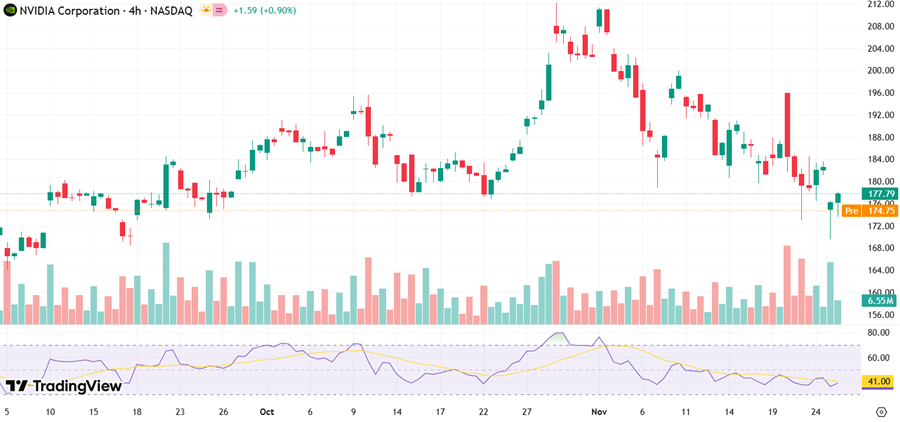
Nvidia stock price dynamics (September 2025 - November 2025). Source: TradingView
Volume trends also point to growing hesitation. Despite Nvidia's prior rallies on strong earnings and AI infrastructure demand, recent sessions have shown heavier selling on down days — suggesting distribution among institutional holders. For now, NVDA remains range-bound, and traders are watching for a decisive breakout above $200 or breakdown below $170 to confirm direction.
Google’s AI chip push threatens Nvidia’s dominance
The latest market pullback in Nvidia stock has been sharply accelerated by signs of intensifying competition in its most critical business line — AI data-center chips. Meta Platforms is in discussions with Google to potentially spend billions of dollars on Google's custom Tensor Processing Units (TPUs) to power its expanding data-center infrastructure. This development signals that hyperscalers are actively exploring alternatives to Nvidia’s high-performance, but often expensive, GPUs.
Nvidia swiftly responded to the report via a statement posted on X (formerly Twitter), defending its leadership position. "Nvidia is a generation ahead of the industry — it's the only platform that runs every AI model and does it everywhere computing is done," the company said. The chipmaker also maintained a cooperative tone toward its competitors, adding, "We're delighted by Google's success — they've made great advances in AI and we continue to supply to Google." However, despite the diplomatic language, the sharp drop in share price reflects investor concern that large-scale customers may begin to diversify away from Nvidia's ecosystem. The possibility of losing exclusivity with clients like Meta, or seeing them shift part of their compute spend toward custom chips, represents a meaningful threat to Nvidia’s growth trajectory.
Google, for its part, emphasized that the demand environment is robust for both types of chips. "We are experiencing accelerating demand for both our custom TPUs and Nvidia GPUs; we are committed to supporting both, as we have for years," a Google spokesperson said. While this suggests that Nvidia will remain an integral supplier in the near term, the shift toward vertical integration — with Google controlling the software (TensorFlow), hardware (TPUs), and cloud distribution (Google Cloud) — could create long-term structural pressure.
Consolidation or correction as pivotal levels approach
In a base-case scenario, if NVDA holds the $170 support area and broader tech sentiment stabilizes, a rebound toward $190–200 is likely in the next 4 to 6 weeks. This move would be contingent on improved investor confidence, clarity around AI-chip competition, or new business wins for Nvidia. A break above $200 would reopen the path toward the 52-week high of $212 and possibly new highs if fundamentals continue to support expansion.
However, if selling accelerates and Nvidia falls below $170 with strong volume, the stock could swiftly retest $162 and potentially $155 — the area of the rising 200-day moving average. A move into this zone would suggest a medium-term correction is underway, likely driven by investor rotation out of AI-heavy positions and growing competitive fears.
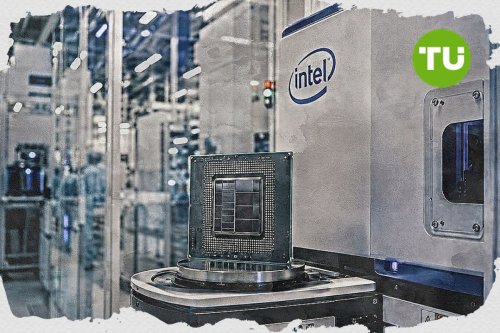
Nvidia’s dominance in the AI chip market came under pressure after reports that Meta is in talks to adopt Google’s custom TPUs for its data centers. If finalized, the deal would represent the biggest move yet by a major tech firm away from Nvidia’s industry-leading GPUs.













-
 Afghanistan
-
 Albania
-
 Algeria
-
 Angola
-
 Argentina
-
 Armenia
-
 Australia
-
 Austria
-
 Azerbaijan
-
 Bahamas
-
 Bahrain
-
 Bangladesh
-
 Belarus
-
 Belgium
-
 Bolivia
-
 Botswana
-
 Brazil
-
 Brunei
-
 Bulgaria
-
 Cambodia
-
 Cameroon
-
 Canada
-
 Chile
Chile
-
 China
China
-
 Colombia
-
 Congo
Congo
-
 Costa Rica
-
 Cote d'Ivoire
-
 Croatia
-
 Cuba
Cuba
-
 Cyprus
-
 Czechia
-
 DR Congo
-
 Denmark
-
 Dominican Republic
-
 Ecuador
-
 Egypt
Egypt
-
 El Salvador
-
 Estonia
-
 Eswatini
-
 Ethiopia
-
 Finland
-
 France
-
 Georgia
-
 Germany
-
 Ghana
Ghana
-
 Greece
-
 Haiti
Haiti
-
 Hong Kong
-
 Hungary
-
 India
India
-
 Indonesia
-
 Iran, Islamic republic
-
 Iraq
Iraq
-
 Ireland
-
 Israel
-
 Italy
Italy
-
 Jamaica
-
 Japan
Japan
-
 Jordan
-
 Kazakhstan
-
 Kenya
Kenya
-
 Korea
Korea
-
 Kuwait
-
 Kyrgyzstan
-
 Laos
Laos
-
 Latvia
-
 Lebanon
-
 Lesotho
-
 Libya
Libya
-
 Lithuania
-
 Luxembourg
-
 Madagascar
-
 Malaysia
-
 Malta
Malta
-
 Mauritius
-
 Mexico
-
 Moldova
-
 Mongolia
-
 Montenegro
-
 Morocco
-
 Mozambique
-
 Myanmar
-
 Namibia
-
 Nepal
Nepal
-
 Netherlands
-
 New Zealand
-
 Nigeria
-
 North Macedonia
-
 Norway
-
 Oman
Oman
-
 Pakistan
-
 Palestine
-
 Panama
-
 Papua New Guinea
-
 Paraguay
-
 Peru
Peru
-
 Philippines
-
 Poland
-
 Portugal
-
 Puerto Rico
-
 Qatar
Qatar
-
 Reunion
-
 Romania
-
 Rwanda
-
 Saudi Arabia
-
 Serbia
-
 Singapore
-
 Slovakia
-
 Slovenia
-
 Somalia
-
 South Africa
-
 Spain
Spain
-
 Sri Lanka
-
 Sweden
-
 Switzerland
-
 Syria
Syria
-
 Taiwan
-
 Tajikistan
-
 Tanzania
-
 Thailand
-
 Trinidad and Tobago
-
 Tunisia
-
 Turkey
-
 UAE
UAE
-
 Uganda
-
 Ukraine
-
 United Kingdom
-
United States
-
 Uruguay
-
 Uzbekistan
-
 Venezuela
-
 Vietnam
-
 Yemen
Yemen
-
 Zambia
-
 Zimbabwe
- Forex
- Crypto












