
Quotex Regulation: Is This Broker Regulated Or Not?


Editorial Note: While we adhere to strict Editorial Integrity, this post may contain references to products from our partners. Here's an explanation for How We Make Money. None of the data and information on this webpage constitutes investment advice according to our Disclaimer.
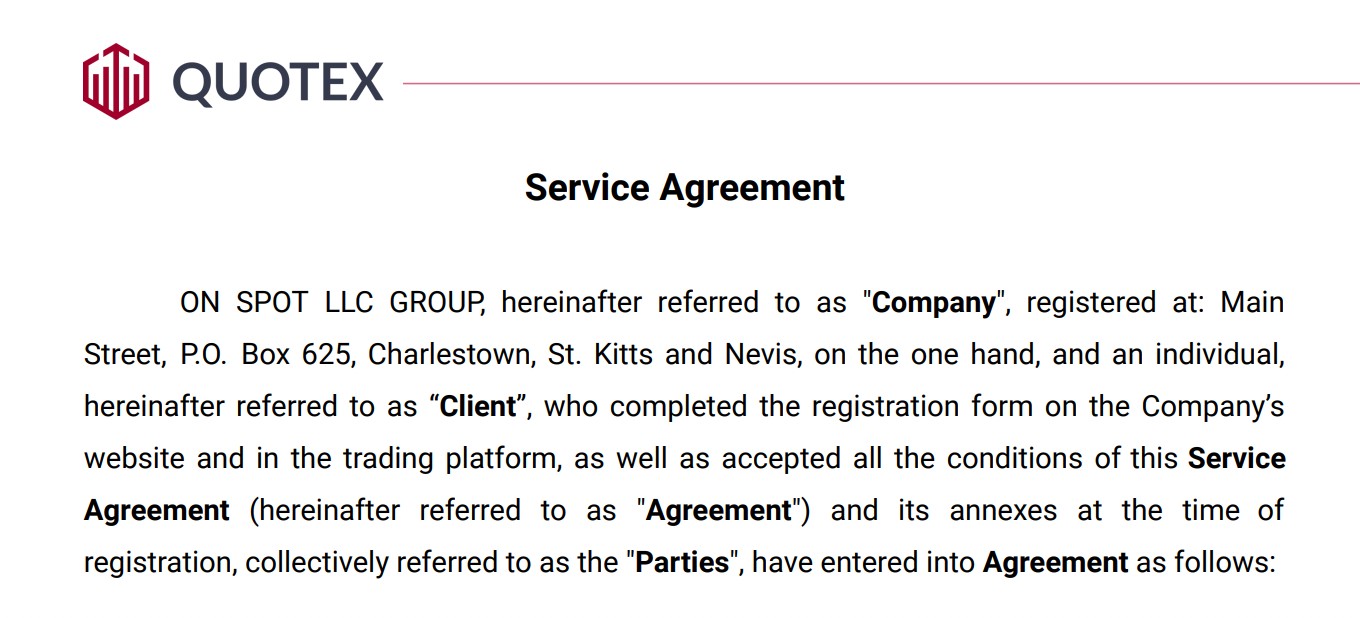
QUOTEX operates under ON SPOT LLC GROUP, which is registered in St. Kitts and Nevis. However, it is not regulated by major financial authorities such as the FCA or CySEC. Due to the absence of top-tier regulatory oversight, investors are advised to conduct thorough research and assess potential risks before using the platform.
Regulation in the trading industry ensures that brokers operate under strict guidelines. Quotex operates under strict rules and regulations that help protect traders from fraud, manipulation, and financial instability. A regulated broker must follow compliance requirements, including financial transparency, segregation of client funds, and fair trading practices. Many traders often wonder, is Quotex officially recognized and properly regulated, given its offshore registration? This makes it essential to understand how its structure compares to fully regulated platforms. Regulatory authorities such as the Financial Conduct Authority (FCA) in the UK and the Cyprus Securities and Exchange Commission (CySEC) oversee brokers to ensure their legitimacy and security.
Risk warning: Binary options trading is highly risky and may result in a total loss of funds. These speculative instruments often lack strong regulation, with over 80% of traders losing their capital. Invest only what you can afford to lose and seek professional advice.
Is Quotex a regulated broker?
Regulation. QUOTEX’s legitimacy is supported by the fact that its operating company, ON SPOT LLC GROUP, is registered in St. Kitts and Nevis.
Security. Uses SSL encryption, 2FA, and fund segregation for trader protection.
Trading. Offers 50+ assets, $1 minimum trade, and up to 98% payout.
Deposits/withdrawals. $10 minimum deposit, withdrawals take up to 5 days, and verification is required for amounts over $5,000.
Key consideration. Lacks major regulatory approval and investor compensation schemes.
Quotex follows a specific regulation framework, but as an offshore-regulated broker, traders should verify its policies before investing.
What does it mean for a broker to be regulated?

A regulated broker operates under the supervision of financial authorities, ensuring fair trading practices, fund security, and transparency. Regulators like the FCA or CySEC set rules brokers must follow, such as segregating client funds and preventing fraud. Being regulated means a broker is accountable and meets strict standards, offering traders more protection. If a broker lacks top-tier regulation, investors may face higher risks, including weak oversight and limited recourse in case of disputes or financial issues.
All Forex Regulators Reviews


The role of compliance and licensing in trading platforms
Licensing is crucial for a trading platform as it provides legal security and reassurance to traders. Many traders often ask, is Quotex officially recognized as a regulated broker, ensuring compliance with industry standards? Quotex, if properly licensed and regulated, must follow anti-money laundering (AML) and Know Your Customer (KYC) regulations to ensure that all transactions are monitored and protected against fraud. Additionally, a regulated trading platform must safeguard client funds and offer compensation schemes in case of insolvency.
Regulatory compliance plays a significant role in ensuring that a trading platform upholds ethical and financial standards. Without proper oversight, traders may face risks such as fraud or inadequate fund protection. This is why many seek clarity on whether Quotex broker operates under the supervision of a recognized body and is fully regulated, providing traders with a secure and transparent environment.
Key regulatory authorities for brokers
Several global regulatory bodies oversee brokers and trading platforms, each with its own set of rules:
FCA (UK). Ensures financial integrity and client protection. More than 55,000 firms operate under its supervision.
CySEC (Cyprus). Regulates European brokers under MiFID guidelines, with over 280 regulated firms.
Commodity Futures Trading Commission (CFTC) and National Futures Association (NFA) (USA). Oversee derivatives and Forex trading, ensuring compliance with strict capital requirements.
Australian Securities and Investments Commission (ASIC). Regulates over 2,000 financial entities in Australia.
Financial Sector Conduct Authority (FSCA) (South Africa). Supervises more than 6,000 registered financial services providers.
Traders should always check a broker's certification and authorization status before investing. This helps determine whether Quotex is officially licensed and properly regulated to meet necessary governance and accountability standards.
Is Quotex a regulated broker?
Quotex is an online trading platform offering digital options trading. Many traders often ask, is Quotex broker fully recognized and properly regulated before deciding to invest. This concern arises from the need for fund security and reliable oversight. Quotex operates under Awesomo Ltd., a company registered in Seychelles, following specific rules designed to maintain compliance and regulations that outline operational standards.
Quotex is managed by ON SPOT LLC GROUP, a company registered in St. Kitts and Nevis. However, the platform does not fall under the regulation of leading financial authorities like the FCA or CySEC. Given the lack of oversight from top-tier regulators, prospective investors should carefully evaluate the platform's credibility, assess potential risks, and conduct thorough due diligence before trading.
Does Quotex hold any trading license?
Quotex’s regulation does not fall under major financial authorities such as the FCA or CySEC, as it operates as an independent trading platform. This means traders should exercise caution and take time to understand how Quotex is officially regulated before investing. Regulatory oversight plays a crucial role in ensuring compliance with industry standards and enhancing platform reliability in financial markets.
How Quotex ensures security and compliance?
Despite lacking strict regulatory oversight, Quotex broker employs several security measures:
SSL encryption for data protection to safeguard user data against cyber threats.
Two-factor authentication (2FA) for account security to prevent unauthorized access.
Transparent deposit and withdrawal policies ensuring that transactions follow clear, documented procedures.
Segregation of client funds from operational funds to reduce risks of financial mismanagement.
By implementing these security measures, Quotex aims to enhance its transparency and authenticity, offering traders a safer trading environment.
Quotex rules and regulations
Traders should fully understand Quotex’s rules and regulations before using the platform. It has established rules and policies to ensure smooth trading operations, including deposit and withdrawal terms, trading conditions, and compliance standards.
Deposit and withdrawal policies
Minimum deposit. $10.
Supported payment methods. Credit/debit cards, cryptocurrencies, e-wallets (with more than 10 supported currencies).
Processing time. Instant for deposits, up to 5 business days for withdrawals.
Withdrawal limits. No maximum withdrawal limit, but verification is required for large sums exceeding $5,000.
Potential fees. No internal withdrawal fees, but third-party transaction fees may apply.
Before making transactions, traders should perform proper verification of their accounts to avoid delays. This additional validation step enhances platform security and helps prevent unauthorized access.
Trading conditions and compliance standards
As highlighted in the Quotex review, the company offers the following trading conditions:
Minimum trade amount: $1.
Maximum trade amount: $1,000 per transaction.
Leverage: Not applicable (fixed payout digital options trading).
Market availability: More than 50 assets, including Forex, commodities, cryptocurrencies, and indices.
Payout percentage: Up to 98% for successful trades.
Following industry standards, traders often ask whether Quotex is fully licensed and properly regulated to ensure fair and transparent trading conditions. This helps users understand potential risks and rewards.
How to verify the legitimacy of a broker?
Before trading on any platform, it is crucial to verify its legitimacy. Many traders look for clarity on whether Quotex is regulated by authorities or not, as regulation ensures that traders’ funds are protected. Here are some steps to take:
Signs of a reliable and regulated broker
Holds a license from a recognized financial regulator.
Offers fund protection and compensation schemes.
Provides transparent trading conditions.
Has positive independent reviews and ratings.
Offers reliable customer support, with response times under 24 hours.
How to check a broker’s regulation status?
Visit the broker's official website for regulatory details.
Cross-check with official regulatory websites like FCA, ASIC, or CySEC.
Look for customer complaints and independent reviews on trusted trading forums.

A trader should always check the jurisdiction in which the broker operates, ensuring that the company follows legal enforcement practices to protect investors.
In trading, opportunity matters – but legal protection matters more

The key question is not whether a platform functions well – but what legal protection you actually have if something goes wrong.
When I evaluate a broker without top-tier regulation, I immediately adjust my approach. I treat it as a higher-risk counterparty. That means smaller deposits, more frequent withdrawals, and zero long-term capital storage on the platform. I never leave significant funds sitting in an environment where there is no strong external oversight or investor compensation framework.
Another point I always consider is dispute resolution. If a conflict arises – execution issues, withdrawal delays, account restrictions – who enforces fairness? With fully regulated brokers, there is a formal escalation path. Without that, your leverage as a client is limited.
My recommendation is simple: if you choose to trade on a platform operating outside major regulatory jurisdictions, do so with controlled exposure. Use it tactically, not as your primary trading base. And if capital protection is your top priority, I would personally favor brokers supervised by recognized authorities where accountability is clearly defined.
Conclusion: Should you trade on Quotex?
While Quotex provides an easy-to-use platform with competitive payouts, many traders ask, is Quotex officially licensed and fully regulated like other major brokers? Its lack of government-backed regulation creates potential risks for traders. However, for those who are comfortable with offshore oversight and independent security measures, it remains a viable trading option.
Pros and cons of using Quotex
- Pros
- Cons
- User-friendly interface
- Low minimum deposit
- Various payment methods
- High payout percentages
- Over 50 tradable assets
- Not regulated by major financial authorities
- IFMRRC regulation does not provide legal protection
- Limited investor compensation schemes
- Not available in some countries
- Offshore regulation may raise concerns
Final thoughts on Quotex regulation
Many traders are still uncertain about whether Quotex is officially regulated, given its offshore registration For those wondering whether Quotex is recognized as a regulated broker, the platform operates independently and does not hold licensing from major financial authorities such as the FCA or CySEC. Traders seeking higher investor protection should consider brokers regulated by well-established financial institutions.
Despite this, Quotex offers a structured trading experience for users who understand and accept its regulatory framework. With a focus on transparency and compliance, the platform continues to develop its reputation, even though it lacks accreditation from top-tier regulators.
FAQs
Is Quotex a regulated broker?
Quotex operates independently and does not hold licensing from major financial regulators such as the FCA, CySEC, or ASIC.
Who oversees Quotex’s regulation?
Quotex is registered under ON SPOT LLC GROUP in St. Kitts and Nevis, but it does not have oversight from top-tier regulatory bodies.
Does Quotex have investor protection?
No, since IFMRRC is a private regulator, there is no official investor compensation scheme like those offered by FCA or ASIC-regulated brokers.
Is it safe to trade on Quotex?
Quotex uses SSL encryption, 2FA, and fund segregation, but as an offshore broker, it lacks major regulatory protections — traders should assess risks before investing.
Related Articles
Team that worked on the article
Mikhail Vnuchkov joined Traders Union as an author in 2020. He began his professional career as a journalist-observer at a small online financial publication, where he covered global economic events and discussed their impact on the segment of financial investment, including investor income.
Dan Blystone began his trading career in 1998 as an arbitrage clerk on the floor of the Chicago Mercantile Exchange (CME). He later traded bond and Eurex futures at proprietary firms such as Altea Trading, gaining valuable experience in high-frequency trading and risk management.
Chinmay Soni is a financial analyst with more than 5 years of experience in working with stocks, Forex, derivatives, and other assets. As a founder of a boutique research firm and an active researcher, he covers various industries and fields, providing insights backed by statistical data.
-
 Afghanistan
-
 Albania
-
 Algeria
-
 Angola
-
 Argentina
-
 Armenia
-
 Australia
-
 Austria
-
 Azerbaijan
-
 Bahamas
-
 Bahrain
-
 Bangladesh
-
 Belarus
-
 Belgium
-
 Bolivia
-
 Botswana
-
 Brazil
-
 Brunei
-
 Bulgaria
-
 Cambodia
-
 Cameroon
-
 Canada
-
 Chile
Chile
-
 China
China
-
 Colombia
-
 Congo
Congo
-
 Costa Rica
-
 Cote d'Ivoire
-
 Croatia
-
 Cuba
Cuba
-
 Cyprus
-
 Czechia
-
 DR Congo
-
 Denmark
-
 Dominican Republic
-
 Ecuador
-
 Egypt
Egypt
-
 El Salvador
-
 Estonia
-
 Eswatini
-
 Ethiopia
-
 Finland
-
 France
-
 Georgia
-
 Germany
-
 Ghana
Ghana
-
 Greece
-
 Haiti
Haiti
-
 Hong Kong
-
 Hungary
-
 India
India
-
 Indonesia
-
 Iran, Islamic republic
-
 Iraq
Iraq
-
 Ireland
-
 Israel
-
 Italy
Italy
-
 Jamaica
-
 Japan
Japan
-
 Jordan
-
 Kazakhstan
-
 Kenya
Kenya
-
 Korea
Korea
-
 Kuwait
-
 Kyrgyzstan
-
 Laos
Laos
-
 Latvia
-
 Lebanon
-
 Lesotho
-
 Libya
Libya
-
 Lithuania
-
 Luxembourg
-
 Madagascar
-
 Malaysia
-
 Malta
Malta
-
 Mauritius
-
 Mexico
-
 Moldova
-
 Mongolia
-
 Montenegro
-
 Morocco
-
 Mozambique
-
 Myanmar
-
 Namibia
-
 Nepal
Nepal
-
 Netherlands
-
 New Zealand
-
 Nigeria
-
 North Macedonia
-
 Norway
-
 Oman
Oman
-
 Pakistan
-
 Palestine
-
 Panama
-
 Papua New Guinea
-
 Paraguay
-
 Peru
Peru
-
 Philippines
-
 Poland
-
 Portugal
-
 Puerto Rico
-
 Qatar
Qatar
-
 Reunion
-
 Romania
-
 Rwanda
-
 Saudi Arabia
-
 Serbia
-
 Singapore
-
 Slovakia
-
 Slovenia
-
 Somalia
-
 South Africa
-
 Spain
Spain
-
 Sri Lanka
-
 Sweden
-
 Switzerland
-
 Syria
Syria
-
 Taiwan
-
 Tajikistan
-
 Tanzania
-
 Thailand
-
 Trinidad and Tobago
-
 Tunisia
-
 Turkey
-
 UAE
UAE
-
 Uganda
-
 Ukraine
-
 United Kingdom
-
United States
-
 Uruguay
-
 Uzbekistan
-
 Venezuela
-
 Vietnam
-
 Yemen
Yemen
-
 Zambia
-
 Zimbabwe
- Forex
- Crypto












