
Forex Gold Trading | All You Need To Know


Editorial Note: While we adhere to strict Editorial Integrity, this post may contain references to products from our partners. Here's an explanation for How We Make Money. None of the data and information on this webpage constitutes investment advice according to our Disclaimer.
To trade gold in Forex, beginners use the XAU/USD pair through a regulated broker. Gold is traded as a derivative, not as physical metal, allowing traders to profit from price movements in both directions. Successful trading requires basic technical and fundamental analysis, proper risk management, and trading during high liquidity market hours.
Gold has long been viewed as a safe haven asset, valued for its ability to retain value during periods of economic uncertainty. In the Forex market, gold plays a different role. Instead of owning physical metal, traders access gold through currency style trading instruments that track its price movements.
For beginners, trading gold on Forex offers a flexible entry point into the commodity market. It allows traders to use familiar Forex platforms, apply standard analysis tools, and start with relatively small capital. Understanding how this market works, how gold prices behave, and how risk is controlled is essential before placing the first trade.
Risk warning: Forex trading carries high risks, with potential losses including your entire deposit. Market fluctuations, economic instability, and geopolitical factors impact outcomes. Studies show that 70-80% of traders lose money. Consult a financial advisor before trading.
How gold trading works on Forex
Before learning how to trade, it is important to understand what gold on Forex actually means. On Forex platforms, gold is traded under the symbol XAU, most commonly paired with the U.S. dollar as XAU/USD. This pair reflects the price of one troy ounce of gold quoted in dollars.
When traders engage in gold on Forex, they are not buying physical metal such as bars or coins. Instead, they trade price movements using derivative instruments, most often contracts for difference. This setup allows traders to speculate on whether gold prices will rise or fall without owning the underlying asset.
So, can you trade gold on Forex? Yes. Most regulated Forex brokers offer access to XAU/USD alongside currency pairs. Gold is treated as a liquid, globally traded instrument, and it can be traded in both rising and falling markets.
For beginners, this structure makes gold accessible. Trading does not require storage, insurance, or large capital outlays. However, it also means that success depends entirely on market analysis, timing, and risk management rather than long term ownership.

Before placing your first gold trade, it helps to know where that trading actually happens. Using a broker that reliably offers XAU/USD access makes execution smoother and reduces avoidable friction when learning. The table below highlights some of the best brokers that offer gold trading, giving beginners a practical starting point before applying any strategy.
| Plus500 | OANDA | FOREX.com | IG Markets | Interactive Brokers | |
|---|---|---|---|---|---|
|
Gold |
Yes | Yes | Yes | Yes | Yes |
|
XAU/USD spread, pips |
45 | 30 | 35 | 30 | 15 |
|
XAU/USD commission, $ |
3 | 3 | 2.5 | No | 2 |
|
Min. deposit, $ |
100 | No | 100 | 1 | No |
|
Regulation |
CySEC, FCA, ASIC, FMA, FSCA, FSA Seychelles, EFSA, MAS, DFSA, SCB | FSC (BVI), ASIC, IIROC, FCA, CFTC, NFA | CIMA, FCA, FSA (Japan), NFA, IIROC, ASIC, CFTC | FCA, BaFin, ASIC, MAS, CySec, FINMA, BMA, CFTC, NFA | SEC, FINRA, SIPC, FCA, NSE, BSE, SEBI, SEHK, HKFE, IIROC, ASIC, CFTC, NFA |
|
TU overall score |
7.7 | 6.63 | 6.47 | 6.38 | 6.37 |
|
Open an account |
Go to broker 81% of retail CFD accounts lose money. |
Go to broker Your capital is at risk. |
Study review | Study review | Study review |
Why trade gold on Forex?
Trading gold on Forex offers clear benefits, but it also comes with specific risks. Understanding both sides helps beginners decide whether gold fits their trading style and risk tolerance.
Easy market access. Gold is traded through the XAU/USD pair on most Forex platforms, allowing traders to speculate on price movements without buying or storing physical metal.
High liquidity. Gold is one of the most actively traded assets globally, which usually results in tight spreads and fast order execution during major market sessions.
Portfolio diversification. Gold often moves independently of major currencies and equities, making it useful for balancing risk in Forex focused portfolios.
Hedging potential. During periods of economic uncertainty or U.S. dollar weakness, gold prices may rise, helping offset losses in currency positions.
High volatility risk. Gold reacts strongly to economic data, central bank decisions, and geopolitical events, which can lead to sharp and rapid price swings.
Leverage exposure. While leverage increases market access, it also amplifies losses, making poor risk control especially dangerous for beginners.
This balance of opportunity and risk is why trading gold on Forex requires clear rules, disciplined position sizing, and consistent risk management.
How gold behaves in the Forex market
Gold price movements on Forex are driven by a mix of macroeconomic, currency, and risk related factors. Beginners should understand these core drivers before applying any trading strategy.
Interest rates. When interest rates rise, gold often weakens because it does not generate yield. Lower or falling rates tend to support higher gold prices.
U.S. dollar strength. Gold is priced in U.S. dollars, so a stronger dollar usually pressures gold lower, while a weaker dollar often supports price gains.
Inflation expectations. Rising inflation or fears of declining purchasing power typically increase demand for gold as a value preservation asset.
Geopolitical risk. Political instability, military conflict, or global uncertainty often trigger safe haven demand, pushing gold prices higher.
Market sentiment. During risk off periods, investors tend to move capital into gold, while risk on environments may reduce demand.
Economic data releases. Reports such as CPI, employment data, and central bank announcements can cause sharp short term price movements.
Understanding these drivers helps traders anticipate potential price reactions and avoid trading blindly during high impact news events.

After understanding what drives gold prices on Forex, many beginners ask the same question: where is gold heading next? While no forecast can guarantee future price movements, traders still use gold outlooks and long-term scenarios to frame expectations, manage risk, and avoid trading against dominant macro forces.
In Forex gold trading, forecasts are not used as entry signals. Instead, they help traders understand whether the broader environment favors bullish, bearish, or range-bound behavior. This context is especially useful for swing traders and beginners who hold positions longer than a single session.
| Year | Price in the middle of the year | Price at the end of the year |
|---|---|---|
| 2026 | $4000 | $4300 |
| 2027 | $4400 | $4300 |
| 2028 | $4300 | $4100 |
| 2029 | $4400 | $4200 |
| 2030 | $4300 | $4400 |
| 2031 | $4300 | $4400 |
| 2032 | $4500 | $4600 |
| 2033 | $4900 | $5000 |
| 2034 | $4900 | $4900 |
| 2035 | $4900 | $4900 |
| 2036 | $5000 | $5100 |
| 2037 | $5400 | $5700 |
| 2038 | $6400 | $7400 |
| 2039 | $7500 | $7400 |
| 2040 | $7400 | $7300 |
How to trade gold on Forex
Before placing your first trade, it is important to set up the right foundation. Gold trading on Forex is accessible, but preparation plays a major role in managing risk and avoiding beginner mistakes.
Confirm gold availability. Most regulated Forex brokers offer gold under the XAU/USD symbol, which allows trading gold against the U.S. dollar.
Choose a regulated broker. Look for brokers licensed by recognized authorities such as FCA, ASIC, or CySEC, with transparent pricing and reliable execution.
Check trading conditions. Review spreads on XAU/USD, margin requirements, leverage limits, and whether negative balance protection is available.
Open the right account type. Beginners often start with a demo account to practice, then move to a standard or micro account with lower position sizes.
Select a trading platform. Popular platforms such as MetaTrader 4 or MetaTrader 5 provide the tools needed for technical analysis and order management.
Understand costs and risks. Be aware of overnight swap fees, commission structures, and how leverage affects potential losses.
Trading styles for gold on Forex
Once you understand how to trade gold on Forex, the next step is choosing a trading style that fits your time availability, risk tolerance, and experience level. Gold behaves differently across timeframes, so strategy selection matters.
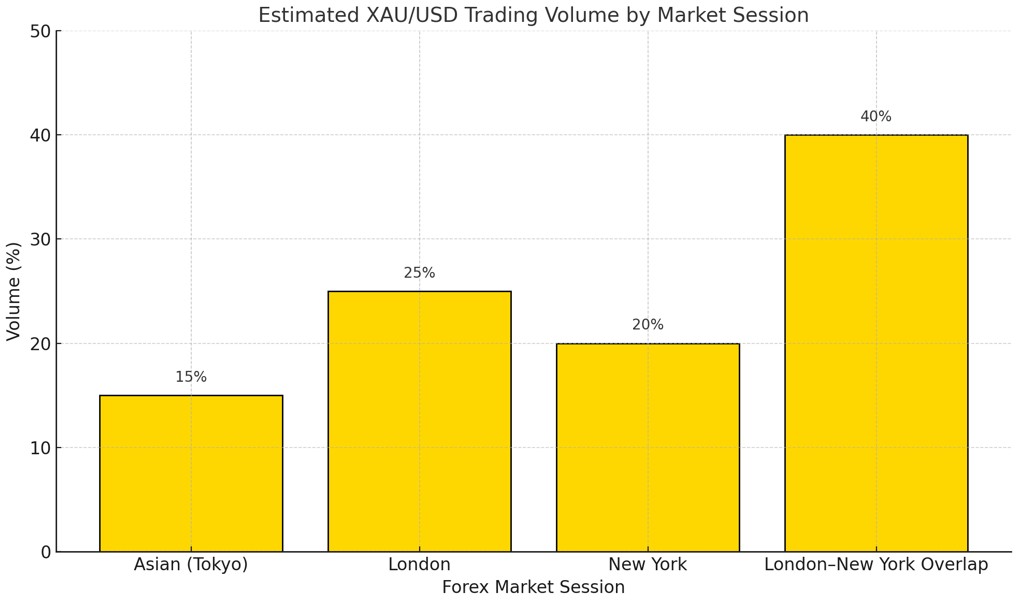
Day trading gold. Day traders open and close positions within the same trading day, focusing on short term price movements in XAU/USD. This style relies on intraday technical analysis and works best during high liquidity periods such as the London and New York session overlap.
Swing trading gold. Swing traders hold positions for several days, aiming to capture medium term price moves. This approach combines technical setups with macro factors such as interest rate expectations, inflation data, and U.S. dollar trends.
Trend following. Trend traders focus on identifying sustained upward or downward moves in gold prices. Tools such as moving averages and trendlines help confirm direction, making this style suitable for traders who prefer fewer but more structured trades.
News based trading. Some traders specialize in reacting to economic releases and geopolitical events. Gold often responds sharply to inflation reports, central bank statements, and global risk events, making this style high risk but potentially high reward.
For beginners, swing trading or trend following is often easier to manage than fast paced day trading. Choosing one style and mastering it is far more effective than switching strategies frequently.
How to build a gold trading strategy
When building a gold trading strategy, keep the following things in mind:
Understanding how to trade gold in Forex
If you're exploring how to trade gold in Forex, your first step is mastering both technical and fundamental analysis. Gold is sensitive to market news, so economic calendars and breaking news feeds are essential tools.
Fundamental events such as Federal Reserve speeches, CPI reports, or geopolitical tensions should inform your bias (bullish or bearish). Technical tools like Bollinger Bands, RSI, and Fibonacci retracements help refine your entry and exit points.
Using smart money management
Any guide on how to trade gold in Forex for beginners must stress risk control. Use position sizing and stop-loss orders to limit your downside. Many traders cap their risk at 1–2% of their capital per trade.
A common beginner mistake is overtrading or using high leverage. Gold is already volatile, so small changes in price can cause significant gains, or losses, especially in leveraged accounts.
Best time to trade gold on Forex
Timing plays an important role when trading gold on Forex because liquidity and volatility change throughout the day. Trading during active market hours helps reduce spreads, improve execution, and increase the reliability of price signals.
The most active period for gold trading is when the London and New York sessions overlap. This window typically runs from 12:00 to 16:00 UTC and is when institutional traders, banks, and large funds are most active. During this time, gold prices often show stronger momentum and clearer intraday trends.
Gold also reacts strongly to U.S. economic data releases, such as inflation reports, employment figures, and Federal Reserve announcements. These events often occur during the New York session and can trigger sharp price movements. Beginners should be cautious around news releases, as volatility can increase rapidly.
Outside of peak hours, such as during the Asian session, gold trading tends to be quieter with narrower ranges. This environment may suit range based strategies, but it also increases the risk of false breakouts.
For beginners learning how to trade gold on Forex, focusing on high liquidity periods is usually the safest approach. Better execution and clearer price behavior make it easier to apply analysis and manage risk consistently.
Common mistakes and how to avoid them
Many beginners struggle with gold trading on Forex not because of poor analysis, but due to avoidable mistakes. Recognizing these issues early helps protect capital and build consistent habits.
Using excessive leverage. Gold is already volatile, and high leverage can quickly turn small price moves into large losses. Beginners should start with low leverage and increase exposure only after gaining experience.
Ignoring fundamental events. Economic data, interest rate decisions, and geopolitical news have an immediate impact on gold prices. Trading without monitoring these events often leads to unexpected losses.
Trading without a plan. Entering trades without clear entry, exit, and risk rules leads to emotional decisions. A structured trading plan is essential when learning how to trade gold on Forex.
Overtrading the market. Opening too many positions increases costs and emotional stress. Focusing on fewer, higher quality setups improves discipline and results.
Chasing price movements. Entering trades after sharp moves usually results in poor timing. Waiting for confirmation helps avoid buying tops or selling bottoms.
Failing to review trades. Not analyzing past trades prevents improvement. Regular trade reviews help identify patterns, mistakes, and areas to refine.
Avoiding these mistakes does not guarantee profits, but it significantly improves the odds of long term consistency in Forex gold trading.
Gold News and Precious Metal & Commodity Market Updates

Weiss Ratings sees gold pullback as entry point for precious metals investors

US interest rates expected higher for longer keep Gold capped

XAU holds steady as resistance caps upside momentum

India’s gold loan sector faces scrutiny over credit quality risks amid rapid growth

Gold drops below $4,000 as Wall Street selloff sparks liquidity crunch

Gold heads for weekly loss as oil-driven rate concerns pressure bullion
Structure and patience beat speed in gold trading

When I work with traders who are new to gold on Forex, I emphasize structure over speed. Gold attracts beginners because of its volatility, but that same volatility punishes traders who rush into positions without a clear plan. A reliable setup, sensible leverage, and consistent risk limits matter far more than trying to catch every price move.
From my experience, the most successful beginners treat trading gold on Forex as a skill to be built gradually. They focus on one trading style, trade during liquid market hours, and review their results regularly. Gold rewards discipline and patience, not impulse decisions.
Conclusion
Trading gold on Forex offers beginners the opportunity to profit from one of the world's most liquid and responsive markets without the need to own physical metal. Success in this arena hinges on disciplined risk management, thoughtful strategy selection, and consistent attention to both technical and fundamental drivers like U.S. economic data and global geopolitical events. For example, focusing on the high liquidity overlap of the London and New York sessions can provide better trade execution, while using low leverage protects against the metal’s inherent volatility. Remember, in gold trading, a structured approach and patience are more valuable than chasing quick, impulsive gains.
FAQs
What are the main risks involved in trading gold on Forex for beginners?
How is gold trading on Forex different from buying physical gold?
Which economic events tend to cause the largest price moves in the gold market on Forex?
How does gold help with portfolio diversification in Forex trading?
Editors' Top Picks and Insights





Related Articles
Team that worked on the article
Aleksandra Chaikina has been a contributor to Traders Union since 2021. With over 15 years of experience in copywriting and more than 5 years focused on financial content, she specializes in producing detailed guides, analytics, and comparative reviews across various sectors, including cryptocurrencies, Forex, investment strategies, and financial technologies.
Dan Blystone began his trading career in 1998 as an arbitrage clerk on the floor of the Chicago Mercantile Exchange (CME). He later traded bond and Eurex futures at proprietary firms such as Altea Trading, gaining valuable experience in high-frequency trading and risk management.
Chinmay Soni is a financial analyst with more than 5 years of experience in working with stocks, Forex, derivatives, and other assets. As a founder of a boutique research firm and an active researcher, he covers various industries and fields, providing insights backed by statistical data.
Volatility refers to the degree of variation or fluctuation in the price or value of a financial asset, such as stocks, bonds, or cryptocurrencies, over a period of time. Higher volatility indicates that an asset's price is experiencing more significant and rapid price swings, while lower volatility suggests relatively stable and gradual price movements.
Forex trading, short for foreign exchange trading, is the practice of buying and selling currencies in the global foreign exchange market with the aim of profiting from fluctuations in exchange rates. Traders speculate on whether one currency will rise or fall in value relative to another currency and make trading decisions accordingly. However, beware that trading carries risks, and you can lose your whole capital.
Overtrading is a phenomenon where a trader executes too many transactions in the market, surpassing their strategy and trading more frequently than planned. It's a common mistake that can lead to financial losses.
Swing trading is a trading strategy that involves holding positions in financial assets, such as stocks or forex, for several days to weeks, aiming to profit from short- to medium-term price swings or "swings" in the market. Swing traders typically use technical and fundamental analysis to identify potential entry and exit points.
A day trader is an individual who engages in buying and selling financial assets within the same trading day, seeking to profit from short-term price movements.

-
 Afghanistan
-
 Albania
-
 Algeria
-
 Angola
-
 Argentina
-
 Armenia
-
 Australia
-
 Austria
-
 Azerbaijan
-
 Bahamas
-
 Bahrain
-
 Bangladesh
-
 Belarus
-
 Belgium
-
 Bolivia
-
 Botswana
-
 Brazil
-
 Brunei
-
 Bulgaria
-
 Cambodia
-
 Cameroon
-
 Canada
-
 Chile
Chile
-
 China
China
-
 Colombia
-
 Congo
Congo
-
 Costa Rica
-
 Cote d'Ivoire
-
 Croatia
-
 Cuba
Cuba
-
 Cyprus
-
 Czechia
-
 DR Congo
-
 Denmark
-
 Dominican Republic
-
 Ecuador
-
 Egypt
Egypt
-
 El Salvador
-
 Estonia
-
 Eswatini
-
 Ethiopia
-
 Finland
-
 France
-
 Georgia
-
 Germany
-
 Ghana
Ghana
-
 Greece
-
 Haiti
Haiti
-
 Hong Kong
-
 Hungary
-
 India
India
-
 Indonesia
-
 Iran, Islamic republic
-
 Iraq
Iraq
-
 Ireland
-
 Israel
-
 Italy
Italy
-
 Jamaica
-
 Japan
Japan
-
 Jordan
-
 Kazakhstan
-
 Kenya
Kenya
-
 Korea
Korea
-
 Kuwait
-
 Kyrgyzstan
-
 Laos
Laos
-
 Latvia
-
 Lebanon
-
 Lesotho
-
 Libya
Libya
-
 Lithuania
-
 Luxembourg
-
 Madagascar
-
 Malaysia
-
 Malta
Malta
-
 Mauritius
-
 Mexico
-
 Moldova
-
 Mongolia
-
 Montenegro
-
 Morocco
-
 Mozambique
-
 Myanmar
-
 Namibia
-
 Nepal
Nepal
-
 Netherlands
-
 New Zealand
-
 Nigeria
-
 North Macedonia
-
 Norway
-
 Oman
Oman
-
 Pakistan
-
 Palestine
-
 Panama
-
 Papua New Guinea
-
 Paraguay
-
 Peru
Peru
-
 Philippines
-
 Poland
-
 Portugal
-
 Puerto Rico
-
 Qatar
Qatar
-
 Reunion
-
 Romania
-
 Rwanda
-
 Saudi Arabia
-
 Serbia
-
 Singapore
-
 Slovakia
-
 Slovenia
-
 Somalia
-
 South Africa
-
 Spain
Spain
-
 Sri Lanka
-
 Sweden
-
 Switzerland
-
 Syria
Syria
-
 Taiwan
-
 Tajikistan
-
 Tanzania
-
 Thailand
-
 Trinidad and Tobago
-
 Tunisia
-
 Turkey
-
 UAE
UAE
-
 Uganda
-
 Ukraine
-
 United Kingdom
-
United States
-
 Uruguay
-
 Uzbekistan
-
 Venezuela
-
 Vietnam
-
 Yemen
Yemen
-
 Zambia
-
 Zimbabwe
- Forex
- Crypto












