
Bitcoin price forecast: South China Sea friction adds to market stress

Bitcoin is trading around $83,817, down 8.9% over the past 24 hours, with a market capitalization of $1.67 trillion and a 24-hour trading volume of $112.24 billion. The price has moved between $83,461 and $92,271, marking one of the steepest single day declines of the month as geopolitical unease and macro stress trigger broad risk aversion across global markets.
Highlights
- South China Sea tensions rise as naval deployments increase confrontation risk.- China warns about foreign digital payment systems undermining national security.
- Euro area policymakers examine digital assets as potential reserve components.
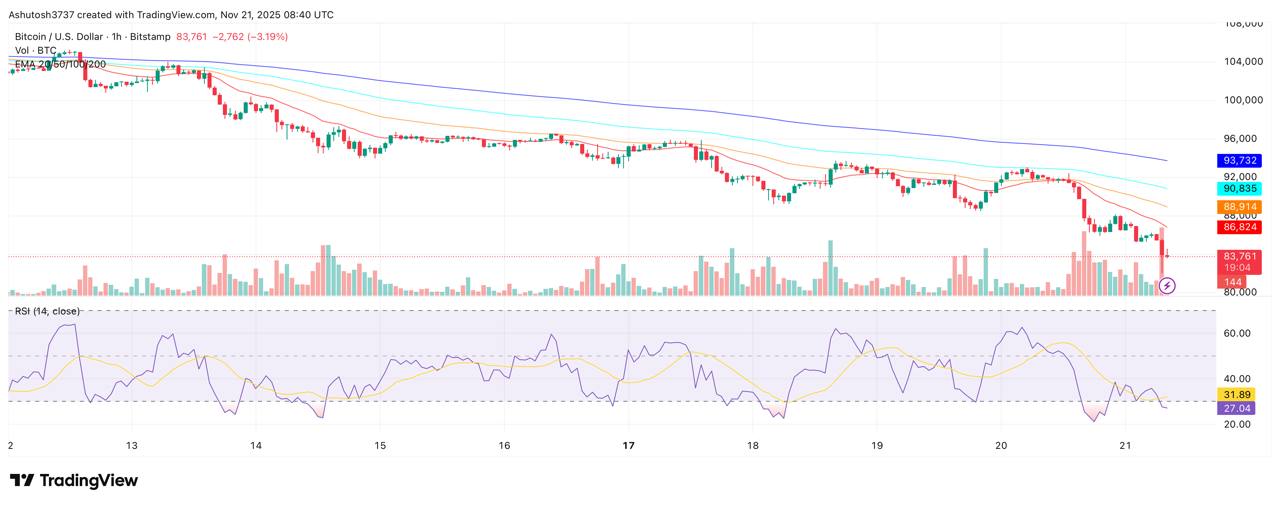
Bitcoin slides as geopolitical tensions widen and macro tone weakens
Bitcoin continues to fall sharply, breaking below the mid 85k zone as global markets react to heightened geopolitical and regulatory uncertainty. The most notable development today is rising friction in the South China Sea, where multiple states have increased naval presence without progress on diplomatic de-escalation. While not a sudden flashpoint, the buildup reinforces defensive positioning across risk assets.Sentiment was further pressured after a senior Chinese telecommunications regulator issued a warning about risks tied to foreign digital payment systems. Markets view this as an implicit signal that sovereign control over financial and blockchain infrastructure remains a strategic priority for China. This adds to geopolitical and regulatory uncertainty for Bitcoin.At the same time, a new European central bank research note indicates that some euro area countries are evaluating digital assets as part of future reserve composition. This long horizon signal offers structural legitimacy for Bitcoin, but does little to offset today’s risk off pressure.
Analysts interpret rising tension as background noise rather than a direct trigger
Anton Kharitonov notes that today’s tensions contribute to the risk premium, but are not the sole cause of the sell-off. He explains that Bitcoin is reacting to cumulative geopolitical unease amplified by fragile macro conditions.Viktoras Karapetyants highlights that strategic competition in digital payments is becoming more explicit. He points out that China’s comments underscore the sensitivity of blockchain infrastructure within broader geopolitical rivalries.
Jainam Mehta adds that while reserve asset discussions in Europe are meaningful longer term, they do not provide immediate support. He notes that liquidity stress and defensive flows remain the short term drivers of Bitcoin’s price action.
Technical structure weakens as selling pressure intensifies
Bitcoin trades near $85,168 on intraday charts, with the 20 EMA at $88,631 acting as immediate resistance. The 50 EMA at $90,951 and 100 EMA at $93,797 form heavier ceilings that align with the broader downtrend. The 200 EMA at $97,820 remains the key trend defining barrier, far above current levels. The RSI at 37.71 signals persistent bearish momentum, with only limited signs of stabilization. A daily close above $88,500 would be the first indication of relief, while a breakdown below $83,500 risks opening a path toward deeper capitulation.Background and earlier analysis
In earlier analysis, Bitcoin’s downside was driven by macro tightening, elevated yields and thinning liquidity. Today’s geopolitical developments add pressure but do not change the broader trend of risk off flows and defensive investor behavior.














-
 Afghanistan
-
 Albania
-
 Algeria
-
 Angola
-
 Argentina
-
 Armenia
-
 Australia
-
 Austria
-
 Azerbaijan
-
 Bahamas
-
 Bahrain
-
 Bangladesh
-
 Belarus
-
 Belgium
-
 Bolivia
-
 Botswana
-
 Brazil
-
 Brunei
-
 Bulgaria
-
 Cambodia
-
 Cameroon
-
 Canada
-
 Chile
Chile
-
 China
China
-
 Colombia
-
 Congo
Congo
-
 Costa Rica
-
 Cote d'Ivoire
-
 Croatia
-
 Cuba
Cuba
-
 Cyprus
-
 Czechia
-
 DR Congo
-
 Denmark
-
 Dominican Republic
-
 Ecuador
-
 Egypt
Egypt
-
 El Salvador
-
 Estonia
-
 Eswatini
-
 Ethiopia
-
 Finland
-
 France
-
 Georgia
-
 Germany
-
 Ghana
Ghana
-
 Greece
-
 Haiti
Haiti
-
 Hong Kong
-
 Hungary
-
 India
India
-
 Indonesia
-
 Iran, Islamic republic
-
 Iraq
Iraq
-
 Ireland
-
 Israel
-
 Italy
Italy
-
 Jamaica
-
 Japan
Japan
-
 Jordan
-
 Kazakhstan
-
 Kenya
Kenya
-
 Korea
Korea
-
 Kuwait
-
 Kyrgyzstan
-
 Laos
Laos
-
 Latvia
-
 Lebanon
-
 Lesotho
-
 Libya
Libya
-
 Lithuania
-
 Luxembourg
-
 Madagascar
-
 Malaysia
-
 Malta
Malta
-
 Mauritius
-
 Mexico
-
 Moldova
-
 Mongolia
-
 Montenegro
-
 Morocco
-
 Mozambique
-
 Myanmar
-
 Namibia
-
 Nepal
Nepal
-
 Netherlands
-
 New Zealand
-
 Nigeria
-
 North Macedonia
-
 Norway
-
 Oman
Oman
-
 Pakistan
-
 Palestine
-
 Panama
-
 Papua New Guinea
-
 Paraguay
-
 Peru
Peru
-
 Philippines
-
 Poland
-
 Portugal
-
 Puerto Rico
-
 Qatar
Qatar
-
 Reunion
-
 Romania
-
 Rwanda
-
 Saudi Arabia
-
 Serbia
-
 Singapore
-
 Slovakia
-
 Slovenia
-
 Somalia
-
 South Africa
-
 Spain
Spain
-
 Sri Lanka
-
 Sweden
-
 Switzerland
-
 Syria
Syria
-
 Taiwan
-
 Tajikistan
-
 Tanzania
-
 Thailand
-
 Trinidad and Tobago
-
 Tunisia
-
 Turkey
-
 UAE
UAE
-
 Uganda
-
 Ukraine
-
 United Kingdom
-
United States
-
 Uruguay
-
 Uzbekistan
-
 Venezuela
-
 Vietnam
-
 Yemen
Yemen
-
 Zambia
-
 Zimbabwe
- Forex
- Crypto












