
Tesla stock falls 4.5% as Europe sales continue to slump

As of September 26, Tesla stock is trading at $423.00, down 4.5% in the past 24 hours. The stock's slide deepens as investors react to weak European sales and slowing global EV demand.
Highlights
- Tesla stock dropped 4.5% following a continued decline in European sales, contrasting with a 26% rise in overall EV registrations in the region.
- Analysts warn that brand perception, aging models, and political controversies are contributing to Tesla’s underperformance.
- While U.S. demand may provide a short-term boost, the company’s structural challenges in Europe remain a key risk.
Technically, the $400–$410 range now emerges as a critical short-term support zone. This area has seen considerable buying interest in the past, and a failure to hold above $400 would expose Tesla to deeper downside risk. On the upside, the stock faces initial resistance between $440 and $450, which coincides with its 50-day moving average. A decisive break above this range would be required to shift the near-term outlook to neutral. However, broader resistance around the $470 level—where the stock topped earlier this month—suggests that bulls have a difficult path ahead.
Tesla is also approaching a potential breakdown of its 200-day moving average, a long-term technical indicator that many institutional investors use to gauge trend strength. Breaching this level could trigger further algorithmic selling. RSI (Relative Strength Index) is moving toward oversold territory but has not yet hit extremes, indicating further downside is possible before bargain hunters step in. A sustained close below the 200-day average would likely shift sentiment decisively bearish across the broader market.
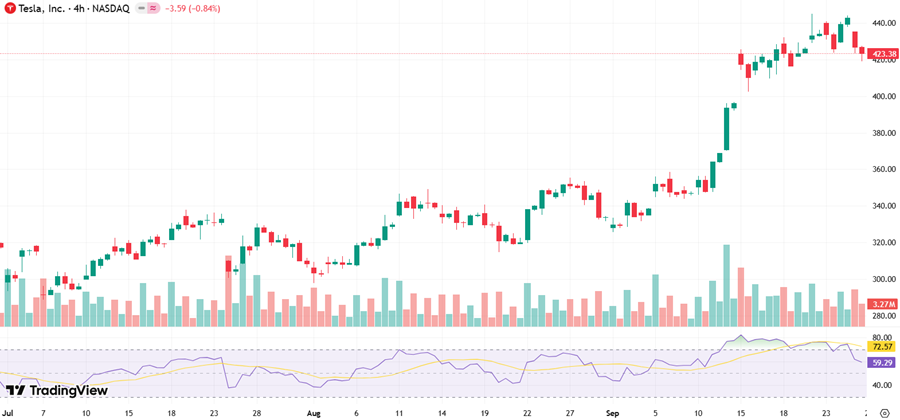
Tesla stock price dynamics (July 2025 - September 2025). Source: TradingView
Volume trends support the bearish picture: Tesla’s recent selloff has come on rising volume, suggesting conviction behind the selling. Institutional flows appear to be rotating out of the stock, further pressuring price action. This surge in volume without any supportive news or buying interest signals a lack of confidence in the near-term outlook. Until buying volume returns or a clear catalyst emerges, downward pressure is likely to persist.
Europe sales drop despite booming EV market
Tesla's 4.5% stock drop reflects a growing divergence between its performance in Europe and broader EV market trends. While fully electric vehicle (EV) registrations in the EU surged 26% year-over-year through August, Tesla’s registrations fell sharply—down 23% in August alone and 32.6% for the first eight months of 2025. According to the ACEA, Tesla registered 14,831 EVs in August, down from 19,136 a year earlier. This signals not just a loss of momentum, but a loss of market share in one of the world’s most mature EV regions.
While legacy automakers and Chinese brands such as BYD have capitalized on growing consumer demand, Tesla appears to be losing ground due to limited model variety, aging designs, and declining brand perception. Musk’s recent political activity—including appearances at far-right rallies in Europe—has triggered backlash from governments and consumers alike. British Prime Minister Keir Starmer publicly condemned Musk for inciting violence during a U.K. rally that ended with injuries to over two dozen police officers. These incidents have increasingly made Tesla a politically polarizing brand, eroding its appeal among progressive, urban EV buyers who have historically formed its core customer base in Europe.
Despite this backdrop, analysts at RBC remain optimistic in the short term. They forecast Tesla’s Q3 global deliveries could reach 456,000 units—above both FactSet and Visible Alpha estimates—driven by a late-quarter surge in U.S. demand ahead of the expiration of a $7,500 EV tax credit. However, even with this potential upside, Tesla’s fundamental challenge in Europe remains unresolved. To regain traction, the company is betting on a more affordable next-generation model, which may help it compete with lower-cost rivals. Until then, the brand’s erosion in Europe continues to cast a shadow over its global growth story.
Scenarios and near-term price forecast
The base case scenario suggests that Tesla trades sideways within a $400 to $460 range. While short-term bounces are possible, they are likely to be capped unless European trends reverse or Tesla announces new growth drivers. In this range, traders should watch for false breakouts or breakdowns, as volatility could increase ahead of Q3 earnings. Much will also depend on how investors interpret management’s forward guidance and delivery figures expected in early October.
A bearish scenario could see Tesla breach the $400 support level and move toward $350 to $380 if European weakness persists or if macro conditions deteriorate. Risks include further EV market softness, increased Chinese competition, or missed financial guidance in upcoming quarters. A breakdown below $400 would likely trigger technical selling, amplifying downside momentum across growth and tech portfolios.
Earlier, Tesla’s stock rally was fueled by Elon Musk’s public defense of his proposed compensation plan, which he framed as essential for maintaining control over the company’s strategic direction amid its expansion into AI and robotics. This helped ease investor concerns about dilution and governance, securing broader support from institutional shareholders.





Latest Tesla News










-
 Afghanistan
-
 Albania
-
 Algeria
-
 Angola
-
 Argentina
-
 Armenia
-
 Australia
-
 Austria
-
 Azerbaijan
-
 Bahamas
-
 Bahrain
-
 Bangladesh
-
 Belarus
-
 Belgium
-
 Bolivia
-
 Botswana
-
 Brazil
-
 Brunei
-
 Bulgaria
-
 Cambodia
-
 Cameroon
-
 Canada
-
 Chile
Chile
-
 China
China
-
 Colombia
-
 Congo
Congo
-
 Costa Rica
-
 Cote d'Ivoire
-
 Croatia
-
 Cuba
Cuba
-
 Cyprus
-
 Czechia
-
 DR Congo
-
 Denmark
-
 Dominican Republic
-
 Ecuador
-
 Egypt
Egypt
-
 El Salvador
-
 Estonia
-
 Eswatini
-
 Ethiopia
-
 Finland
-
 France
-
 Georgia
-
 Germany
-
 Ghana
Ghana
-
 Greece
-
 Haiti
Haiti
-
 Hong Kong
-
 Hungary
-
 India
India
-
 Indonesia
-
 Iran, Islamic republic
-
 Iraq
Iraq
-
 Ireland
-
 Israel
-
 Italy
Italy
-
 Jamaica
-
 Japan
Japan
-
 Jordan
-
 Kazakhstan
-
 Kenya
Kenya
-
 Korea
Korea
-
 Kuwait
-
 Kyrgyzstan
-
 Laos
Laos
-
 Latvia
-
 Lebanon
-
 Lesotho
-
 Libya
Libya
-
 Lithuania
-
 Luxembourg
-
 Madagascar
-
 Malaysia
-
 Malta
Malta
-
 Mauritius
-
 Mexico
-
 Moldova
-
 Mongolia
-
 Montenegro
-
 Morocco
-
 Mozambique
-
 Myanmar
-
 Namibia
-
 Nepal
Nepal
-
 Netherlands
-
 New Zealand
-
 Nigeria
-
 North Macedonia
-
 Norway
-
 Oman
Oman
-
 Pakistan
-
 Palestine
-
 Panama
-
 Papua New Guinea
-
 Paraguay
-
 Peru
Peru
-
 Philippines
-
 Poland
-
 Portugal
-
 Puerto Rico
-
 Qatar
Qatar
-
 Reunion
-
 Romania
-
 Rwanda
-
 Saudi Arabia
-
 Serbia
-
 Singapore
-
 Slovakia
-
 Slovenia
-
 Somalia
-
 South Africa
-
 Spain
Spain
-
 Sri Lanka
-
 Sweden
-
 Switzerland
-
 Syria
Syria
-
 Taiwan
-
 Tajikistan
-
 Tanzania
-
 Thailand
-
 Trinidad and Tobago
-
 Tunisia
-
 Turkey
-
 UAE
UAE
-
 Uganda
-
 Ukraine
-
 United Kingdom
-
United States
-
 Uruguay
-
 Uzbekistan
-
 Venezuela
-
 Vietnam
-
 Yemen
Yemen
-
 Zambia
-
 Zimbabwe
- Forex
- Crypto












