
Tesla stock holds at $393 amid final stages of AI5 chip development
As of November 24, Tesla stock is trading at $393.84, down 0.3% in the past 24 hours. The price action remains range-bound, reflecting investor hesitation in the face of competing signals from both technical and fundamental fronts.
Highlights
- Tesla is close to completing its in-house AI5 chip design, with Elon Musk outlining a plan for annual chip releases starting with AI6.
- Despite the ambitious roadmap, volume production of AI5 is not expected until 2027, limiting short-term impact.
- The stock remains range-bound between $380 and $420, with near-term movement tied more to EV performance than AI developments.
Tesla’s price structure around the $390–$400 range shows the stock consolidating after a period of elevated volatility, forming a medium-term equilibrium zone that traders are watching closely. The recent pullback to $393.84 suggests the market is testing support near the lower boundary of this consolidation band, while the broader trend remains influenced by Tesla’s high beta and sensitivity to macro sentiment. The stock continues to trade well above its multi-month moving averages, an indication that momentum—despite cooling—remains structurally positive.
From a technical standpoint, the $380–$385 region is emerging as the nearest support zone shaped by previous volume accumulation and recent intraday lows. A decisive break below this area could shift the short-term trend bearish, potentially opening the way toward the next support cluster near $355. Conversely, resistance remains centered around $405–$415, where Tesla has repeatedly faced selling pressure. A breakout above this band with strong volume would reassert bullish momentum and place the $440–$450 range back into view.
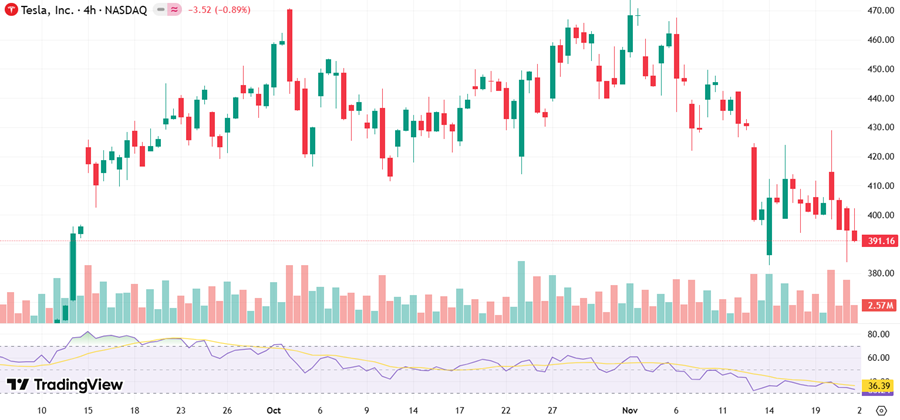
Tesla stock price dynamics (September 2025 - November 2025). Source: TradingView
Momentum indicators offer a mixed picture. The RSI is hovering in neutral territory, signalling neither overbought nor oversold conditions, while MACD lines are flattening, reflecting indecision rather than trend exhaustion. Volume trends remain elevated but not climactic—characteristic of consolidation rather than reversal. Overall, Tesla’s technical posture suggests the stock is in a compression phase where major catalysts, such as AI chip progress or macro shifts, could trigger the next directional move. Traders will be watching for a breakout from the current horizontal channel to determine whether the broader uptrend can resume or whether deeper retracement is likely.
AI, autonomy, and chip strategy as growth catalysts
Tesla’s AI chip program has accelerated sharply, with Elon Musk confirming that the company is nearing completion of its AI5 design while simultaneously initiating work on AI6. The new roadmap reflects an aggressive target: introducing a new, fully redesigned AI chip into volume production every 12 months. Musk framed this as central to Tesla’s ambition to dominate real-world AI, emphasizing that the company has been building and deploying millions of in-house AI chips across vehicles and data centers—an advantage he believes competitors still underestimate.
A major highlight from Musk’s latest updates is Tesla’s claim that it expects to eventually manufacture more AI chips than all other AI chip makers combined. Whether this is aspirational or technically feasible remains to be seen, but it underscores the scale of Tesla’s strategic shift. With AI4 currently in vehicles and AI5 almost ready for tape-out, Tesla is positioning its silicon team as the backbone of its autonomy and robotics ecosystem. According to Musk, this long-running engineering effort is what allows Tesla to lead in real-world AI training, testing, and deployment.
However, the execution timeline remains a critical uncertainty. AI5 is now expected to enter low-volume production in 2026, with full-scale manufacturing planned for 2027 through TSMC—later than earlier internal projections. Still, Musk has hinted that the actual release may come sooner, citing rapid progress and ongoing recruitment to expand the chip engineering team. If Tesla can maintain its proposed 12-month chip cycle while overcoming manufacturing bottlenecks, the company could gain a substantial technological moat in autonomy, humanoid robotics, and AI compute—key long-term drivers of the Tesla narrative.
AI roadmap fuels long-term revaluation
In the base case, Tesla stock is expected to trade sideways within the $380–$420 range, as technical indicators remain neutral and no immediate catalysts are in sight. A breakout above $420 would require a strong trigger such as a Q4 delivery beat or accelerated AI deployment, but for now, the market appears to be in a wait-and-see mode.
A bearish scenario could unfold if macroeconomic conditions worsen or upcoming earnings disappoint, particularly on margins or demand. In that case, a break below $380 could lead to a move toward the $350 level. While Tesla’s AI roadmap adds long-term potential, it is not yet priced into short-term movements, which remain driven by core automotive performance.
Piper Sandler reaffirmed its Overweight rating on Tesla with a $500 price target after a visit to the Fremont plant, highlighting progress in AI, robotics, and Full Self-Driving version 14. The firm sees Tesla’s autonomy push—bolstered by a flawless FSD demo—as a key long-term growth driver, setting it apart from traditional automakers.





Latest Forecast News










-
 Afghanistan
-
 Albania
-
 Algeria
-
 Angola
-
 Argentina
-
 Armenia
-
 Australia
-
 Austria
-
 Azerbaijan
-
 Bahamas
-
 Bahrain
-
 Bangladesh
-
 Belarus
-
 Belgium
-
 Bolivia
-
 Botswana
-
 Brazil
-
 Brunei
-
 Bulgaria
-
 Cambodia
-
 Cameroon
-
 Canada
-
 Chile
Chile
-
 China
China
-
 Colombia
-
 Congo
Congo
-
 Costa Rica
-
 Cote d'Ivoire
-
 Croatia
-
 Cuba
Cuba
-
 Cyprus
-
 Czechia
-
 DR Congo
-
 Denmark
-
 Dominican Republic
-
 Ecuador
-
 Egypt
Egypt
-
 El Salvador
-
 Estonia
-
 Eswatini
-
 Ethiopia
-
 Finland
-
 France
-
 Georgia
-
 Germany
-
 Ghana
Ghana
-
 Greece
-
 Haiti
Haiti
-
 Hong Kong
-
 Hungary
-
 India
India
-
 Indonesia
-
 Iran, Islamic republic
-
 Iraq
Iraq
-
 Ireland
-
 Israel
-
 Italy
Italy
-
 Jamaica
-
 Japan
Japan
-
 Jordan
-
 Kazakhstan
-
 Kenya
Kenya
-
 Korea
Korea
-
 Kuwait
-
 Kyrgyzstan
-
 Laos
Laos
-
 Latvia
-
 Lebanon
-
 Lesotho
-
 Libya
Libya
-
 Lithuania
-
 Luxembourg
-
 Madagascar
-
 Malaysia
-
 Malta
Malta
-
 Mauritius
-
 Mexico
-
 Moldova
-
 Mongolia
-
 Montenegro
-
 Morocco
-
 Mozambique
-
 Myanmar
-
 Namibia
-
 Nepal
Nepal
-
 Netherlands
-
 New Zealand
-
 Nigeria
-
 North Macedonia
-
 Norway
-
 Oman
Oman
-
 Pakistan
-
 Palestine
-
 Panama
-
 Papua New Guinea
-
 Paraguay
-
 Peru
Peru
-
 Philippines
-
 Poland
-
 Portugal
-
 Puerto Rico
-
 Qatar
Qatar
-
 Reunion
-
 Romania
-
 Rwanda
-
 Saudi Arabia
-
 Serbia
-
 Singapore
-
 Slovakia
-
 Slovenia
-
 Somalia
-
 South Africa
-
 Spain
Spain
-
 Sri Lanka
-
 Sweden
-
 Switzerland
-
 Syria
Syria
-
 Taiwan
-
 Tajikistan
-
 Tanzania
-
 Thailand
-
 Trinidad and Tobago
-
 Tunisia
-
 Turkey
-
 UAE
UAE
-
 Uganda
-
 Ukraine
-
 United Kingdom
-
United States
-
 Uruguay
-
 Uzbekistan
-
 Venezuela
-
 Vietnam
-
 Yemen
Yemen
-
 Zambia
-
 Zimbabwe
- Forex
- Crypto












