
Nvidia stock climbs 1% as Bernstein reaffirms Outperform rating and $275 target

As of November 27, Nvidia stock is trading at $179.50, up 1% over the past 24 hours. This modest rebound comes after a period of consolidation, with NVDA down from its mid-year peak of over $210. The stock is currently range-bound between $173 and $183.
Highlights
- Nvidia is trading around $179.50, showing signs of short-term consolidation below key moving averages, with resistance at $185 and support at $173.
- Bernstein reaffirmed its “Outperform” rating and $275 price target, expressing confidence in Nvidia’s AI leadership despite competitive threats from in-house chips like Google’s TPUs.
- A break below $173 could trigger downside toward $165, while a move above $185 may open the path to $195–200 in the near term.
The 50-day at approximately $182.60, the 100-day at $186.60, and the 200-day near $189.80. The inability to reclaim the 50-day moving average signals ongoing technical weakness, despite sporadic buying interest on intraday dips. This pattern suggests a lack of institutional conviction at current levels, with short-term rallies being sold into rather than sustained. Until NVDA decisively reclaims the 50-day average, momentum traders are likely to remain cautious, awaiting a clear breakout or capitulation move.
The Relative Strength Index (RSI) on the daily chart hovers around 47, a neutral-to-slightly bearish reading, while the MACD remains in negative territory — further confirming a lack of bullish momentum in the short term. Technical support sits at $173, a level tested multiple times in recent weeks. A break below this could expose Nvidia to a deeper retracement toward the $165–168 area. Resistance remains firm at $183–185, where prior breakdown levels coincide with short-term moving average clusters.
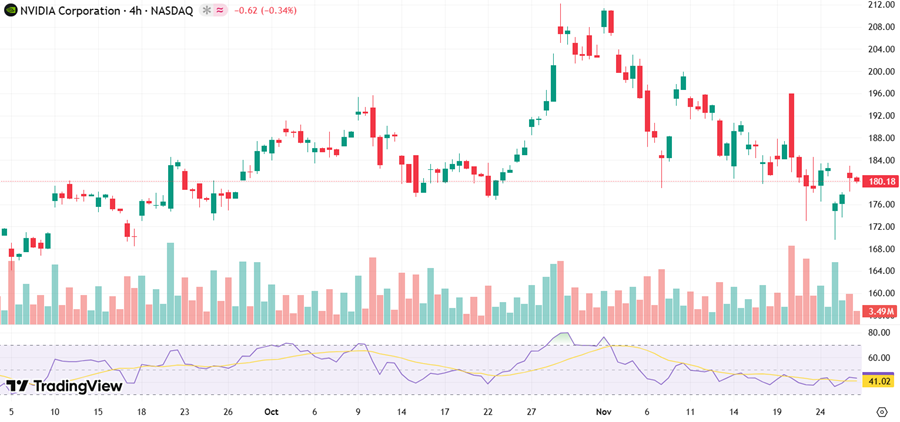
Nvidia stock price dynamics (September 2025 - November 2025). Source: TradingView
Shorter-term Fibonacci pivot levels also align with this view. The classic support levels for the week fall around $171.60 and $169.20, while resistance levels appear at $176.40 and $180.60. These overlapping technical markers suggest that Nvidia is in a fragile range where traders are watching for a catalyst to either push the stock back above its declining trendline — or confirm a deeper correction.
Bernstein reiterates $275 target
Investor sentiment remains divided following mixed headlines. On November 26, Bernstein reaffirmed its “Outperform” rating on Nvidia and maintained a $275 price target, expressing confidence in the company’s response to bearish claims around “circular revenue” and other accounting concerns. Bernstein concluded that Nvidia’s investor memo issued earlier this month is “broadly valid” and continues to see strength in the company's data-center growth and AI infrastructure positioning.
However, Nvidia's long-term dominance in AI hardware is facing increasing scrutiny. Reports last week revealed that Meta is preparing to use Google’s Tensor Processing Units (TPUs) in its data centers starting 2027. This marks a strategic challenge to Nvidia’s dominance, as hyperscalers like Google, Meta, and Amazon continue developing in-house silicon alternatives to reduce dependency on external GPU suppliers.
Despite these threats, Nvidia's near-monopoly position in high-performance GPUs — particularly for large language models and AI training workloads — remains intact in the short to medium term. The H100 and upcoming H200 lines continue to see strong demand, especially in Asia and North America. Analysts note that Nvidia is still the standard in AI compute, with unmatched software support through its CUDA ecosystem. But clouds are forming on the horizon, and any erosion in gross margins or forward guidance will quickly test investor conviction.
Near-term trading scenarios and key trigger levels
In the near term, NVDA is likely to remain in a consolidation phase between $172 and $185, unless a clear catalyst emerges. Technical resistance at $183–185 must be reclaimed for bulls to gain confidence. If this zone is broken decisively, a rally toward the $195–200 region is likely — supported by former support-turned-resistance levels and the 100-day moving average.
If the stock fails to hold $173, traders should be prepared for a slide toward $165–168, where longer-term buyers may reenter. A break below that would negate the medium-term bullish structure. Such a move would likely trigger stop-loss orders and accelerate downside momentum, especially if accompanied by weak market breadth or bearish news from the tech sector.
Nvidia swiftly responded to reports that Meta may shift AI chip spending to Google’s TPUs, defending its leadership and emphasizing that it remains the only platform capable of running all major AI models across computing environments. Despite this, the stock pulled back sharply as investors reacted to the risk of major clients like Meta diversifying away from Nvidia’s ecosystem, raising concerns about long-term growth.














-
 Afghanistan
-
 Albania
-
 Algeria
-
 Angola
-
 Argentina
-
 Armenia
-
 Australia
-
 Austria
-
 Azerbaijan
-
 Bahamas
-
 Bahrain
-
 Bangladesh
-
 Belarus
-
 Belgium
-
 Bolivia
-
 Botswana
-
 Brazil
-
 Brunei
-
 Bulgaria
-
 Cambodia
-
 Cameroon
-
 Canada
-
 Chile
Chile
-
 China
China
-
 Colombia
-
 Congo
Congo
-
 Costa Rica
-
 Cote d'Ivoire
-
 Croatia
-
 Cuba
Cuba
-
 Cyprus
-
 Czechia
-
 DR Congo
-
 Denmark
-
 Dominican Republic
-
 Ecuador
-
 Egypt
Egypt
-
 El Salvador
-
 Estonia
-
 Eswatini
-
 Ethiopia
-
 Finland
-
 France
-
 Georgia
-
 Germany
-
 Ghana
Ghana
-
 Greece
-
 Haiti
Haiti
-
 Hong Kong
-
 Hungary
-
 India
India
-
 Indonesia
-
 Iran, Islamic republic
-
 Iraq
Iraq
-
 Ireland
-
 Israel
-
 Italy
Italy
-
 Jamaica
-
 Japan
Japan
-
 Jordan
-
 Kazakhstan
-
 Kenya
Kenya
-
 Korea
Korea
-
 Kuwait
-
 Kyrgyzstan
-
 Laos
Laos
-
 Latvia
-
 Lebanon
-
 Lesotho
-
 Libya
Libya
-
 Lithuania
-
 Luxembourg
-
 Madagascar
-
 Malaysia
-
 Malta
Malta
-
 Mauritius
-
 Mexico
-
 Moldova
-
 Mongolia
-
 Montenegro
-
 Morocco
-
 Mozambique
-
 Myanmar
-
 Namibia
-
 Nepal
Nepal
-
 Netherlands
-
 New Zealand
-
 Nigeria
-
 North Macedonia
-
 Norway
-
 Oman
Oman
-
 Pakistan
-
 Palestine
-
 Panama
-
 Papua New Guinea
-
 Paraguay
-
 Peru
Peru
-
 Philippines
-
 Poland
-
 Portugal
-
 Puerto Rico
-
 Qatar
Qatar
-
 Reunion
-
 Romania
-
 Rwanda
-
 Saudi Arabia
-
 Serbia
-
 Singapore
-
 Slovakia
-
 Slovenia
-
 Somalia
-
 South Africa
-
 Spain
Spain
-
 Sri Lanka
-
 Sweden
-
 Switzerland
-
 Syria
Syria
-
 Taiwan
-
 Tajikistan
-
 Tanzania
-
 Thailand
-
 Trinidad and Tobago
-
 Tunisia
-
 Turkey
-
 UAE
UAE
-
 Uganda
-
 Ukraine
-
 United Kingdom
-
United States
-
 Uruguay
-
 Uzbekistan
-
 Venezuela
-
 Vietnam
-
 Yemen
Yemen
-
 Zambia
-
 Zimbabwe
- Forex
- Crypto












