
WTI crude holds near $59.40 as Black Sea disruption and U.S.–Venezuela tension reshape supply outlook

WTI crude oil futures traded near $59.40 per barrel on Tuesday, stabilizing after a two-day rebound driven by a fast-shifting geopolitical landscape. A major export route in the Black Sea remains offline following Ukrainian strikes on infrastructure tied to the Caspian Pipeline Consortium, while U.S. messaging toward Venezuela has hardened after President Donald Trump warned that Venezuelan airspace should be regarded as closed.
Highlights
- WTI trades near $59.40 as geopolitical disruptions reshape supply expectations.
- Black Sea outages and U.S.–Venezuela tension push markets toward risk-premium pricing.
- OPEC+ maintains output into 2026, reflecting cautious stewardship amid uneven demand.
The shift has pushed supply risks to the forefront just as OPEC+ reaffirmed its decision to keep output unchanged through the first quarter of 2026, a move designed to contain inventories in a period of fragile demand.
Technical compression persists as crude tests long-term floor
On the chart, WTI has spent much of the year inside a compressing descending triangle, a formation marked by lower highs and a long-term support corridor between $56.50 and $57.00. That band has acted as a structural anchor for both physical and speculative flows. The latest rebound formed precisely at this threshold, underscoring that market participants continue to respect established technical levels even as macro uncertainty intensifies.
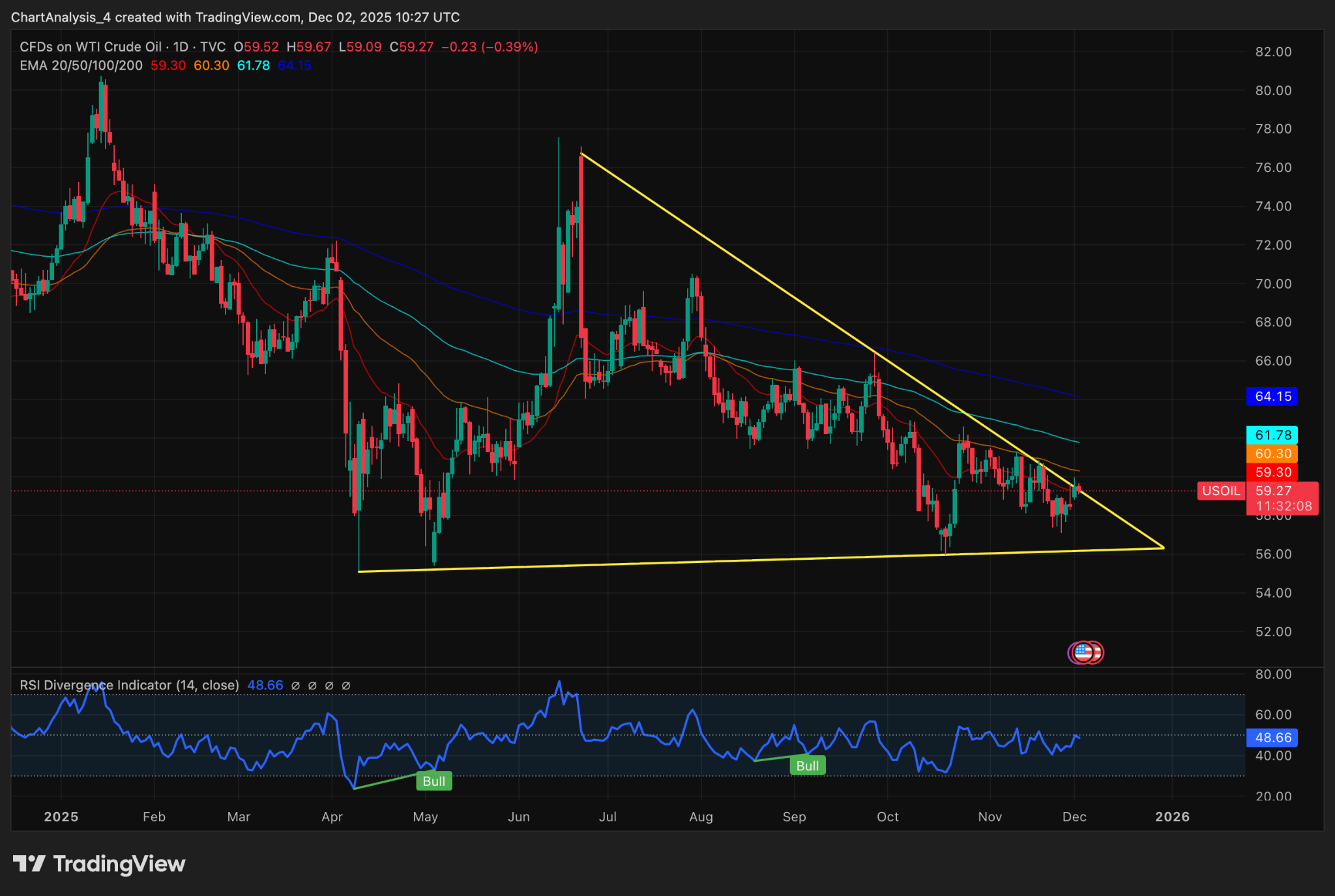
WTI crude price dynamics (Source: TradingView)
Yet price remains firmly capped beneath a descending resistance line near $60.30, which now aligns with the declining 20-day EMA. This confluence reinforces the zone as a short-term ceiling that must be overcome for any bullish narrative to regain traction. WTI also trades below the 50-day EMA at $61.78 and the 100-day EMA at $64.15, a configuration that reflects persistent downward pressure stemming from weak refinery margins and unstable consumption patterns. Each rally attempt in recent months has faded when confronted with this stacked resistance profile.
Momentum, however, shows signs of underlying stabilization. RSI has avoided deep oversold readings in recent pullbacks and is now displaying early bullish divergence, a signal that has preceded recoveries of 7 to 12 percent earlier this year. While divergence alone is not a trigger, it suggests sellers are losing momentum at progressively higher floors, strengthening the case that WTI is building a base rather than preparing for a broader breakdown.
Supply shocks raise stakes as OPEC+ holds firm and U.S. foreign policy tightens
The fundamental picture complicates the technical landscape. The shutdown of CPC crude loading operations in the Black Sea removes a meaningful flow of Kazakh supply at a moment when the global market is acutely sensitive to incremental disruptions. With spare capacity limited to a few politically fragile regions, traders are quick to price the “marginal barrel” at a premium.
At the same time, U.S.–Venezuela tensions have escalated. Trump’s statement regarding restricted Venezuelan airspace, combined with a stronger American military posture in the region, raises the risk that diplomatic deterioration could impair production or transport logistics. Venezuela has served as an important offset to OPEC+ restraint this year, and any interruption would tighten balances faster than expected.
For its part, OPEC+ elected to maintain current output levels through early 2026. By choosing to freeze production instead of cutting further, the group signaled confidence that credibility and disciplined messaging can manage inventories without deeper intervention. The risk is that this approach may fall short if global growth weakens, though supply shocks may relieve downside pressure if disruptions become more widespread.
Outlook: Crude waits for a break as macro turbulence collides with technical fatigue
WTI now sits at an intersection of structural support and geopolitical unpredictability. A close above $60.30 would be the first sign that crude is ready to challenge higher bands, with $61.80 and $64.00 serving as sequential resistance levels tied to major moving averages. Failure to clear resistance, however, leaves prices vulnerable to a return toward the $56.50–$57.00 floor. A breakdown there would expose $53.00, a level not revisited since early 2024.
For now, the balance of signals suggests a market waiting for conviction. Technical fatigue, emerging bullish divergence, and persistent defense of support point toward base-building. But macro turbulence — particularly supply interruptions and U.S. foreign policy shifts — continues to inject volatility into an already fragile demand environment.
In earlier reporting, we highlighted that WTI’s steady defense of its long-term support despite bearish flows suggested the market was entering a compression phase rather than a breakdown. The current interplay between geopolitics and technical structure reinforces that view, with the $56.50–$57.00 region remaining the fulcrum for crude’s next major direction.





Latest WTI News









-
 Afghanistan
-
 Albania
-
 Algeria
-
 Angola
-
 Argentina
-
 Armenia
-
 Australia
-
 Austria
-
 Azerbaijan
-
 Bahamas
-
 Bahrain
-
 Bangladesh
-
 Belarus
-
 Belgium
-
 Bolivia
-
 Botswana
-
 Brazil
-
 Brunei
-
 Bulgaria
-
 Cambodia
-
 Cameroon
-
 Canada
-
 Chile
Chile
-
 China
China
-
 Colombia
-
 Congo
Congo
-
 Costa Rica
-
 Cote d'Ivoire
-
 Croatia
-
 Cuba
Cuba
-
 Cyprus
-
 Czechia
-
 DR Congo
-
 Denmark
-
 Dominican Republic
-
 Ecuador
-
 Egypt
Egypt
-
 El Salvador
-
 Estonia
-
 Eswatini
-
 Ethiopia
-
 Finland
-
 France
-
 Georgia
-
 Germany
-
 Ghana
Ghana
-
 Greece
-
 Haiti
Haiti
-
 Hong Kong
-
 Hungary
-
 India
India
-
 Indonesia
-
 Iran, Islamic republic
-
 Iraq
Iraq
-
 Ireland
-
 Israel
-
 Italy
Italy
-
 Jamaica
-
 Japan
Japan
-
 Jordan
-
 Kazakhstan
-
 Kenya
Kenya
-
 Korea
Korea
-
 Kuwait
-
 Kyrgyzstan
-
 Laos
Laos
-
 Latvia
-
 Lebanon
-
 Lesotho
-
 Libya
Libya
-
 Lithuania
-
 Luxembourg
-
 Madagascar
-
 Malaysia
-
 Malta
Malta
-
 Mauritius
-
 Mexico
-
 Moldova
-
 Mongolia
-
 Montenegro
-
 Morocco
-
 Mozambique
-
 Myanmar
-
 Namibia
-
 Nepal
Nepal
-
 Netherlands
-
 New Zealand
-
 Nigeria
-
 North Macedonia
-
 Norway
-
 Oman
Oman
-
 Pakistan
-
 Palestine
-
 Panama
-
 Papua New Guinea
-
 Paraguay
-
 Peru
Peru
-
 Philippines
-
 Poland
-
 Portugal
-
 Puerto Rico
-
 Qatar
Qatar
-
 Reunion
-
 Romania
-
 Rwanda
-
 Saudi Arabia
-
 Serbia
-
 Singapore
-
 Slovakia
-
 Slovenia
-
 Somalia
-
 South Africa
-
 Spain
Spain
-
 Sri Lanka
-
 Sweden
-
 Switzerland
-
 Syria
Syria
-
 Taiwan
-
 Tajikistan
-
 Tanzania
-
 Thailand
-
 Trinidad and Tobago
-
 Tunisia
-
 Turkey
-
 UAE
UAE
-
 Uganda
-
 Ukraine
-
 United Kingdom
-
United States
-
 Uruguay
-
 Uzbekistan
-
 Venezuela
-
 Vietnam
-
 Yemen
Yemen
-
 Zambia
-
 Zimbabwe
- Forex
- Crypto












