
S&P 500 slips to 6,672 as Nvidia earnings and delayed U.S. data amplify market tension

The S&P 500 fell to 6,672 on Monday, entering one of its most sensitive phases in months as investors brace for Nvidia’s earnings and the release of key U.S. economic data delayed by the recent government shutdown. The drop reflects a shift in sentiment after months of steady gains, with the index now testing crucial technical levels that have supported every major rebound since spring.
Highlights
- S&P 500 drops to 6,672 as markets await Nvidia’s earnings and major U.S. data releases.
- Index slips below 20-day and 50-day EMAs, signaling cooling momentum and rising caution.
- Key support sits at 6,520–6,550, the zone that anchored rebounds during August and October.
The move lower marks a notable turn for the benchmark index, which spent much of the year grinding higher within a rising channel. Monday’s loss pulled price below the channel’s midline, exposing the lower boundary near the 6,520–6,550 area. That region now represents the most important technical line in the sand for traders assessing whether the broader uptrend remains intact.
Technical structure softens as index tests trend support
The daily chart highlights growing fragility. S&P 500 price now sits just above the rising channel’s lower band, a zone that has acted as a reset point for every pullback since May. A clean break below 6,520 would increase the risk of a deeper unwind, setting up potential tests of the 100-day EMA at 6,522 and even the 200-day EMA at 6,270.
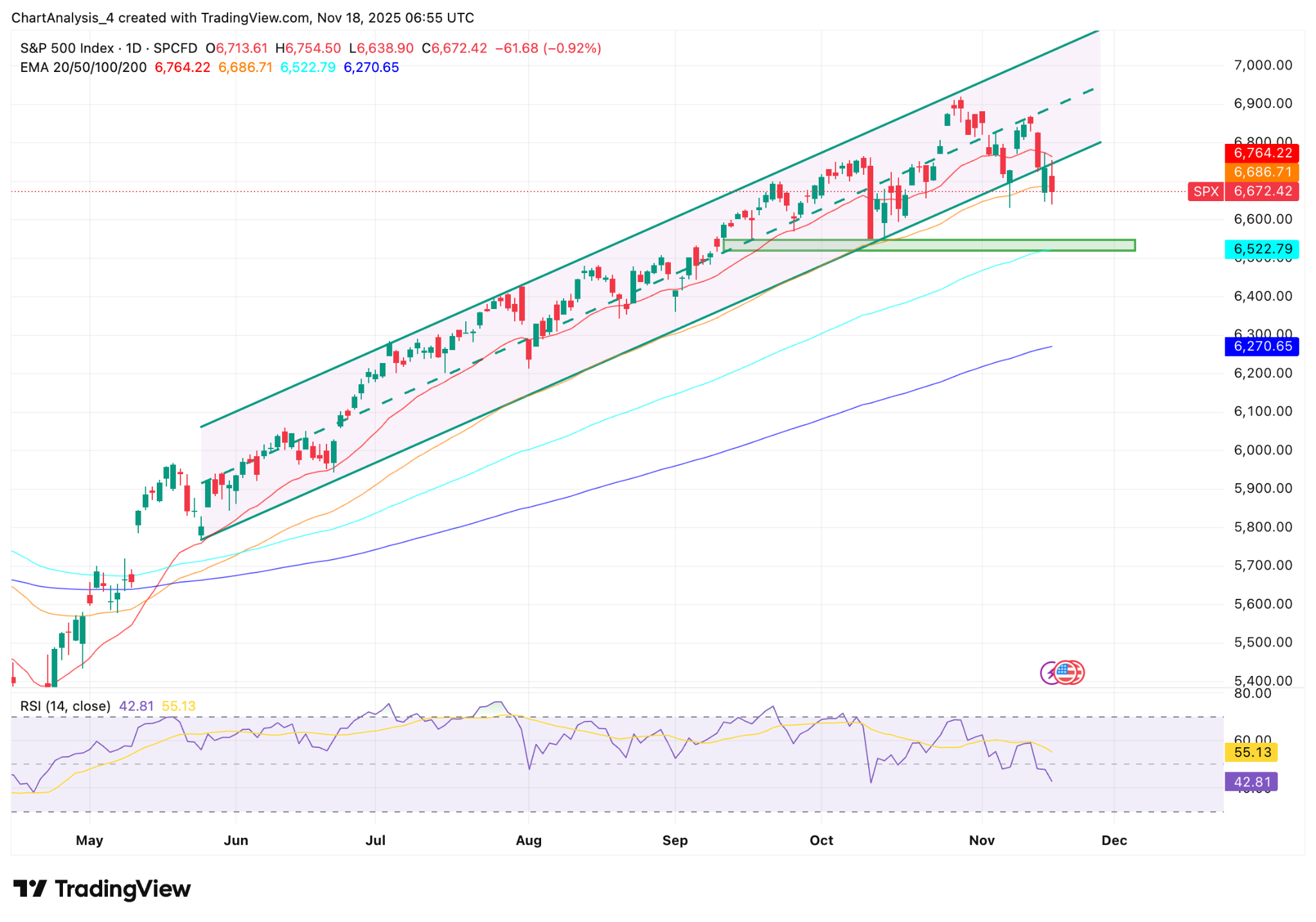
S&P 500 price dynamics (Source: TradingView)
Shorter-term moving averages underline the cooling phase. The 20-day EMA at 6,764 has flattened and begun to roll over, while the index has fallen decisively beneath the 50-day EMA at 6,686. Price trading below both levels for the first time in weeks suggests an early-stage consolidation cycle. Yet the longer-term picture remains constructive, with the 100- and 200-day averages still rising steadily and reflecting underlying earnings strength.
Momentum has also softened. The RSI sits near 42, signaling a steady loss of buying pressure without the panic that typically precedes capitulation. This aligns with a broader sentiment shift: traders are not abandoning risk, but reassessing positioning ahead of major catalysts.The most critical of those catalysts arrives this week as Nvidia prepares to report quarterly earnings. With the AI trade driving much of the S&P 500’s performance this year, expectations surrounding Nvidia have grown heavy. Peter Thiel’s recent sale of nearly $100 million in Nvidia stock has only heightened anxiety that the AI sector may be approaching an exhaustion point.
Macro and corporate crosscurrents add pressure
The market is also facing an unusually dense schedule of economic releases. A backlog of U.S. data — including the September jobs report and the Federal Reserve’s meeting minutes — is set to land at a time when investors are searching for clarity on the path of monetary policy. Fed Vice Chair Philip Jefferson recently pointed to rising risks to the labor market, reinforcing expectations that policymakers will maintain a cautious approach. Still, markets remain wary of hawkish surprises.
Corporate developments beyond Nvidia are influencing sector-level dynamics. Target and Walmart earnings will add clarity to consumer demand trends, while Berkshire Hathaway’s recent accumulation of 17.9 million Alphabet shares, paired with reductions in Apple and Bank of America, underscores subtle shifts within mega-cap allocations. Meanwhile, Ford’s agreement with Amazon to list certified used vehicles introduces new competitive pressure within automotives and e-commerce.
Despite the near-term turbulence, longer-term views remain optimistic. Morgan Stanley’s updated strategic outlook projects the S&P 500 reaching 7,800 by 2026, citing AI-driven productivity gains, durable earnings growth, and a supportive policy backdrop. The bank expects U.S. equities to outperform global peers and sees next year as the beginning of another cycle-wide expansion phase.
The direction of the index in the days ahead will hinge on whether buyers can defend the 6,520–6,550 support band. A hold above this area would preserve the rising-channel structure and allow the index to resume its grinding ascent. A breakdown, however, would open the door to sharper volatility, with the 100-day EMA acting as the next gravitational level.
Outlook as markets await clarity
The coming week is likely to determine whether the S&P 500’s pullback remains a brief consolidation or evolves into a more significant unwind. Nvidia’s earnings and the return of key U.S. data will signal whether recent weakness reflects temporary positioning adjustments or broader cracks in market confidence.
In earlier analysis, we highlighted how the S&P 500 has repeatedly relied on the lower boundary of its rising channel to stabilize during episodes of volatility. Today’s price action brings the index back to the same zone, reinforcing its role as the decisive battleground between short-term fragility and a still-intact long-term uptrend.





Latest S&P 500 News










-
 Afghanistan
-
 Albania
-
 Algeria
-
 Angola
-
 Argentina
-
 Armenia
-
 Australia
-
 Austria
-
 Azerbaijan
-
 Bahamas
-
 Bahrain
-
 Bangladesh
-
 Belarus
-
 Belgium
-
 Bolivia
-
 Botswana
-
 Brazil
-
 Brunei
-
 Bulgaria
-
 Cambodia
-
 Cameroon
-
 Canada
-
 Chile
Chile
-
 China
China
-
 Colombia
-
 Congo
Congo
-
 Costa Rica
-
 Cote d'Ivoire
-
 Croatia
-
 Cuba
Cuba
-
 Cyprus
-
 Czechia
-
 DR Congo
-
 Denmark
-
 Dominican Republic
-
 Ecuador
-
 Egypt
Egypt
-
 El Salvador
-
 Estonia
-
 Eswatini
-
 Ethiopia
-
 Finland
-
 France
-
 Georgia
-
 Germany
-
 Ghana
Ghana
-
 Greece
-
 Haiti
Haiti
-
 Hong Kong
-
 Hungary
-
 India
India
-
 Indonesia
-
 Iran, Islamic republic
-
 Iraq
Iraq
-
 Ireland
-
 Israel
-
 Italy
Italy
-
 Jamaica
-
 Japan
Japan
-
 Jordan
-
 Kazakhstan
-
 Kenya
Kenya
-
 Korea
Korea
-
 Kuwait
-
 Kyrgyzstan
-
 Laos
Laos
-
 Latvia
-
 Lebanon
-
 Lesotho
-
 Libya
Libya
-
 Lithuania
-
 Luxembourg
-
 Madagascar
-
 Malaysia
-
 Malta
Malta
-
 Mauritius
-
 Mexico
-
 Moldova
-
 Mongolia
-
 Montenegro
-
 Morocco
-
 Mozambique
-
 Myanmar
-
 Namibia
-
 Nepal
Nepal
-
 Netherlands
-
 New Zealand
-
 Nigeria
-
 North Macedonia
-
 Norway
-
 Oman
Oman
-
 Pakistan
-
 Palestine
-
 Panama
-
 Papua New Guinea
-
 Paraguay
-
 Peru
Peru
-
 Philippines
-
 Poland
-
 Portugal
-
 Puerto Rico
-
 Qatar
Qatar
-
 Reunion
-
 Romania
-
 Rwanda
-
 Saudi Arabia
-
 Serbia
-
 Singapore
-
 Slovakia
-
 Slovenia
-
 Somalia
-
 South Africa
-
 Spain
Spain
-
 Sri Lanka
-
 Sweden
-
 Switzerland
-
 Syria
Syria
-
 Taiwan
-
 Tajikistan
-
 Tanzania
-
 Thailand
-
 Trinidad and Tobago
-
 Tunisia
-
 Turkey
-
 UAE
UAE
-
 Uganda
-
 Ukraine
-
 United Kingdom
-
United States
-
 Uruguay
-
 Uzbekistan
-
 Venezuela
-
 Vietnam
-
 Yemen
Yemen
-
 Zambia
-
 Zimbabwe
- Forex
- Crypto












