
USD-INR Trading In The Forex Market – Top Strategies


Editorial Note: While we adhere to strict Editorial Integrity, this post may contain references to products from our partners. Here's an explanation for How We Make Money. None of the data and information on this webpage constitutes investment advice according to our Disclaimer.
The best USD-INR trading strategies are:
As the exchange rate between the United States Dollar (USD) and the Indian Rupee (INR) continually shifts, employing well-informed trading approaches becomes important for traders aiming to make the most out of its opportunities and mitigate risks. In this comprehensive guide, the experts at TU delve into an analysis of strategies tailored to USD-INR trading.
What is USD-INR trading?
USD-INR trading involves the exchange of the United States Dollar (USD) and the Indian Rupee (INR), playing a significant role in the global foreign exchange market. This trading practice revolves around the buying and selling of these two currencies, with the goal of profiting from their ever-shifting exchange rates. Traders carefully monitor and analyze market trends, seizing opportunities to optimize profits through well-thought-out transactions within this currency pair.
USD-INR trading is a popular currency pair among traders, attracting a diverse range of participants, including individual traders, financial institutions, multinational corporations, and central banks. The exchange rate between USD and INR is influenced by a multitude of factors, including economic indicators, geopolitical occurrences, monetary policies, and prevailing market sentiment. These forces come together to create a dynamic landscape for traders to navigate.
Best USD-INR trading strategies
Trend trading strategy
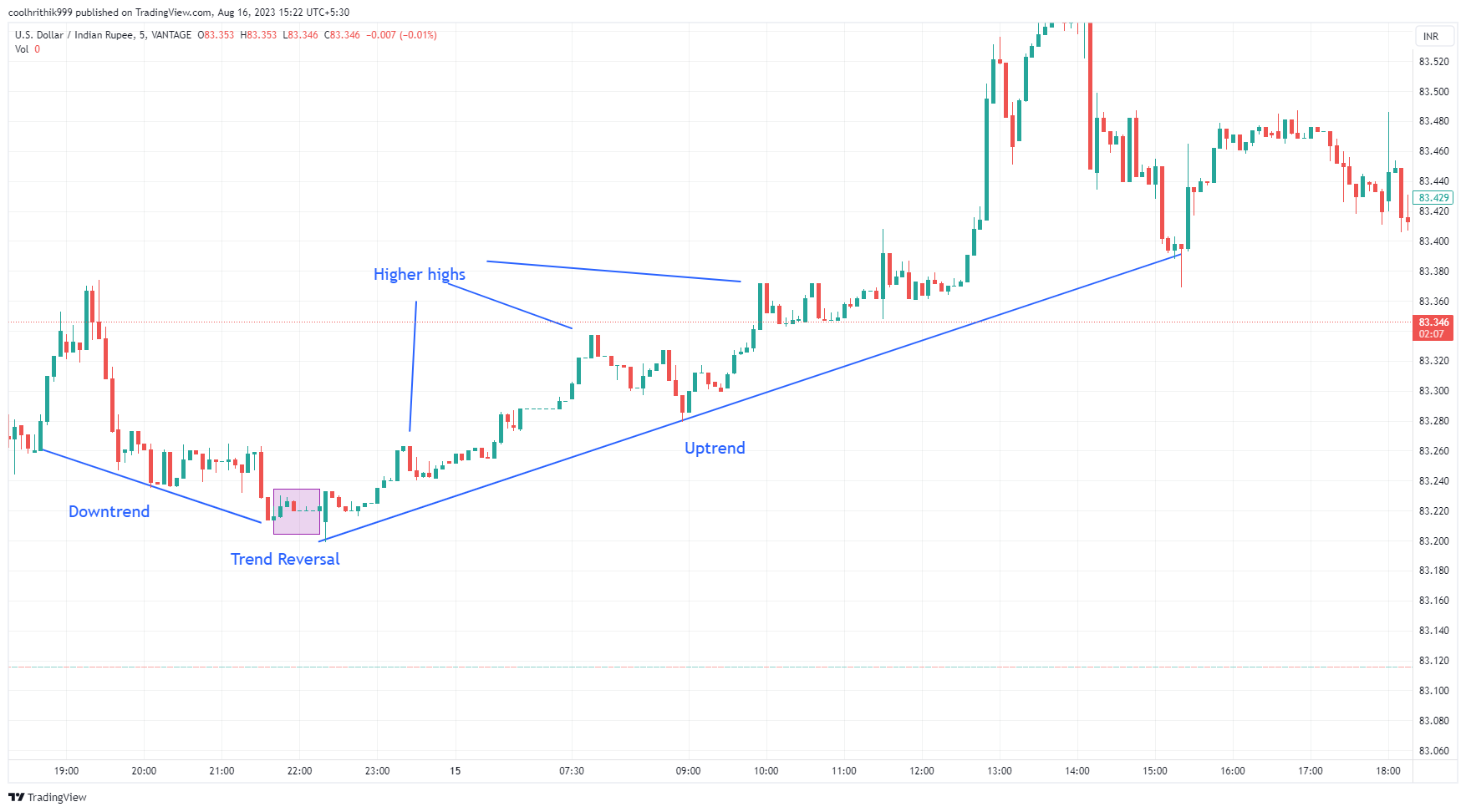 Trend Trading Illustration – USD-INR Trading
The trend trading strategy is very important in USD-INR trading and is one of the more effective ones. In this strategy, traders must align their positions with the prevalent market trends. By looking at the currency price movements, traders predict the trajectory of the trends and then make calculated entry decisions. This strategy works on the premise that markets exhibit directional biases, and by riding these trends, traders can obtain substantial profit potential.
By identifying higher highs (HH) and higher lows (HL) in an uptrend or lower highs (LH) and lower lows (LL) in a downtrend, traders predict the market's prevailing direction. Through this knowledge, they enter positions that align with the trend’s momentum. This strategy also has an added benefit, it allows the advantage of riding extended price movements whilst minimizing temporary drawdowns or price fluctuations.
Observe the illustration. A trend trader would first engage in a short trade while the price is in downtrend, and once the trend reversal is identified, they would switch their positions and enter a long trade. The ultimate goal is to match one’s position with the direction of the market.
However, it is important to note that these trends can change unexpectedly. Therefore, traders should employ supplementary tools such as technical indicators or fundamental analysis to validate trend assessments and manage positions rather effectively.
Breakout trading
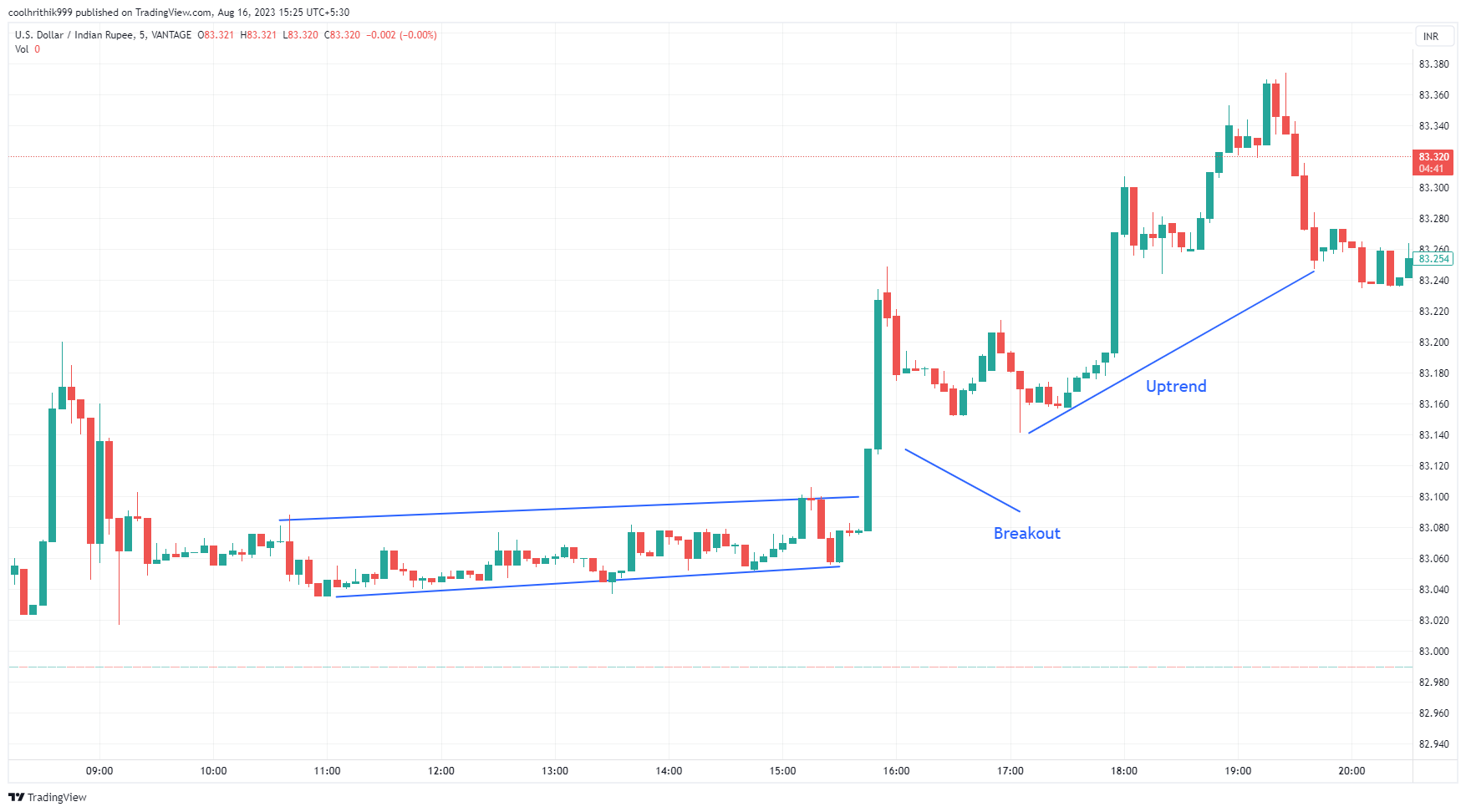 Breakout Trading Illustration – USD-INR Trading
Breakout trading is a strategy wherein traders identify significant price movements beyond established trading ranges (particularly support and resistance levels). When prices breach these levels, traders enter the market with the expectation that these breakouts will then lead to extended price movements in the same direction.
This strategy hinges on the notion that these breakout moments signal a shift in market sentiment, or that a new trend will emerge. By entering positions during these breakouts, traders seek to capitalize on potential price momentum and the continuation of the new trend.
To implement this strategy, traders must carefully monitor price consolidation patterns and identify breakout points. One common approach is to wait for a confirmed breakout, typically marked by a decisive price close beyond a resistance or support level. Stop-loss orders are crucial in breakout trading to manage potential losses if the price reverses after the breakout.
While breakout trading offers the chance of capturing strong market movements, false breakouts can occur. Traders must exercise prudence by using additional indicators and confirming factors before committing to trades.
Range trading
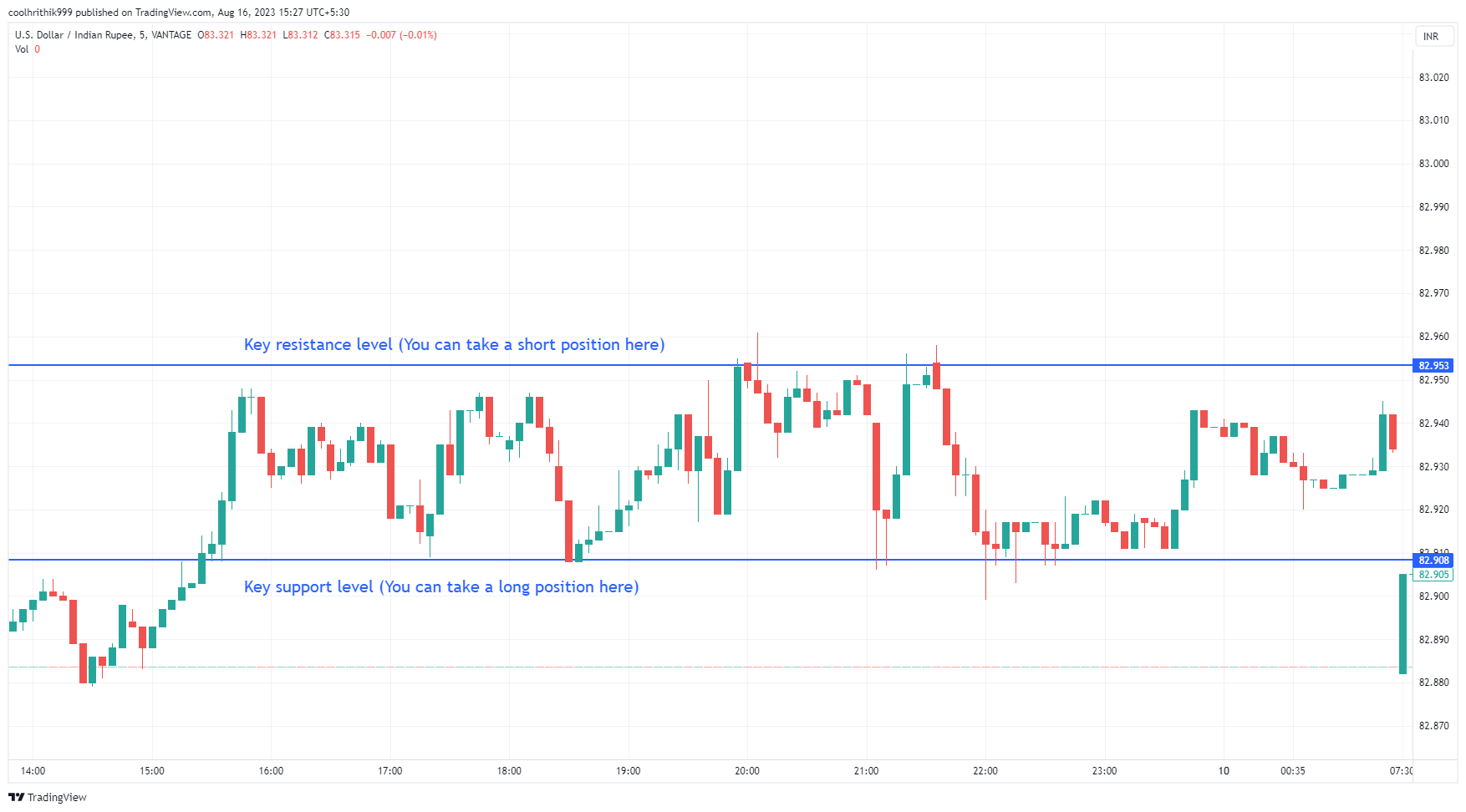 Range Trading Illustration – USD-INR Trading
Range trading, also known as horizontal trading, revolves around identifying specific support and resistance levels within which the currency pair's exchange rate oscillates. This strategy is particularly useful when markets lack a clear trend and exhibit sideways movement.
Traders practicing range trading seek to capitalize on price reversals within the established range. They initiate buy positions near support levels and sell positions close to resistance levels. The goal is to profit from the predictable price fluctuations within the range.
This strategy demands a thorough understanding of support and resistance levels, as well as an ability to identify potential breakout points. Traders should remain vigilant for signs of price reversal, such as candlestick patterns or the weakening of the prevailing trend.
Range trading is often favored by traders who can skillfully interpret price patterns. However, it's crucial to note that ranges can eventually transform into trends, and traders must adapt their strategies accordingly.
Price action analysis
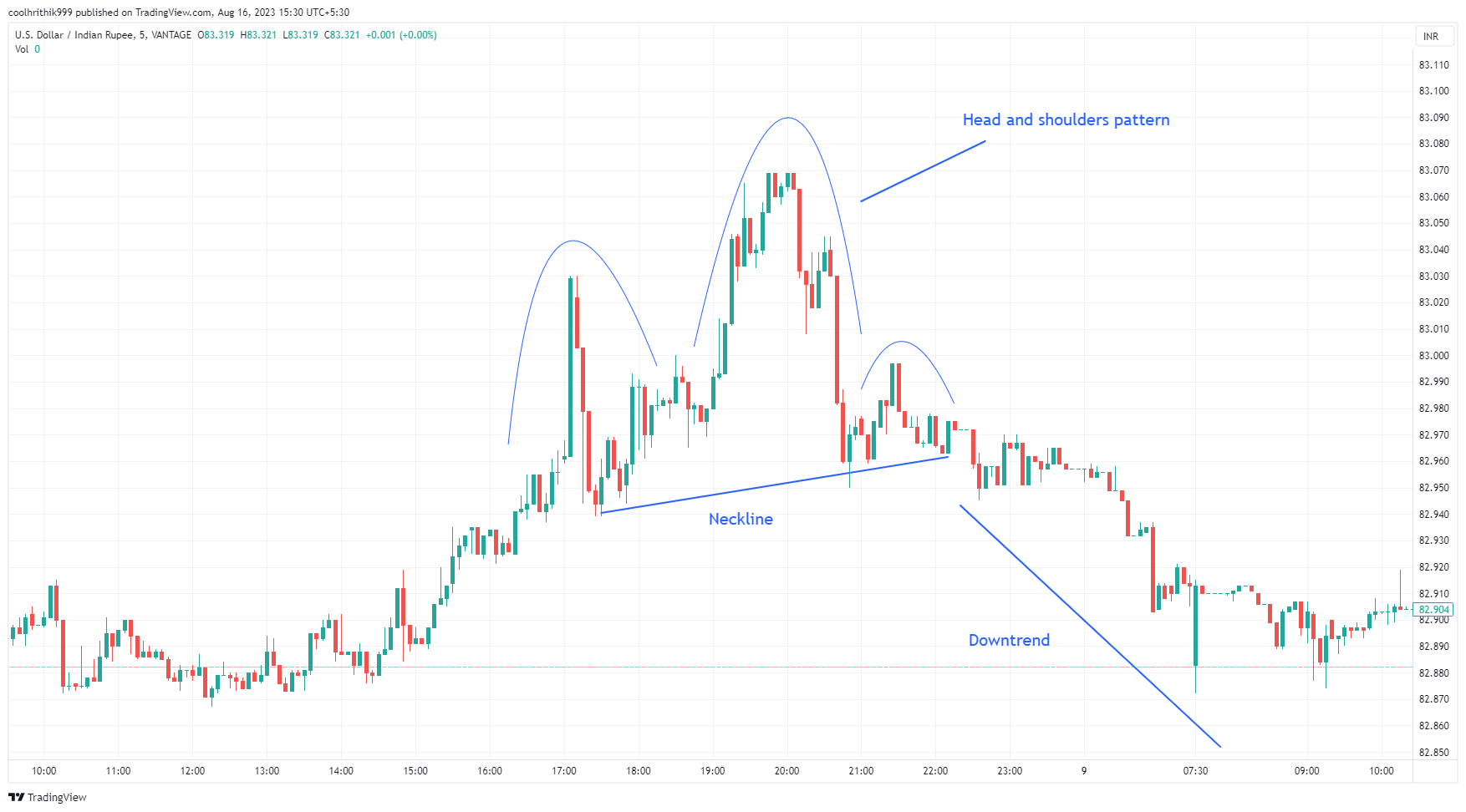 Price Action Illustration – USD-INR Trading
Price action analysis is a strategy that revolves around interpreting historical price movements and chart patterns to predict future price changes. This technique eliminates the use of complex indicators and focuses solely on studying price movement itself.
Traders who employ price action analysis look for patterns, such as head and shoulders, double tops, or flags, to anticipate potential price reversals or continuations. By observing the interplay of bullish and bearish candles, traders predict market sentiment and make informed decisions.
This strategy emphasizes the principle that historical price movements often repeat themselves due to the recurring influence of market psychology. Through careful observation of price patterns, traders aim to forecast future price movements with a higher degree of accuracy.
However, mastering price action analysis requires ample practice and a keen eye for detail. Traders must differentiate between genuine price signals and noise to effectively implement this strategy.
As you might observe in the illustration, the head and shoulders pattern formed for the USD-INR pair is somewhat imperfect. This is very common for trading pairs such as the USD-INR where traded volume is relatively on the lower side when compared to Forex majors. It thus calls for sharp knowledge of technical analysis if you wish to employ this strategy for the pair.
Moving averages (13-26) strategy
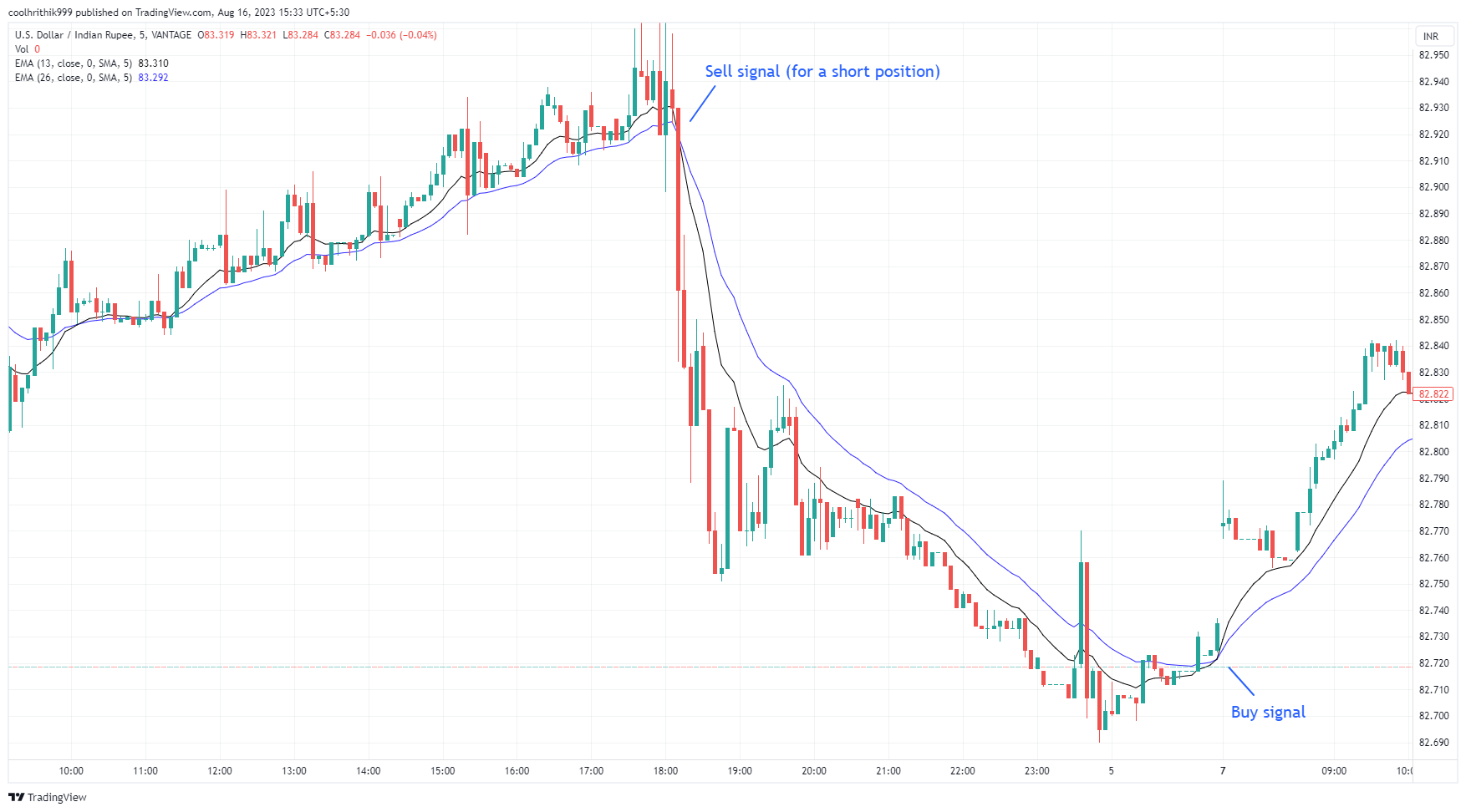 Moving Average Illustration – USD-INR Trading
Moving averages (MAs) are widely used technical indicators that smooth out price data to reveal underlying trends. The 13-26 moving average strategy involves employing two moving averages with different periods (13 and 26) to identify potential trend shifts and entry points.
When the shorter-period moving average crosses above the longer-period moving average, a potential bullish signal is generated, indicating a potential uptrend. Conversely, when the shorter-period moving average crosses below the longer-period moving average, a bearish signal suggests a potential downtrend.
The advantage of this strategy lies in its simplicity and ability to filter out short-term price fluctuations, revealing the overarching trend. It aids traders in entering positions that align with the prevailing market direction.
However, moving average strategies can lag during rapidly changing market conditions. Traders should combine this strategy with other indicators or techniques to enhance its effectiveness.
Now that we’ve explored the key USD-INR trading strategies, it’s important to choose a reliable broker that provides competitive spreads, fast execution, and regulatory safety. The right trading platform can directly impact your results, especially when applying strategies that rely on timing and precision.
Below is a comparison of some of the leading Forex brokers that support USD-INR trading and offer favorable conditions for both beginners and experienced traders.
| Demo | Min. deposit, $ | Max. leverage | Currency pairs | ECN Commission | Swap Free | INR | TU overall score | Max. Regulation Level | Open an account | |
|---|---|---|---|---|---|---|---|---|---|---|
| Yes | 50 | 1:30 | 60 | 5.5 | No | Yes | 5.97 | Tier-1 | Go to broker Your capital is at risk.
|
|
| Yes | 10 | 1:1000 | 60 | 5 | No | Yes | 3.38 | Tier-3 | Go to broker Your capital is at risk.
|
|
| Yes | No | 1:1 | 7 | No | No | Yes | 4.43 | Tier-2 | Study review | |
| No | 250 | 1:400 | 45 | No | No | Yes | 3.66 | Tier-3 | Study review |
Best time to trade USD-INR
For Indian traders, the optimal window for Forex trading typically spans from 17:30 IST to 20:30 IST, aligning with the periods of heightened market activity and potential opportunity.
It's worth noting that Indian residents engaging in Forex trading must adhere to the guidelines established by the Foreign Exchange Management Act, 1999 (FEMA). These regulations permit trading activities solely with authorized professionals and for purposes that fall within the bounds of legality. Perhaps you are also interested in information about the best time to trade USD/INR
What affects USD-INR trading?
USD-INR trading is shaped by a range of factors that contribute to currency price movements. These include:
Economic and political conditions
The value of currencies can shift due to economic indicators and the political climate. Changes in economic growth, inflation, and employment, along with political developments, may materially impact the USD-INR exchange rate.
Forex market dynamics
The demand and supply of USD and INR in the global and domestic Forex markets play a significant role in determining their exchange rate. Market sentiment and trends contribute to price fluctuations.
Major events
Significant global events, such as geopolitical occurrences and economic announcements, can swiftly affect the USD-INR exchange rate. Traders must stay updated to anticipate and respond to these events.
PIP (Point in Percentage)
PIP refers to the smallest price movement in the fourth decimal place of a currency pair. In the case of USD-INR, the PIP size can be fixed at 0.0025, known as the tick size. This minute change can lead to notable differences in Forex reserves, which in turn can impact FX fundamentals.
Lot size
In USD-INR trading, the lot size typically stands at USD 1,000. This standardized amount influences potential gains or losses per trade.
Quoting rates
Forex values are quoted up to the fourth decimal point, signifying the level of precision required in currency exchange calculations. Central banks, like the Reserve Bank of India, often use this precision when setting reference rates.
Benefits of USD-INR trading
Opting for the USD-INR pairing in the currency market offers several benefits for traders. Here are the advantages:
Inclusive trading opportunities
Both resident Indians and NRIs have the liberty to engage in trading and establish positions within the USD-INR pair, even in the absence of an underlying asset, within certain limits.
Minimal bid-ask spreads
When traded with reputed brokers, the bid-ask spreads within USD-INR trading can go exceptionally low, often as narrow as 0.0025 in the near-month pair. This reduced spread contributes to mitigating liquidity risks within the market.
Transparent market structure
The USD-INR pair operates within a transparent market mechanism, setting it apart from the forward market setup. This transparency is particularly advantageous for retail traders who typically have limited access to comprehensive market information. It ensures a fair and open trading environment.
Ample liquidity
Within the Indian Forex market, the USD-INR pair stands out as one of the most actively traded currency pairs. This robust liquidity ensures that traders can seamlessly enter and exit positions, significantly reducing the likelihood of slippage - a phenomenon where the execution price differs from the expected price.
Hedging opportunities
USD-INR trading presents a valuable avenue for both individuals and businesses to hedge against currency risks. For instance, importers can employ USD-INR contracts to safeguard themselves from unfavorable exchange rate fluctuations when converting Indian Rupees to US Dollars for import transactions.
Tips to keep in mind while trading USD-INR
Experts have provided the following tips to traders interested in trading the USD-INR pair:
Understand the currency pair
Prioritize understanding the fundamentals of the USD-INR pair. Delve into its historical price patterns, levels of volatility, and the key factors that dominate influence over its valuation.
Stay aware of the economic updates
Stay aware when it comes to economic indicators, central bank declarations, and geopolitical occurrences that hold the potential to impact the USD-INR pair. This knowledge will help you to make well-informed trading choices.
Use technical analysis
Use the power of technical analysis tools and indicators. These aids can help pinpoint good moments for entering and exiting trades. By understanding price charts, tracking trend lines, identifying support and resistance levels, and assessing moving averages, you can make informed decisions.
Prioritize risk management
Protect your capital by employing effective risk management practices. Implement strategies like setting stop-loss orders and adjusting your position sizes appropriately to limit potential losses.
Monitor market liquidity
Keep a watchful eye on market liquidity, particularly during significant news releases or market-moving events. These conditions can significantly influence trade execution and the spreads.
Trading sessions
Take into consideration the trading sessions of various financial hubs. Trading volumes and market volatility can vary throughout the day, impacting your trading experience.
Experiment with demo accounts
If you're new to trading or navigating the USD-INR pair, consider honing your skills using a demo account provided by your broker. This allows you to gain practical experience and test your strategies without exposing real capital.
Continuous learning
Cultivate an ongoing commitment to learning. Stay current with market trends, evolving trading strategies, and developments within the Forex landscape. Take part in webinars, explore educational resources, and follow reputable financial news outlets to enhance your trading acumen.
Start with a clear strategy

In my experience, trading the USD-INR pair requires patience, structure, and consistency. I always recommend starting with a clear strategy that matches your trading personality – whether it’s trend following, breakout trading, or price action analysis. Before opening any position, I analyze both macroeconomic conditions and intraday sentiment, because this pair reacts strongly to policy decisions from the Reserve Bank of India and movements in the U.S. dollar index.
I also advise traders to treat USD-INR not as a purely speculative instrument but as a tool for long-term consistency. Maintaining disciplined risk management – particularly strict stop-loss placement – is what separates professionals from beginners. I personally use a blend of trend and moving average strategies, confirming my entries with price action signals. This approach allows me to trade confidently even during volatile sessions.
Finally, never underestimate the importance of preparation. Backtesting your strategies, keeping a detailed trading journal, and staying updated with global and local economic data can significantly improve your performance. The USD-INR market rewards those who respect its rhythm – patient, analytical traders who balance logic with adaptability are the ones who succeed in the long run.
Conclusion
Success in USD-INR trading hinges on adopting disciplined strategies that match both the trader’s style and the ever-changing nature of the currency pair. Whether utilizing trend following with moving averages or capitalizing on price breakouts, consistent analysis and risk management are key ingredients for profitability. For example, combining stop-loss orders with technical indicators can help safeguard capital during volatile sessions, while persistent learning ensures readiness for market shifts. Ultimately, those who balance logic with adaptability and cultivate patience will find themselves best positioned to thrive in the dynamic USD-INR market.
FAQs
What are the main challenges traders face when using technical analysis in USD-INR trading?
How do trading sessions and market hours affect USD-INR trading strategies?
How can traders use hedging strategies to manage currency risk in USD-INR trading?
Why is ongoing education important for those trading USD-INR?
Editors' Top Picks and Insights






Related Articles
Team that worked on the article
Parshwa is a content expert and finance professional possessing deep knowledge of stock and options trading, technical and fundamental analysis, and equity research. As a Chartered Accountant Finalist, Parshwa also has expertise in Forex, crypto trading, and personal taxation.
Dan Blystone began his trading career in 1998 as an arbitrage clerk on the floor of the Chicago Mercantile Exchange (CME). He later traded bond and Eurex futures at proprietary firms such as Altea Trading, gaining valuable experience in high-frequency trading and risk management.
Chinmay Soni is a financial analyst with more than 5 years of experience in working with stocks, Forex, derivatives, and other assets. As a founder of a boutique research firm and an active researcher, he covers various industries and fields, providing insights backed by statistical data.
Ethereum is a decentralized blockchain platform and cryptocurrency that was proposed by Vitalik Buterin in late 2013 and development began in early 2014. It was designed as a versatile platform for creating decentralized applications (DApps) and smart contracts.
Bitcoin is a decentralized digital cryptocurrency that was created in 2009 by an anonymous individual or group using the pseudonym Satoshi Nakamoto. It operates on a technology called blockchain, which is a distributed ledger that records all transactions across a network of computers.
Trade execution is knowing how to place and close trades at the right price. This is the key to turning your trading plans into real action and has a direct impact on your profits.
Backtesting is the process of testing a trading strategy on historical data. It allows you to evaluate the strategy's performance in the past and identify its potential risks and benefits.
Forex leverage is a tool enabling traders to control larger positions with a relatively small amount of capital, amplifying potential profits and losses based on the chosen leverage ratio.

-
 Afghanistan
-
 Albania
-
 Algeria
-
 Angola
-
 Argentina
-
 Armenia
-
 Australia
-
 Austria
-
 Azerbaijan
-
 Bahamas
-
 Bahrain
-
 Bangladesh
-
 Belarus
-
 Belgium
-
 Bolivia
-
 Botswana
-
 Brazil
-
 Brunei
-
 Bulgaria
-
 Cambodia
-
 Cameroon
-
 Canada
-
 Chile
Chile
-
 China
China
-
 Colombia
-
 Congo
Congo
-
 Costa Rica
-
 Cote d'Ivoire
-
 Croatia
-
 Cuba
Cuba
-
 Cyprus
-
 Czechia
-
 DR Congo
-
 Denmark
-
 Dominican Republic
-
 Ecuador
-
 Egypt
Egypt
-
 El Salvador
-
 Estonia
-
 Eswatini
-
 Ethiopia
-
 Finland
-
 France
-
 Georgia
-
 Germany
-
 Ghana
Ghana
-
 Greece
-
 Haiti
Haiti
-
 Hong Kong
-
 Hungary
-
 India
India
-
 Indonesia
-
 Iran, Islamic republic
-
 Iraq
Iraq
-
 Ireland
-
 Israel
-
 Italy
Italy
-
 Jamaica
-
 Japan
Japan
-
 Jordan
-
 Kazakhstan
-
 Kenya
Kenya
-
 Korea
Korea
-
 Kuwait
-
 Kyrgyzstan
-
 Laos
Laos
-
 Latvia
-
 Lebanon
-
 Lesotho
-
 Libya
Libya
-
 Lithuania
-
 Luxembourg
-
 Madagascar
-
 Malaysia
-
 Malta
Malta
-
 Mauritius
-
 Mexico
-
 Moldova
-
 Mongolia
-
 Montenegro
-
 Morocco
-
 Mozambique
-
 Myanmar
-
 Namibia
-
 Nepal
Nepal
-
 Netherlands
-
 New Zealand
-
 Nigeria
-
 North Macedonia
-
 Norway
-
 Oman
Oman
-
 Pakistan
-
 Palestine
-
 Panama
-
 Papua New Guinea
-
 Paraguay
-
 Peru
Peru
-
 Philippines
-
 Poland
-
 Portugal
-
 Puerto Rico
-
 Qatar
Qatar
-
 Reunion
-
 Romania
-
 Rwanda
-
 Saudi Arabia
-
 Serbia
-
 Singapore
-
 Slovakia
-
 Slovenia
-
 Somalia
-
 South Africa
-
 Spain
Spain
-
 Sri Lanka
-
 Sweden
-
 Switzerland
-
 Syria
Syria
-
 Taiwan
-
 Tajikistan
-
 Tanzania
-
 Thailand
-
 Trinidad and Tobago
-
 Tunisia
-
 Turkey
-
 UAE
UAE
-
 Uganda
-
 Ukraine
-
 United Kingdom
-
United States
-
 Uruguay
-
 Uzbekistan
-
 Venezuela
-
 Vietnam
-
 Yemen
Yemen
-
 Zambia
-
 Zimbabwe
- Forex
- Crypto












