
Low liquidity keeps Bitcoin vulnerable to sharp swings
Despite a slowdown in outflows from spot Bitcoin ETFs, the market continues to face a shortage of fresh capital, limiting Bitcoin's upside potential and increasing the risk of sharp price movements.
According to Bloomberg, the global financial system is beginning to experience a gradual reduction in liquidity, while the high cost of capital is becoming an increasingly significant headwind for risk assets. This is particularly important for Bitcoin, as the cryptocurrency market remains one of the asset classes most sensitive to changes in monetary liquidity.
Another important signal comes from spot Bitcoin ETF flows. The large outflows seen in late May and early June have started to slow, but the market has yet to return to a period of sustained inflows. This trend suggests not so much an improvement in sentiment as a decline in investor activity and overall crypto market liquidity.
A potential agreement between the United States and Iran remains a positive factor. The two sides recently completed the first round of negotiations in Switzerland and established a roadmap for reaching a final agreement.
However, the risk of renewed hostilities remains, which could negatively affect Bitcoin's price.
Bitcoin struggles to break key resistance
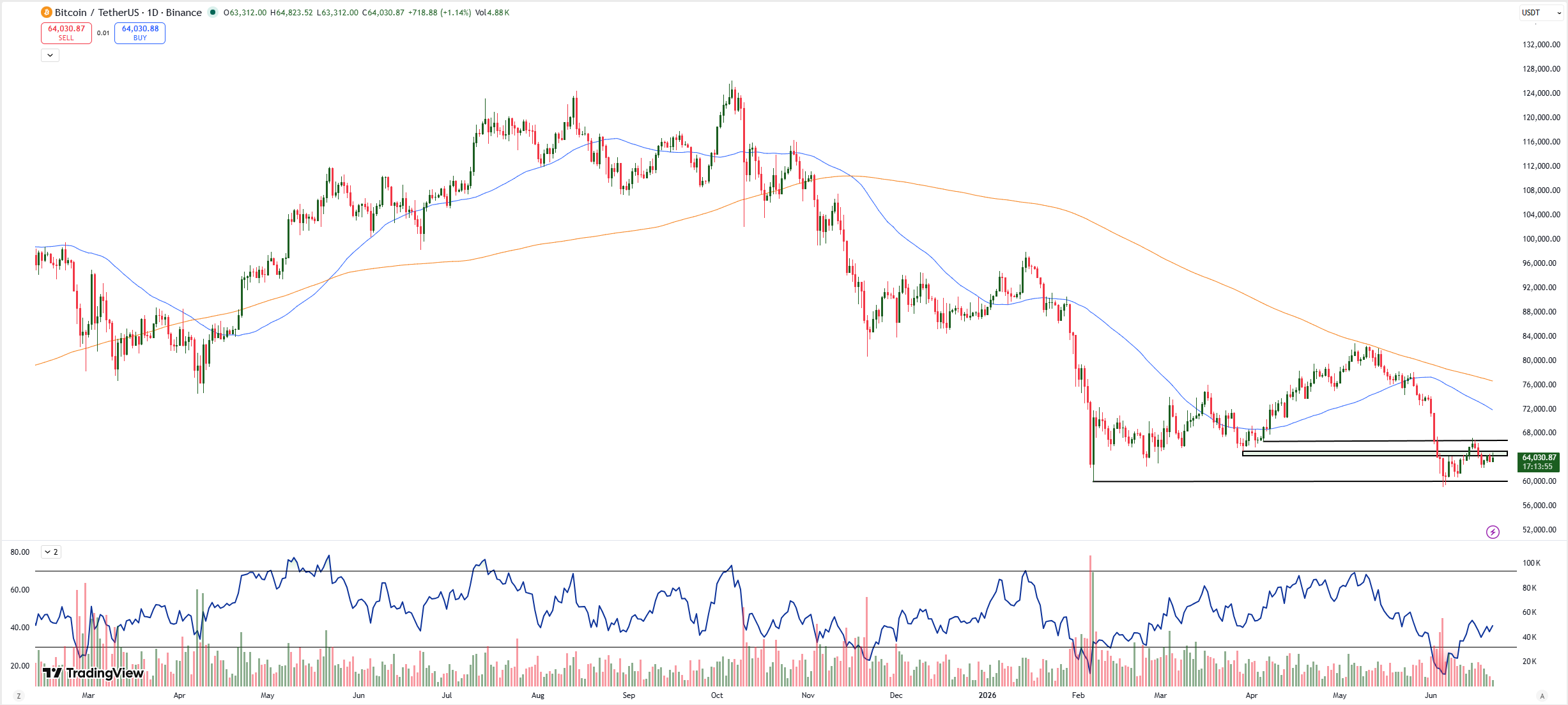
From a technical perspective, BTC is trading near a key resistance zone between $64,000 and $65,000. So far, the price has been unable to establish itself convincingly above this zone.
Today's expected trading range is approximately $63,000–$64,500, where significant short-term trader liquidity is concentrated.
The risk of a retest of $60,000 remains elevated in the near term. Meanwhile, the RSI (14) has exited oversold territory, leaving room for a strong directional move. Against a backdrop of declining liquidity, any break of a major support or resistance level could trigger a sharp acceleration in price action.
Bitcoin enters a high-volatility, low-liquidity phase
Declining trading volumes create a mixed outlook for Bitcoin.
On one hand, the absence of large-scale selling pressure allows the market to stabilize following the recent correction. On the other hand, the lack of fresh capital leaves BTC vulnerable to negative news and sudden shifts in sentiment.
Historically, periods of low liquidity have been associated with more aggressive price swings in both directions. Until sustained ETF inflows return and macroeconomic conditions improve, Bitcoin is likely to remain in a high-volatility environment.





Latest Bitcoin News









-
 Afghanistan
-
 Albania
-
 Algeria
-
 Angola
-
 Argentina
-
 Armenia
-
 Australia
-
 Austria
-
 Azerbaijan
-
 Bahamas
-
 Bahrain
-
 Bangladesh
-
 Belarus
-
 Belgium
-
 Bolivia
-
 Botswana
-
 Brazil
-
 Brunei
-
 Bulgaria
-
 Cambodia
-
 Cameroon
-
 Canada
-
 Chile
Chile
-
 China
China
-
 Colombia
-
 Congo
Congo
-
 Costa Rica
-
 Cote d'Ivoire
-
 Croatia
-
 Cuba
Cuba
-
 Cyprus
-
 Czechia
-
 DR Congo
-
 Denmark
-
 Dominican Republic
-
 Ecuador
-
 Egypt
Egypt
-
 El Salvador
-
 Estonia
-
 Eswatini
-
 Ethiopia
-
 Finland
-
 France
-
 Georgia
-
 Germany
-
 Ghana
Ghana
-
 Greece
-
 Haiti
Haiti
-
 Hong Kong
-
 Hungary
-
 India
India
-
 Indonesia
-
 Iran, Islamic republic
-
 Iraq
Iraq
-
 Ireland
-
 Israel
-
 Italy
Italy
-
 Jamaica
-
 Japan
Japan
-
 Jordan
-
 Kazakhstan
-
 Kenya
Kenya
-
 Korea
Korea
-
 Kuwait
-
 Kyrgyzstan
-
 Laos
Laos
-
 Latvia
-
 Lebanon
-
 Lesotho
-
 Libya
Libya
-
 Lithuania
-
 Luxembourg
-
 Madagascar
-
 Malaysia
-
 Malta
Malta
-
 Mauritius
-
 Mexico
-
 Moldova
-
 Mongolia
-
 Montenegro
-
 Morocco
-
 Mozambique
-
 Myanmar
-
 Namibia
-
 Nepal
Nepal
-
 Netherlands
-
 New Zealand
-
 Nigeria
-
 North Macedonia
-
 Norway
-
 Oman
Oman
-
 Pakistan
-
 Palestine
-
 Panama
-
 Papua New Guinea
-
 Paraguay
-
 Peru
Peru
-
 Philippines
-
 Poland
-
 Portugal
-
 Puerto Rico
-
 Qatar
Qatar
-
 Reunion
-
 Romania
-
 Rwanda
-
 Saudi Arabia
-
 Serbia
-
 Singapore
-
 Slovakia
-
 Slovenia
-
 Somalia
-
 South Africa
-
 Spain
Spain
-
 Sri Lanka
-
 Sweden
-
 Switzerland
-
 Syria
Syria
-
 Taiwan
-
 Tajikistan
-
 Tanzania
-
 Thailand
-
 Trinidad and Tobago
-
 Tunisia
-
 Turkey
-
 UAE
UAE
-
 Uganda
-
 Ukraine
-
 United Kingdom
-
United States
-
 Uruguay
-
 Uzbekistan
-
 Venezuela
-
 Vietnam
-
 Yemen
Yemen
-
 Zambia
-
 Zimbabwe
- Forex
- Crypto












