
Bitcoin price prediction: BTC holds near $87,617 with global tensions keep investors cautious

Bitcoin is hovering near $87,617 after a sharp pullback, posting a 3.2% decline over the past 24 hours. The asset is holding a market capitalization of roughly $1.74 trillion, while 24-hour trading volume has climbed to about $44.09 billion, reflecting elevated repositioning activity. Price action has stretched between $86,818 and $90,037 as traders unwound exposure following a failed attempt to hold above the $90,000 zone. Market sentiment is being shaped by renewed geopolitical persistence across major regions, where conflicts remain contained but unresolved, keeping risk premia elevated and limiting conviction.
Highlights
- Middle East diplomacy advances alongside continued military pressure, extending regional uncertainty.
- Ukraine conflict deepens into a prolonged legal and financial standoff rather than a battlefield change.
- U.S.-China rivalry intensifies through alliance signaling, embedding long-term geopolitical risk.
Bitcoin is losing upside momentum near $87,617 as geopolitical developments reduce the probability of sudden shocks but fail to deliver a resolution. Investors are adapting to a world where tensions are structured and long-lasting, discouraging aggressive risk-taking and favoring defensive positioning even after strong rebounds.
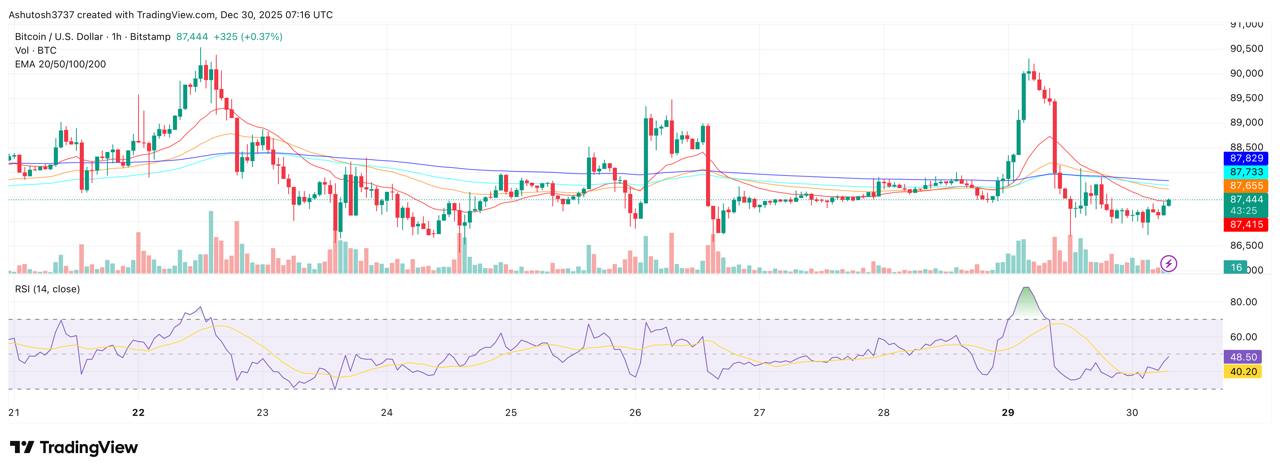
Bitcoin price dynamics (Source: TradingView)
Bitcoin pulls back as geopolitics reinforce structural risk
In the Middle East, geopolitical dynamics remained focused on parallel tracks of diplomacy and deterrence. U.S.-mediated discussions continued around shaping post-conflict governance for Gaza, with regional powers positioning for roles in reconstruction and security oversight. At the same time, Israeli military pressure against Hezbollah-linked targets persisted, reinforcing a strategy of deterrence rather than de-escalation. For Bitcoin, this mix lowers immediate escalation risk but extends the timeline of uncertainty, keeping geopolitical risk priced into assets.The Ukraine conflict stayed locked in a pressure-driven phase. European policymakers continued advancing legal frameworks to deploy frozen Russian assets, shifting the conflict further into financial and institutional territory. Russia reiterated that permanent asset seizure would be treated as a breach of international norms, increasing the likelihood of long-term retaliatory measures. This dynamic sustains geopolitical risk without triggering abrupt volatility, weighing on sentiment rather than driving panic.
U.S.-China relations added further background stress. Washington reinforced commitments to Indo-Pacific allies and defense coordination, while Beijing responded with warnings against bloc formation and containment strategies, particularly around Taiwan and technology leadership. Although no immediate military or trade actions followed, the steady escalation of signaling reinforces the structural nature of the rivalry, embedding uncertainty into global risk assessment.
Emerging markets reflected similar fragility. Political transitions, security challenges, and governance stress across parts of Africa and South Asia highlighted ongoing institutional vulnerability. While these developments were not individually market-moving, their accumulation reinforces caution toward long-duration capital deployment and global supply chain exposure.
Analysts highlight persistent tension without immediate catalysts
Anton Kharitonov notes that geopolitical risk is increasingly embedded in institutions and post conflict frameworks, keeping risk premia elevated without forcing sudden repricing.Viktoras Karapetyants explains that managed conflicts and strategic signaling favor consolidation and pullbacks rather than sustained breakouts.
Jainam Mehta adds that as geopolitical fragmentation deepens, Bitcoin remains sensitive to global risk sentiment instead of acting as a standalone hedge.
Technical view shows downside pressure after failed breakout
Bitcoin is trading near $87,617, with immediate support around $86,800, where buyers previously absorbed selling pressure. The 20 EMA near $88,400 now acts as overhead resistance, while the 50 EMA around $89,200 marks the level that must be reclaimed to restore confidence. RSI near 44 reflects weakening momentum consistent with risk reduction rather than capitulation. Sustained acceptance below $86,800 could expose the $85,500 region, while a recovery above $89,500 would signal improved tolerance for geopolitical risk.Background and earlier analysis
In earlier analysis, Bitcoin’s strength was driven by reduced geopolitical shock risk rather than resolution. Today’s pullback aligns with that framework. Geopolitical tensions remain broad, persistent, and unresolved, but not yet catalytic. This keeps Bitcoin in a restrained and reactive phase, with direction dependent on whether geopolitical pressures stabilize structurally or re-escalate into headline-driven risk.





Latest Bitcoin News










-
 Afghanistan
-
 Albania
-
 Algeria
-
 Angola
-
 Argentina
-
 Armenia
-
 Australia
-
 Austria
-
 Azerbaijan
-
 Bahamas
-
 Bahrain
-
 Bangladesh
-
 Belarus
-
 Belgium
-
 Bolivia
-
 Botswana
-
 Brazil
-
 Brunei
-
 Bulgaria
-
 Cambodia
-
 Cameroon
-
 Canada
-
 Chile
Chile
-
 China
China
-
 Colombia
-
 Congo
Congo
-
 Costa Rica
-
 Cote d'Ivoire
-
 Croatia
-
 Cuba
Cuba
-
 Cyprus
-
 Czechia
-
 DR Congo
-
 Denmark
-
 Dominican Republic
-
 Ecuador
-
 Egypt
Egypt
-
 El Salvador
-
 Estonia
-
 Eswatini
-
 Ethiopia
-
 Finland
-
 France
-
 Georgia
-
 Germany
-
 Ghana
Ghana
-
 Greece
-
 Haiti
Haiti
-
 Hong Kong
-
 Hungary
-
 India
India
-
 Indonesia
-
 Iran, Islamic republic
-
 Iraq
Iraq
-
 Ireland
-
 Israel
-
 Italy
Italy
-
 Jamaica
-
 Japan
Japan
-
 Jordan
-
 Kazakhstan
-
 Kenya
Kenya
-
 Korea
Korea
-
 Kuwait
-
 Kyrgyzstan
-
 Laos
Laos
-
 Latvia
-
 Lebanon
-
 Lesotho
-
 Libya
Libya
-
 Lithuania
-
 Luxembourg
-
 Madagascar
-
 Malaysia
-
 Malta
Malta
-
 Mauritius
-
 Mexico
-
 Moldova
-
 Mongolia
-
 Montenegro
-
 Morocco
-
 Mozambique
-
 Myanmar
-
 Namibia
-
 Nepal
Nepal
-
 Netherlands
-
 New Zealand
-
 Nigeria
-
 North Macedonia
-
 Norway
-
 Oman
Oman
-
 Pakistan
-
 Palestine
-
 Panama
-
 Papua New Guinea
-
 Paraguay
-
 Peru
Peru
-
 Philippines
-
 Poland
-
 Portugal
-
 Puerto Rico
-
 Qatar
Qatar
-
 Reunion
-
 Romania
-
 Rwanda
-
 Saudi Arabia
-
 Serbia
-
 Singapore
-
 Slovakia
-
 Slovenia
-
 Somalia
-
 South Africa
-
 Spain
Spain
-
 Sri Lanka
-
 Sweden
-
 Switzerland
-
 Syria
Syria
-
 Taiwan
-
 Tajikistan
-
 Tanzania
-
 Thailand
-
 Trinidad and Tobago
-
 Tunisia
-
 Turkey
-
 UAE
UAE
-
 Uganda
-
 Ukraine
-
 United Kingdom
-
United States
-
 Uruguay
-
 Uzbekistan
-
 Venezuela
-
 Vietnam
-
 Yemen
Yemen
-
 Zambia
-
 Zimbabwe
- Forex
- Crypto












