
Bitcoin price prediction: BTC holds near $92,673 as geopolitical stress pertaining to Venezuela restrains risk-taking

Bitcoin is trading near $92,673 after extending a steady rebound, posting a 1.4% gain over the past day. The asset is holding a $1.85 trillion market capitalization with 24-hour trading volume near $38.16 billion, while price action remains active between $90,925 and $93,169. Market sentiment is being shaped by geopolitical developments that emphasize governance, endurance, and alliance positioning rather than immediate escalation, reducing shock risk while keeping long-term uncertainty firmly priced into global markets.
Highlights
- Middle East focus shifts toward post-conflict governance planning alongside controlled military deterrence.
- Ukraine war evolves further into a long-duration economic and political endurance contest.
- U.S.-China rivalry deepens through alliance management and strategic alignment rather than confrontation.
Bitcoin is attempting to consolidate near $92,673 as geopolitical signals point to managed tension instead of acute disruption. Investors are adapting to an environment where conflicts are prolonged and structured, limiting panic-driven flows while restraining aggressive risk-taking despite improving price momentum.
Venezuela remains part of this broader endurance-driven risk landscape, as prolonged political strain under President Maduro continues to influence emerging market stability and long-term capital confidence.
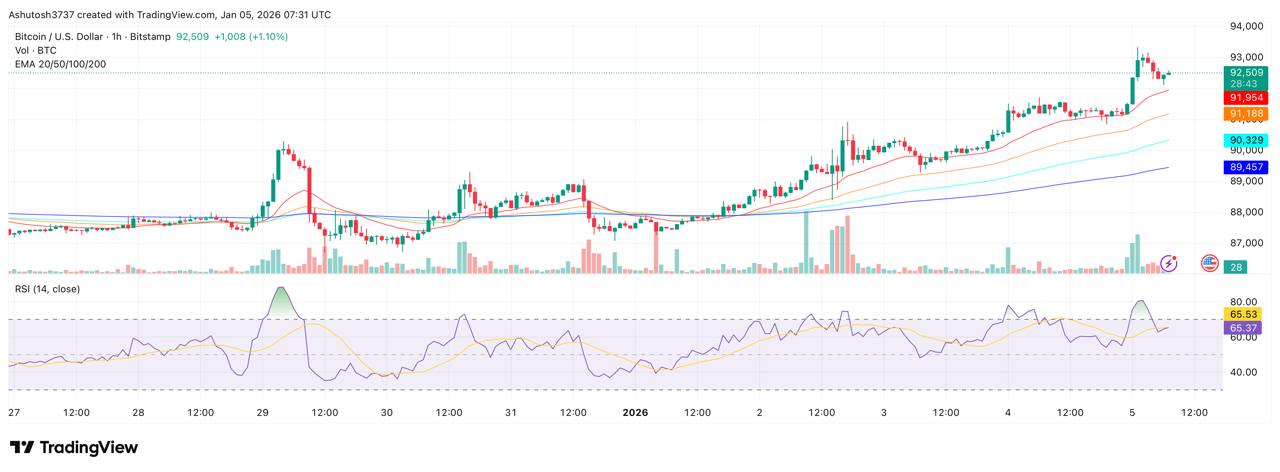
Bitcoin price dynamics (Source: TradingView)
Bitcoin consolidates as geopolitics reinforce endurance over escalation
In the Middle East, geopolitical attention moved decisively toward ownership of the post-conflict phase. U.S. and regional officials signaled more in-depth engagement on Gaza’s future administrative and security framework, including reconstruction financing and oversight mechanisms. This indicates preparation for an extended interim arrangement rather than a clean resolution. At the same time, Israel continued calibrated strikes against Hezbollah-linked infrastructure in southern Lebanon, reinforcing deterrence without crossing into broader escalation. For Bitcoin, this combination reduces the risk of sudden downside shocks but keeps geopolitical uncertainty embedded, limiting aggressive upside positioning despite supportive price action.Latin American political risk, including Venezuela’s unresolved governance and sanctions backdrop, reinforces this cautious global positioning rather than triggering abrupt reallocations.
The Ukraine conflict continued to shift toward an endurance-based framework. European policymakers focused on sustaining Ukraine through financial engineering, defense production expansion, and legal pathways to mobilize frozen Russian assets. Russia framed the conflict increasingly as a test of national resilience rather than territorial control. This mutual positioning suggests a prolonged standoff where time and economic capacity matter more than battlefield movement, embedding geopolitical risk structurally into European assets.
U.S.-China relations remained tense through strategic alignment rather than action. Washington reinforced coordination with Indo-Pacific partners around deterrence, supply chain security, and defense interoperability, while Beijing warned against bloc-based containment. Taiwan continued to accelerate preparedness measures. This pattern highlights a transition from episodic flare-ups to a durable architecture of competition, keeping background uncertainty elevated without triggering immediate market stress.
Venezuela’s prolonged economic constraints and institutional strain contribute to this emerging market fragility, reinforcing investor preference for liquidity and defensive positioning.
Analysts highlight persistent geopolitical pressure without immediate catalysts
Anton Kharitonov notes that geopolitical risk is increasingly embedded in governance structures and endurance strategies, keeping risk premia elevated without forcing rapid repricing.
Viktoras Karapetyants explains that managed deterrence and alliance-based competition favor consolidation rather than breakout behavior across risk assets.
Jainam Mehta adds that as geopolitical tension becomes structural, Bitcoin remains closely tied to global risk sentiment instead of functioning as a standalone hedge.
Technical view shows consolidation with resistance overhead
Bitcoin is trading near $92,673, with the 20 EMA around $91,950 acting as immediate support and the 50 EMA near $92,800 forming short-term resistance. The 100 EMA near $93,700 remains a key upside threshold that must be reclaimed to sustain a stronger bullish structure. The RSI near 56 reflects mildly positive momentum consistent with consolidation. A sustained move above $93,200 would improve near-term stability, while a drop below $91,000 could reopen downside toward the $88,500 region.Background and earlier analysis
In earlier analysis, Bitcoin’s movement was shaped primarily by liquidity positioning and macro caution rather than single geopolitical shocks. Today’s environment reinforces that framework. Geopolitical risk remains broad, persistent, and unresolved but increasingly managed through endurance, governance, and alliance structures. This keeps Bitcoin in a controlled consolidation phase as global uncertainty stays elevated without triggering acute volatility.





Latest Bitcoin News










-
 Afghanistan
-
 Albania
-
 Algeria
-
 Angola
-
 Argentina
-
 Armenia
-
 Australia
-
 Austria
-
 Azerbaijan
-
 Bahamas
-
 Bahrain
-
 Bangladesh
-
 Belarus
-
 Belgium
-
 Bolivia
-
 Botswana
-
 Brazil
-
 Brunei
-
 Bulgaria
-
 Cambodia
-
 Cameroon
-
 Canada
-
 Chile
Chile
-
 China
China
-
 Colombia
-
 Congo
Congo
-
 Costa Rica
-
 Cote d'Ivoire
-
 Croatia
-
 Cuba
Cuba
-
 Cyprus
-
 Czechia
-
 DR Congo
-
 Denmark
-
 Dominican Republic
-
 Ecuador
-
 Egypt
Egypt
-
 El Salvador
-
 Estonia
-
 Eswatini
-
 Ethiopia
-
 Finland
-
 France
-
 Georgia
-
 Germany
-
 Ghana
Ghana
-
 Greece
-
 Haiti
Haiti
-
 Hong Kong
-
 Hungary
-
 India
India
-
 Indonesia
-
 Iran, Islamic republic
-
 Iraq
Iraq
-
 Ireland
-
 Israel
-
 Italy
Italy
-
 Jamaica
-
 Japan
Japan
-
 Jordan
-
 Kazakhstan
-
 Kenya
Kenya
-
 Korea
Korea
-
 Kuwait
-
 Kyrgyzstan
-
 Laos
Laos
-
 Latvia
-
 Lebanon
-
 Lesotho
-
 Libya
Libya
-
 Lithuania
-
 Luxembourg
-
 Madagascar
-
 Malaysia
-
 Malta
Malta
-
 Mauritius
-
 Mexico
-
 Moldova
-
 Mongolia
-
 Montenegro
-
 Morocco
-
 Mozambique
-
 Myanmar
-
 Namibia
-
 Nepal
Nepal
-
 Netherlands
-
 New Zealand
-
 Nigeria
-
 North Macedonia
-
 Norway
-
 Oman
Oman
-
 Pakistan
-
 Palestine
-
 Panama
-
 Papua New Guinea
-
 Paraguay
-
 Peru
Peru
-
 Philippines
-
 Poland
-
 Portugal
-
 Puerto Rico
-
 Qatar
Qatar
-
 Reunion
-
 Romania
-
 Rwanda
-
 Saudi Arabia
-
 Serbia
-
 Singapore
-
 Slovakia
-
 Slovenia
-
 Somalia
-
 South Africa
-
 Spain
Spain
-
 Sri Lanka
-
 Sweden
-
 Switzerland
-
 Syria
Syria
-
 Taiwan
-
 Tajikistan
-
 Tanzania
-
 Thailand
-
 Trinidad and Tobago
-
 Tunisia
-
 Turkey
-
 UAE
UAE
-
 Uganda
-
 Ukraine
-
 United Kingdom
-
United States
-
 Uruguay
-
 Uzbekistan
-
 Venezuela
-
 Vietnam
-
 Yemen
Yemen
-
 Zambia
-
 Zimbabwe
- Forex
- Crypto












